





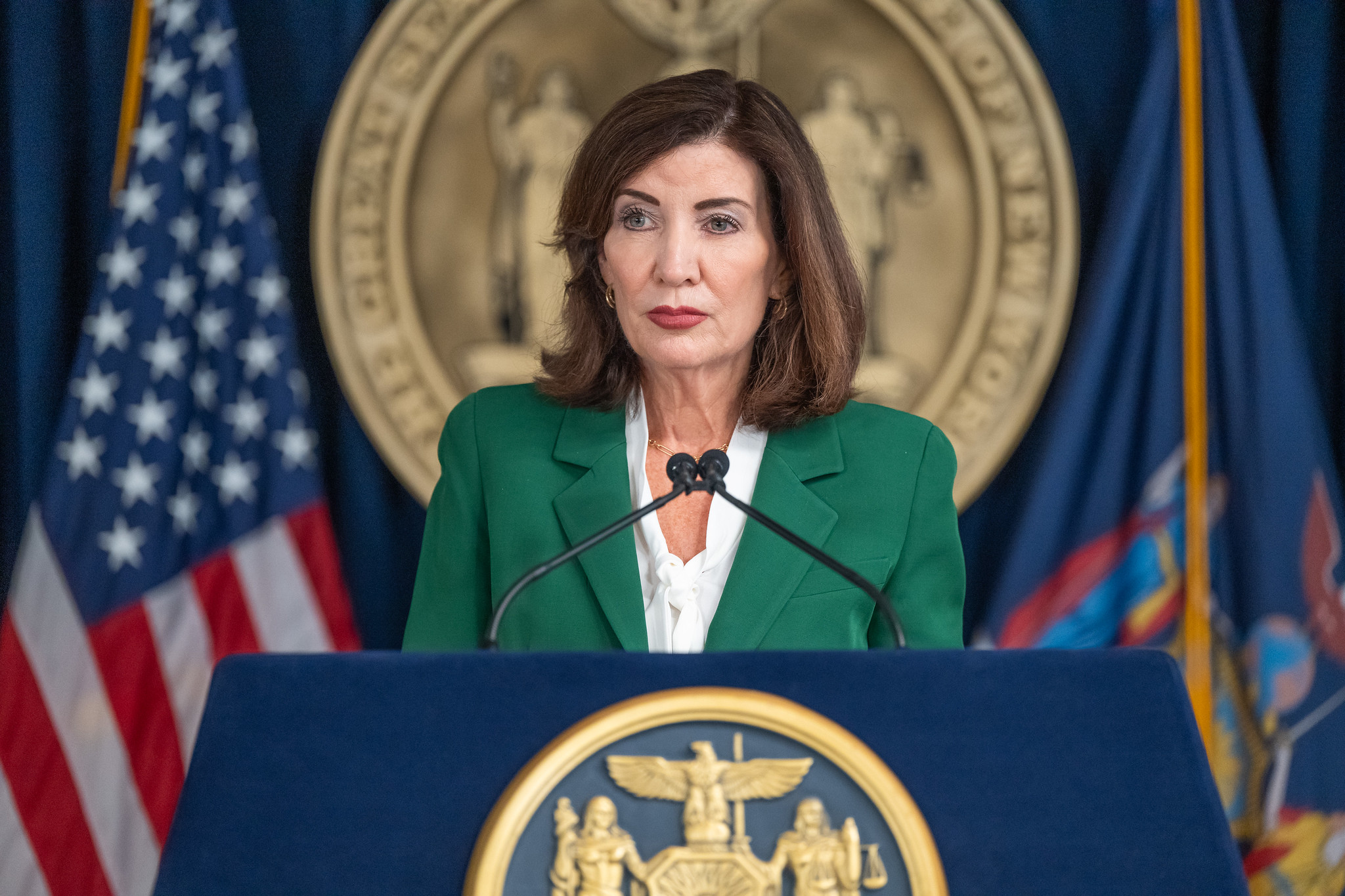
Gov. Kathy Hochul offered support Thursday to members of New York’s Nepali community following catastrophic flash flooding caused by a glacier collapse near the Nepal-Tibet border.
“Our hearts are with Nepal and all those affected by the devastating flooding along the Nepal-Tibet border,” Hochul wrote in a statement on X. “We mourn the lives lost, pray for those still missing, and stand with New Yorkers who are grieving loved ones and worrying about family back home.”
Looking for job?
Click hereNew York is home to one of the nation’s largest Nepali immigrant populations, with a particularly large concentration in Queens.
The statement came as rescue crews continued searching for survivors in the Himalayan border region, where a sudden deluge and mudflows caused widespread destruction.
According to Nepal’s National Disaster Risk Reduction and Management Authority, the disaster caused severe damage along the Bhote Koshi and Trishuli river basins. Authorities said the disaster was triggered Aug. 26 by a massive ice-rock avalanche that covered roughly 1 square kilometer near the Lhende River and generated seismic signals equivalent to a magnitude 5.2 earthquake.
According to NDRRMA Situation Report, emergency personnel recovered 389 bodies, while 977 people remained missing, including 517 foreign nationals.
Among the Americans listed as missing by Nepal Police were several New York residents. Rashi Shashidharan, 14, of New York, and her mother, Rekha Shashidharan, 54, had not been heard from since shortly before the disaster struck Wednesday.
In addition, U.S. citizens Ramesh Sharma, 65, and Neelam Kumari Sharma, 64, remained unaccounted for. Their daughter, Radhika Sharma, issued urgent appeals on social media for assistance from rescue crews, government agencies and regional contacts.
More than 13,200 security personnel — including members of Nepal Police, the Nepali Army and the Armed Police Force — are deployed across affected areas, along with 15 helicopters. Emergency crews rescued 1,976 people by air and provided medical treatment to 130 injured survivors at regional hospitals, including facilities in Kathmandu.
Authorities warned that the risk of additional disasters remained high. Satellite imagery identified a newly formed 0.11-square-kilometer dammed lake blocking the Lhende River about 18 kilometers upstream from the Rasuwagadhi border checkpoint. Officials said a breach could trigger secondary outburst flooding, prompting urgent evacuation warnings for downstream communities.
