





The U.S. visitor visa refusal rate for Nepali nationals climbed to 69.47% in fiscal 2025, its highest level in at least 20 years of available State Department data. The increase came before the introduction of a separate financial bond requirement for eligible Nepali applicants.
The adjusted refusal rate rose nearly 20 percentage points from 49.47% in fiscal 2024, according to the State Department’s annual report, Adjusted Refusal Rate — B-Visas Only by Nationality.
Looking for job?
Click here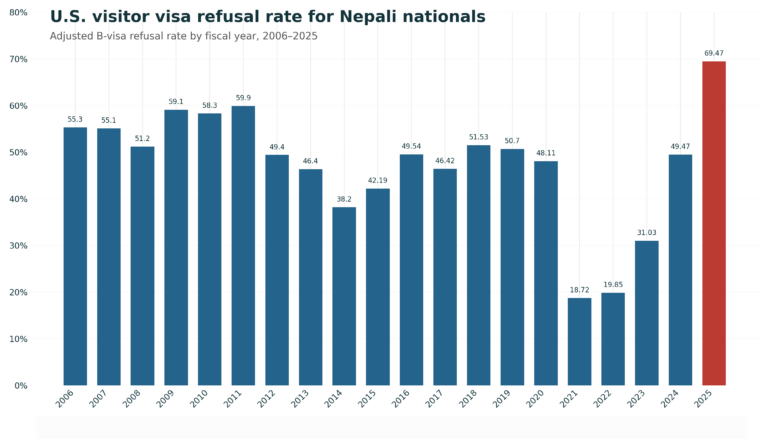
In the four months before President Donald Trump took office on Jan. 20, 2025, the United States issued 1,670 B-category visas to Nepali nationals in October 2024, 1,636 in November and 1,191 in December. Issuances increased to 2,156 in January 2025.
After Trump’s inauguration, monthly visa issuances began to decline. The United States issued 1,840 B-category visas to Nepali nationals in February 2025, followed by 1,550 in March and 1,307 in April.
The monthly totals fell further to 908 in May before edging up to 913 in June and 994 in July. Issuances increased to 1,232 in August and stood at 1,221 in September 2025.
The downward trend continued in the final months of 2025. The United States issued 1,006 B-category visas to Nepali nationals in October, 774 in November and 766 in December.
The number rose to 808 in January 2026 before plunging to just 27 in February, the first full month after the visa bond requirement took effect. That represented a 96.7% decline from January and a 97.8% drop from September 2025.
The monthly figures from February 2025 through January 2026 show that the United States issued 13,319 B-category visas to Nepali nationals during Trump’s first 12 months in office.
That total was 45.2% lower than the 24,303 B-category visas issued in fiscal 2024 and 55.2% below the 29,722 issued in fiscal 2023.
Annual State Department statistics show that the United States issued 24,303 B-category visas to Nepali nationals in fiscal 2024, down from 29,722 in fiscal 2023. Issuances had increased from 18,245 in fiscal 2022.
During the COVID-19 pandemic, visa issuances fell to 7,128 in fiscal 2021 and 7,751 in fiscal 2020.
Visa Bond Adds a Financial Requirement
The bond requirement applies to Nepali passport holders who are otherwise found eligible for B-1/B-2 business and tourist visas, regardless of where they apply.
The requirement imposes an additional financial condition on applicants who qualify for a visa; it does not offer a way to overcome a visa refusal. Posting a bond does not guarantee that a visa will be issued, according to the State Department.
Under the initial pilot program, bond amounts were set at $5,000, $10,000 or $15,000, with consular officers determining the amount during the visa interview. The final rule lists higher amounts of $10,000, $15,000 or $20,000.

Applicants must post the bond only after receiving instructions from a consular officer. They must also submit the required Department of Homeland Security immigration bond form and make the payment through the Treasury Department’s Pay.gov platform. The State Department has warned applicants against making payments through unauthorized websites.
The bond is refundable if travelers comply with its terms, including the conditions governing their authorized stay and departure from the United States. Suspected violations are referred to U.S. Citizenship and Immigration Services, which determines whether the bond has been breached.
Current rules also require travelers subject to the bond to enter and leave the United States through commercial airports, including approved U.S. preclearance locations. Land and sea crossings are not permitted under the program.
Refusal Rate Has Climbed Since 2022
Nepal’s adjusted visitor visa refusal rate has risen substantially since falling to 18.72% in fiscal 2021 and 19.85% in fiscal 2022. It increased to 31.03% in fiscal 2023 before jumping to 49.47% in fiscal 2024.
Before fiscal 2025, Nepal’s highest refusal rate in the available data, which date to fiscal 2006, was 59.9%, recorded in fiscal 2011.
The figures cover only B-category visas issued for short-term business or tourism. They do not reflect refusal rates for student, employment-based or immigrant visas.
The adjusted refusal rate accounts for initial denials that are later overcome, including cases in which applicants provide additional information establishing their eligibility. The State Department counts each applicant once per fiscal year, based on the application’s final status at the end of that year.
An applicant initially refused a visa but subsequently approved within the same fiscal year is counted as an issuance. Applicants refused multiple times during the year are counted as a single refusal.
