






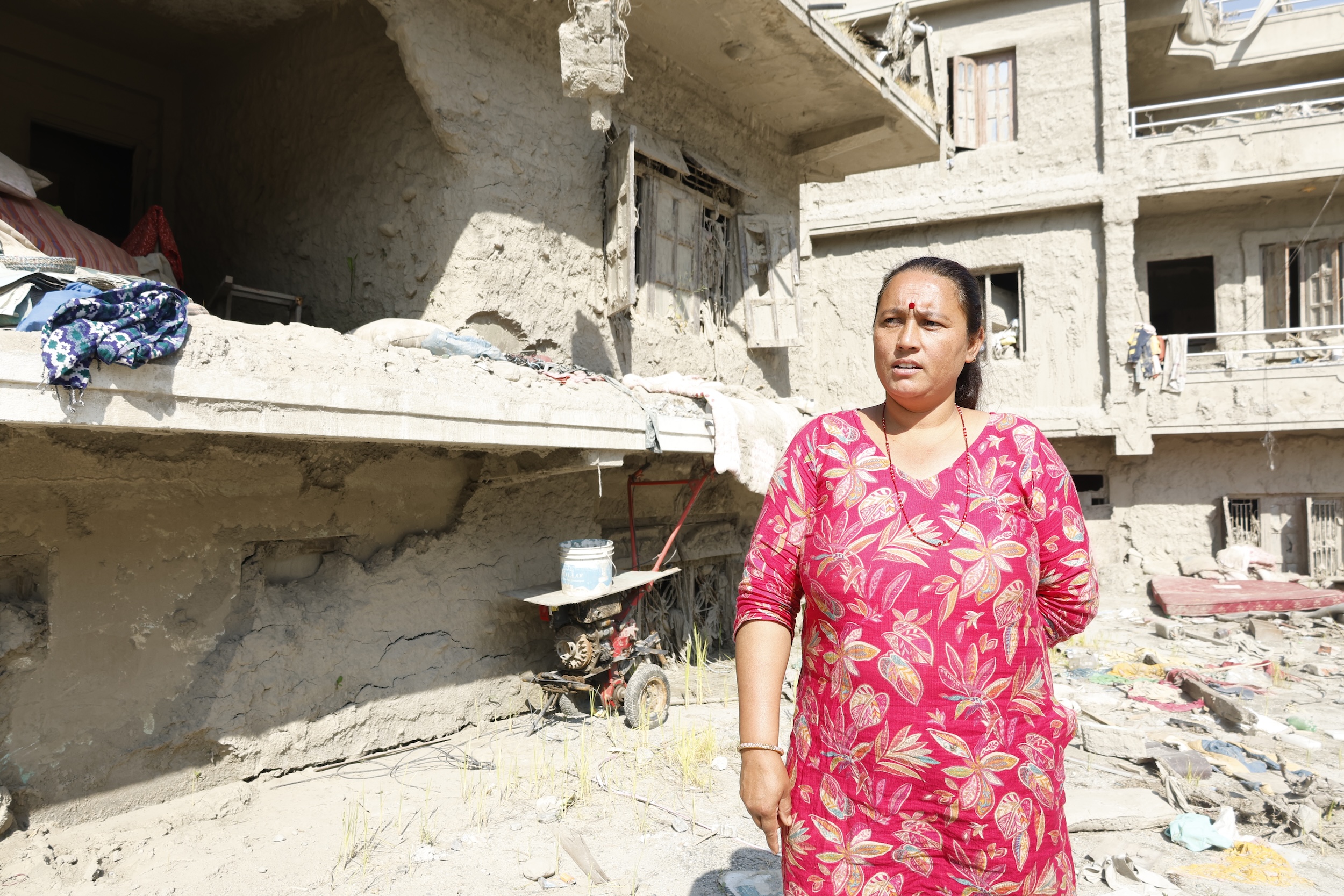
BETRAWATI, Nepal — Geetamaya Dangol was digging through the rubble of her home, searching for anything the flood might have left behind. Nearly three months earlier, a devastating torrent had buried her house and farmland. Her immediate family survived, but five relatives died.
Before the disaster, she supported her children by running a school cafeteria. Now, she worries about how she will provide them with an education and a future.
Looking for job?
Click here“What we need right now is a roof over our heads,” she said. “I wish the government would arrange that for us.”
Relief organizations have distributed rice, clothing and other necessities. But those supplies cannot replace a home or a source of income, she said.
“I used to work hard to make ends meet and educate my children,” she said. “Now I don’t know how I will manage their schooling.”
As the three-month mark approaches, families displaced by flooding along the Bhotekoshi and Trishuli river basins remain in relatives’ homes, rented accommodations or temporary shelters. The government has announced that it will cover rent for displaced families, but residents say they have yet to receive the promised assistance.
Food, clothing and some cash aid have arrived from nongovernmental organizations and other institutions. What survivors want now is a lasting solution: safe housing, sustainable livelihoods and a clear path to rebuilding their lives.
They have a straightforward question for the government: Where will we live, how will we rebuild our homes, and how will we earn a living again?
The scale of the destruction has been enormous. The Aug. 26 disaster in the Bhotekoshi-Trishuli watershed caused widespread destruction, killing and displacing residents and sweeping away homes, farmland, businesses and infrastructure. Reconstruction and recovery costs have been estimated at approximately $5 billion.
Yet nearly three months later, permanent resettlement remains unresolved.
Families Face a Second Struggle After Losing Loved Ones
Mithu Dangol, 65, lost her 41-year-old son in the flood. He was the family’s sole breadwinner. She is now responsible for her daughter-in-law, grandchildren and a daughter who requires special care.
The disaster took not only her home but also the family’s financial foundation.
“We survived, but it has become impossible to live,” she said. She is staying in a rented house after the flood buried her home and farmland.
She said local authorities had failed to assess families’ circumstances and distribute assistance according to the extent of their losses.
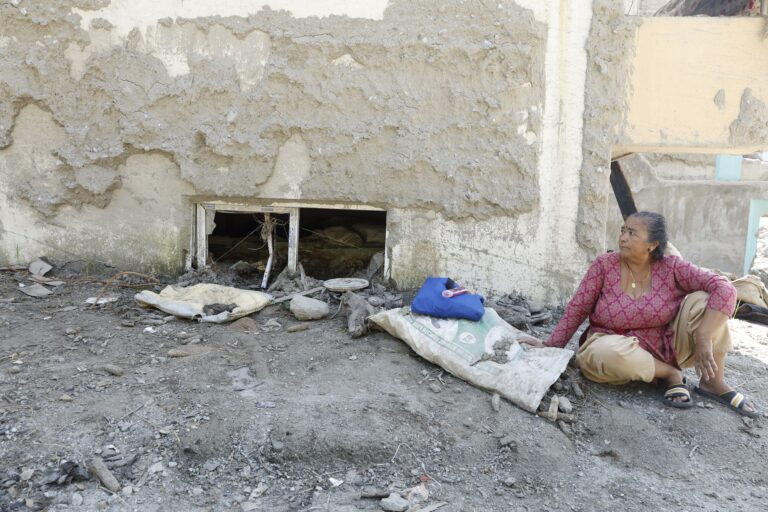
Officials should visit affected households, determine who has suffered the most and understand the conditions in which survivors are living, she said.
“But there is no one here to do that. Nobody is checking. Where have the local leaders gone?” she asked.
She has heard that the government may provide around $2,000 to affected households, but said that would not be enough to rebuild a home and support a family.
“What can you do with $2,000 after such enormous losses? It isn’t even enough to build a small temporary shelter. We have to eat. We have to survive. How are we supposed to manage?” she said.
Two floors of her house remain buried. She has been digging through the debris in the hope that some parts can be cleared and made habitable again.
Although there is some sloping farmland above the property, it is largely unsuitable for cultivation. The land is overgrown with forest, and there is no irrigation system. She said the government could at least help build a temporary shelter or clear the buried house so the family might have somewhere to stay.
“We are searching to see if anything can be recovered,” she said. “If we need something now, we have to go all the way to the market. There is nowhere else in between.”
She was home when the flood struck and never imagined that the torrent could reach the settlement.
After hearing that floodwaters had reached a bridge, she and others went to look at the river.
“Who could have known the river would come this far? The water came from so far below, reached all the way back here and swept everything away,” she said. “What are we supposed to do now?”
Residents say they have heard the government would pay their rent, but that assistance has not materialized.
Families Who Lost Everything Are Still Waiting for Resettlement
For 65-year-old Triratna Dangol, the losses were even greater. He lost 18 members of his extended family in the flood.
Among the dead were four members of one brother’s family, one from his youngest brother’s family, seven from another brother’s family and six from his eldest brother’s family.
On the morning of the disaster, he had returned home after feeding his livestock. He was preparing to burn wood shavings to drive away mosquitoes when his daughter, who was in Kathmandu, called.
“Dad, a flood is coming. Move to higher ground. I’ll call Mom,” she told him.
He had climbed a short distance above the house. As he reached into his pocket for his phone, he watched the river sweep the house away.
Water was rushing past both the front and back of the home. Family members ran uphill as the building collapsed before their eyes.
“We couldn’t take anything with us,” he said. “The buffaloes we had raised and the animals tied up outside were swept away. The rice we had grown on someone else’s land and the 30 sacks we had bought for our business were also lost.”
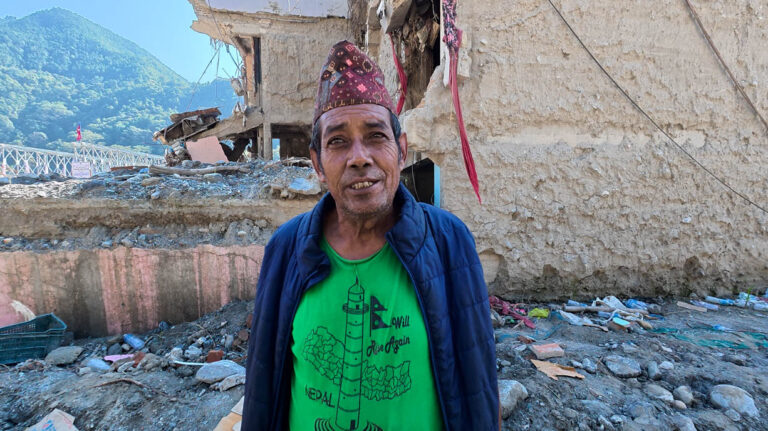
The flood destroyed two four-story houses and about two ropani of land, he said. One house stood on seven aana of land and the other on eight aana. (A ropani is about 508.7 square meters, and an aana is one-sixteenth of a ropani.)
Today, he lives in a temporary holding center. Although he has received some cash and relief supplies, he has no land in his own name that he can safely settle on.
He said seven or eight families were living in tents and a holding center in an elevated area. The Red Cross and other organizations had deposited about $100 in his bank account, another organization had provided roughly $30, and he had recently received a voucher worth about $330.
But none of that answers the question of where he will live permanently.
“We are waiting, hoping the government will arrange a place for us,” he said. “How long can we continue living as disaster victims? Depending on other people’s homes or organizations for shelter has become humiliating.”
Before the flood, Dangol operated the Muskan Hotel, where he cooked the meals himself. The business sometimes used an entire sack of rice and a whole goat in a single day.
He had spent years building his two houses and establishing his business. Now both his property and his livelihood are gone.
Relief assistance may meet immediate needs, but it cannot sustain a family indefinitely, he said.
“We cannot depend on organizations forever. We have to find work ourselves and return to the kind of work we know how to do,” he said.
He is trying to find a place where he can live independently rather than remain in the holding center.
“Moving up and down is very difficult. Even the resources we had were swept away. How can we continue like this?”
His biggest request is for the government to provide a safe, permanent place for flood-affected families to live.
Resettlement Could Break Apart a Community’s Cultural Ties
Somlal Lopchan, a resident of Betravati, lost five members of his family in the disaster. Two daughters-in-law, his elder brother and two other relatives died. His brother was among those who went to rescue schoolchildren when the flood struck.
Lopchan, from Ward 5 of Uttargaya, said some victims had not understood the danger, while others were swept away trying to save the little property they had.
He estimated that floodwaters traveled about 49 kilometers and reached Betravati in roughly 25 minutes. He said 97 members of the Newar community alone died in the area.
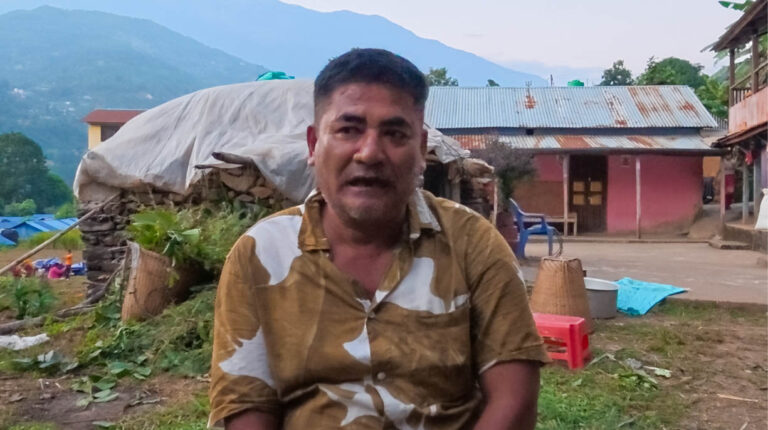
Somlal Lopchan, who lost five family members in the floods, stands amid the devastation in Nepal. (Photo by Dipendra Dhungana for NepYork)
“We knew floods could happen, but we never imagined one would come with enough force to destroy everything,” he said.
The loss of farmland has left residents wondering how they will support themselves. But Lopchan’s concerns extend beyond homes and property.
He said some families with missing relatives had received assistance from different organizations. Some received between $67 and $100, while the World Food Program had promised affected households about $600 in cash assistance. The first installment, roughly $300, had been distributed, he said.
But he said the payments were nowhere near enough to resolve the community’s long-term problems.
“Are we supposed to be satisfied with this?” he asked. “After 70 or 80 days, the state still hasn’t told us where it will settle us or how. Should we stay here? Should we go live on a piece of land in the middle of the forest? We have no answers.”
Betravati’s Newar community has a long-established cultural identity, with traditional festivals, religious ceremonies, temples and historic sites tied to the settlement.
Some temples date to the reign of King Prithvi Narayan Shah, Nepal’s 18th-century unifier. The area also has religious sites associated with ancestral offerings and other traditional practices.
Lopchan said any resettlement plan should preserve those cultural connections rather than scatter families across distant locations.
“If my family settles in one place and everyone else moves somewhere else, what will happen to the culture of Betravati’s Newar community?” he asked.
“Our festivals, our traditions, our religious sites and the places where people come to make offerings to their ancestors are part of who we are,” he said. “The government must protect them. Even if people have to move, these religious and tourist sites should be preserved.”
He also said residents did not want to move far from their ancestral area. Without government assistance, some might eventually return to their buried homes and try to clear the debris themselves, despite the dangers during the rainy season.
“If the state doesn’t act soon, what choice will we have?” he said. “We lived beside the river before. We survived this time, but perhaps we will die in the next flood.”
Complaints Over Relief Distribution
Premkumari Shrestha, 65, was working at a farm when the flood struck. She fled to higher ground after learning about the rising waters but could not save her livestock. She now worries about her family’s future.
She said she was working at Golbidha Farm on the day of the disaster. She learned about the flood only after reaching Kathmandu from Syabrubesi and receiving a phone call.
Although no members of her immediate family died, she lost her domestic animals.
“I tried to cut the ropes and drive the buffaloes away, but in a moment like that, I couldn’t even find a sickle,” she said. “I had brought the goats as far as the road, but I couldn’t save them.”
She had assumed the flood would not reach the road. But she watched as two people nearby were swept away.
About 100 residents moved to higher ground after the flood, she said. They do not want to live beside the river again, but moving far from their community is not a realistic option.
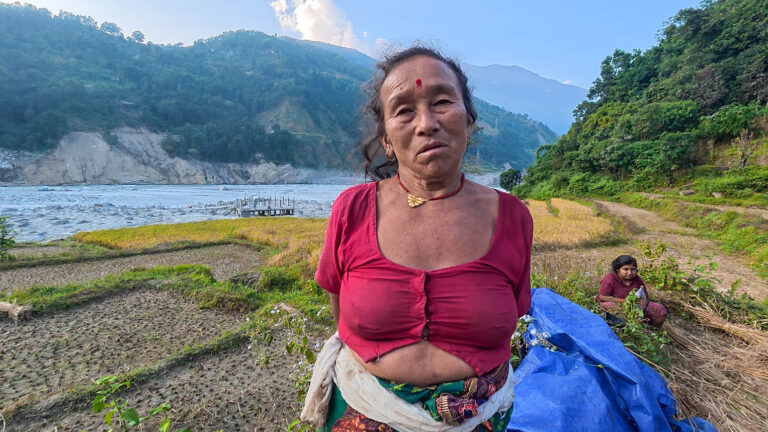
“We don’t want to live next to the river anymore. But where can we go? We cannot move far beyond these hills,” she said. “If the government builds houses for us, we are ready to live in them. If it gives us money to build our own homes, we are ready for that, too.”
She has heard that the government may construct two-room houses for survivors, but said that would not accommodate large families.
“How can a house that small be enough for a family like ours?” she asked.
The flood also swept away nearly eight ropani of her family’s land, leaving them without enough farmland to grow food. She hopes that strong embankments along the river might eventually make it possible to earn a living in the area again.
With reports of large sums of money collected for flood victims, she wants the government to ensure that survivors receive direct benefits.
“The government has received money from so many places. It should not use that money as an excuse to exploit us,” she said. “It should find a solution quickly and tell us where we can live. How long can we keep staying in other people’s homes?”
She also complained that she missed relief distribution because she had traveled to Kathmandu and returned after the supplies had been handed out.
More broadly, she accused local authorities of failing to identify the families that had suffered the greatest losses. She said some people whose homes and land were not damaged had received assistance, while genuine victims were turned away for various reasons.
“People don’t even tell us when relief arrives. We have to go and ask ourselves,” she said, adding that some people appeared to be deciding on their own whether to keep or sell donated supplies.
Shrestha is currently staying at her daughter’s home.
Other residents have raised concerns about the accuracy of beneficiary lists. They allege that locations where a single household stood before the flood are now being counted as three or four separate households for relief purposes.
They fear that assistance intended for the most severely affected families could be diverted elsewhere. They want authorities to verify household records and the actual extent of damage before distributing aid.
Under a World Food Program initiative, affected families were promised approximately $600 each. Residents said the first installment of about $300 had been distributed. Other organizations had provided between $67 and $100 in cash assistance.
But survivors said such payments were temporary relief, not a substitute for permanent resettlement.
Survivors Need Jobs as Well as Safe Housing
Yog Bahadur Bhandari, 74, of Devighat, said he had never seen a flood of such magnitude in his lifetime.
He was at home when he heard warnings about the rising waters. He prepared to close the doors and leave with his ailing wife, heading toward a higher settlement. The flood came within a few feet of them, he recalled.
Bhandari remembered another flood on Bhadra 12, 2012, in the Nepali calendar, which swept away a suspension bridge. But he said no one imagined anything like the latest disaster.
“Even a 5-year-old child knows that floods can happen near a river,” he said. “But nobody taught us how to escape, where to go or how to stay safe.”
He said that although warnings had been issued, residents had not received enough practical information about what to do.
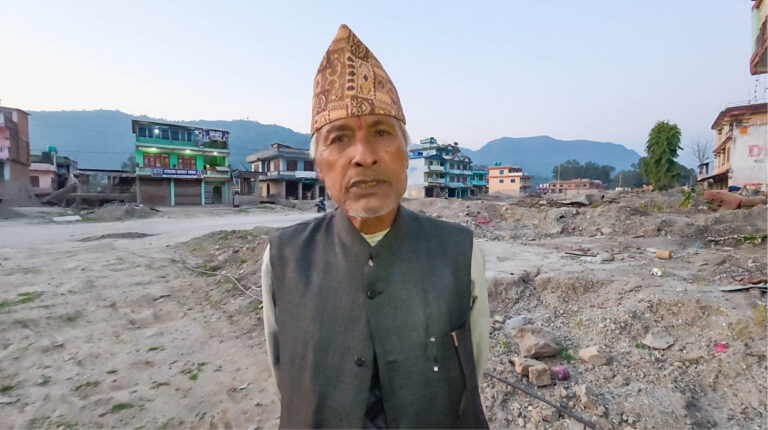
Yog Bahadur Bhandari, 74, stands in Devighat, Nepal, where recent floods threatened his home and livelihood. He is among the survivors seeking safe housing and long-term protection from future floods. (Photo by Dipendra Dhungana for NepYork)
“If we had known a flood of this magnitude was coming, we could have taken our gold, silver and important documents before leaving,” he said.
His son, who was in Kathmandu, called and told him to evacuate immediately. When Bhandari looked outside, communication cables had already been cut. As he and his wife were leaving, floodwaters struck the building of Nilkantha Ashram and surrounded the area.
Bhandari said organizations had provided enough food and clothing for immediate needs. But the government had yet to offer a lasting housing solution.
“The main thing is a place to live, somewhere we can stay permanently,” he said. “The state has not yet come through on that. A lot of time has already passed.”
He has heard that the government may provide two to four aana of land in a safe location and build houses with two to four rooms. But he said such standardized plans might not meet the needs of every household.
Families need sufficient space for their members, food supplies and everyday belongings. The government should also clarify whether it will build homes on survivors’ existing land or provide money for construction, he said.
Many families in Devighat depend on shops and small businesses for their livelihoods. Moving them to distant locations and providing houses would not solve their economic problems.
“If the government gives us money to build houses, we can do it ourselves. If we can stay somewhere around here, we can start some kind of business,” he said. “We cannot move far away.”
He said he had heard about a government proposal to prohibit settlement within 150 meters of rivers. For poor families and landless residents who have no alternative property, he said, the government must provide land and housing elsewhere.
He also called for strong river embankments to protect settlements.
“People should not be allowed to live along dangerous riverbanks. They should be moved to safer places, and strong embankments should be built along the river,” he said.
He suggested constructing embankments 50 to 60 meters wide and four to five meters high, using concrete and reinforced wire-mesh structures, to reduce the risk of future flooding.
Nearly 16% of $5 Billion Recovery Bill Pledged in Assistance and Financing
Nepal’s estimated recovery and reconstruction needs following the floods stand at approximately $5 billion. The country has received or been promised assistance and financing worth nearly $750 million, approaching 16 percent of that estimated cost. The commitments include international grants, emergency financing, loans, and humanitarian pledges, although not all of the money is available for immediate distribution to survivors.
On Nov. 23, Indian Prime Minister Narendra Modi announced a $1.62 billion economic assistance package during a meeting with Nepal’s Prime Minister, Balendra Shah, in New Delhi. The package includes a $377 million grant for post-disaster reconstruction and infrastructure projects, alongside a $1.24 billion line of credit primarily for energy projects. Modi said the assistance would support reconstruction and help communities affected by the floods.

Not all of the $1.62 billion package is direct flood relief. Only the grant component is specifically designated for post-disaster reconstruction, while the credit facility is primarily intended for broader infrastructure and energy projects.
The World Bank has made roughly $170 million in emergency financing available to Nepal to support the government’s response and the restoration of critical infrastructure and services. This financing is part of broader support for recovery and reconstruction.
The United States has committed about $36 million for flood response and recovery. The assistance includes support for permanent bridges, water and sanitation, shelter, livelihoods, protection, and winterization, as well as equipment to strengthen future disaster response.
The United Nations’ Fund for Responding to Loss and Damage has approved nearly $20 million for Nepal to support affected communities. The funding is intended to address the consequences of climate-related disasters and aid recovery and reconstruction.
In addition, the United Nations and its humanitarian partners launched a $49.6 million emergency appeal to assist people affected by the disaster.
Australia, Japan, and other countries have announced assistance as well, with their combined contributions estimated at around $40 million.
Domestically, the government has mobilized its own resources. The Prime Minister’s Disaster Relief Fund has accumulated roughly $130 million following the disaster.
Government officials said that about $6.7 million has been spent and that the remaining balance will be allocated to affected areas following a Cabinet decision. According to government figures, the funds spent so far went toward helicopter operations, relief supplies, and cash assistance.
Private fundraising has brought in substantial sums, too. GoFundMe reported that fundraisers established for flood victims collected nearly $10 million within the first week of the disaster, with additional funds raised through other platforms.
The government has not yet provided affected communities with a comprehensive public accounting showing how much of the available money will go toward permanent housing, employment, infrastructure reconstruction, and long-term disaster preparedness.
Residents are demanding transparent accounts of all money collected in the name of flood victims. They want assurances that government allocations, international assistance, and private donations will reach the families that suffered the greatest losses.
For survivors, the question is no longer simply how much money has been raised or pledged. They want to know when it will be spent, who will receive it, and whether it will provide them with permanent homes and a way to earn a living again.
Government Promises Land and Housing Grants
The National Disaster Risk Reduction and Management Authority says it has begun identifying, registering and verifying affected households.
Local governments have been instructed to enter household information into the agency’s Register Management Information System. The authority says most entries in Rasuwa have been completed, while registration is continuing in Nuwakot.
Based on the records, the government plans to provide temporary housing, transitional shelters or a monthly rental allowance of $100 to affected households.
Government officials say more than 126 temporary shelters have been established and 50 camps have been built under the leadership of the Ministry of Urban Development.
For permanent resettlement, a team led by the director general of the Department of Survey has identified potentially safe land in Rasuwa, Nuwakot and Dhading.
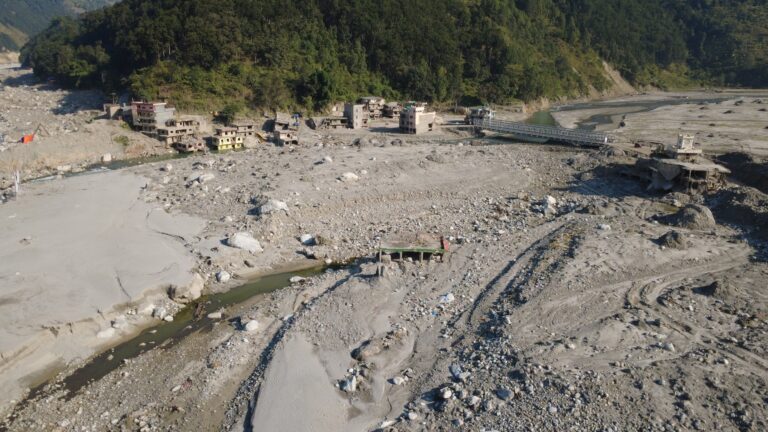
The government has also introduced an ordinance to facilitate the use of forest and government-owned land for resettlement.
Under the proposed assistance program, families without safe land could receive up to $2,000 to purchase a plot and a minimum grant of about $3,300 to build a house, according to government officials.
The ordinance also simplifies the process for declaring missing people dead after 10 days of unsuccessful searches. Once a death registration certificate is issued, families can pursue insurance claims, transfer property and conduct banking transactions.
Officials say relief funds available at the district level can also be distributed to families of deceased victims on the recommendation of ward offices.
But residents are asking when these plans will actually be implemented and who will benefit.
Survivors say resettlement plans must account for the size of each family, the condition of their former homes and land, their sources of income and their local circumstances.
A single housing standard or grant amount, they argue, will not address the needs of large households, families that have lost farmland or those whose livelihoods depend on local businesses.
Communities Facing Climate Risks Without Knowing How to Prepare
Climate change is no longer an abstract subject confined to academic discussions, international conferences or government policy documents. Recent floods and landslides have brought its potential consequences directly into communities across Nepal.
Yet many people living in high-risk areas have little understanding of climate change, its possible effects or how to protect themselves.
Figures from the National Disaster Risk Reduction and Management Authority show that Nepal recorded more than 7,500 natural disaster events over the past five years.
They included more than 2,200 landslides, more than 1,800 floods and heavy-rainfall events, about 1,800 lightning strikes and more than 1,500 windstorms and hailstorms. Dozens of earthquakes measuring above magnitude 4 were also recorded.
The disasters killed roughly 1,800 to more than 2,000 people, left hundreds missing and caused extensive damage to infrastructure and agriculture, according to the authority.
The government has spent substantial sums on climate change programs. Government agencies, private institutions, nongovernmental organizations and international organizations have also invested in research and awareness initiatives.
The law requires environmental impact assessments for major construction projects, including industrial facilities, hotels and residential developments.
But how much of that information has reached ordinary residents, particularly those living in vulnerable settlements, remains an open question.
In interviews with flood survivors in the Bhotekoshi region, some said they had never heard the term climate change. Others recognized the phrase but did not understand its implications.
Somlal Lopchan said he had some general awareness of climate change but never imagined it could be associated with such devastating events.
“We had heard the name, but ordinary people were never properly taught what kinds of events could happen,” he said. “If we had understood earlier, perhaps some of this damage could have been reduced.”
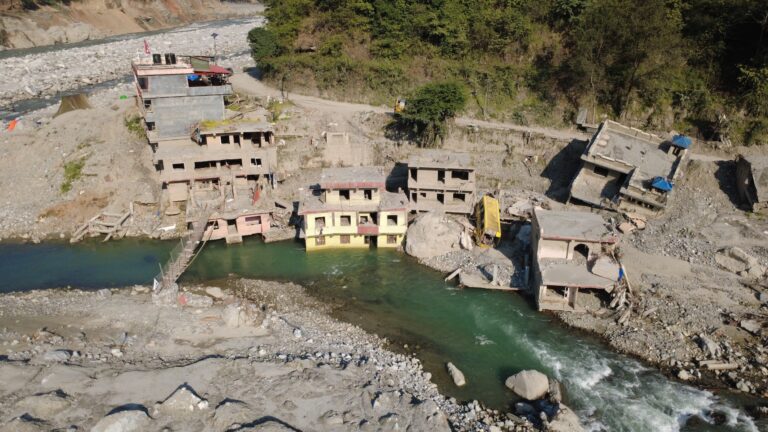
He said residents of high-risk river settlements needed timely relocation, emergency training and better preparation.
Premkumari Shrestha said she had never experienced anything like the disaster in her life. She said she knew little about climate change and described the destructive force of the sand and debris left behind by the flood.
“The sand deposited by the flood starts blowing around when the sun comes out,” she said. “A wave of debris came down from above. Wherever it hit, it lifted houses and carried them away. Houses it didn’t strike directly were buried in sand. The river was nothing like the calm river we used to know.”
Geetamaya Dangol also said she had heard little about climate change. Initially, she had difficulty believing reports that the river was rising. After the flood, fear spread through the community.
She recalled that for four or five days afterward, rocks continued rolling down the river with frightening, rumbling sounds.
Triratna Dangol, who had lived beside the river for years, said the latest flood was unlike anything he had experienced before.
“In the past, we would even go into the river during floods to catch fish. The water would rise gradually,” he said. “This time it came so suddenly that nobody had a chance to escape. We were completely stunned.”
He said residents had been told not to live in dangerous areas, but many had nowhere else to go and no alternative land.
Yog Bahadur Bhandari, 74, said he had heard on television, radio and mobile phones about melting snow in the Himalayas. But he never imagined it could lead to a disaster of this scale.
“Everyone knows floods can happen near rivers,” he said. “But nobody taught us how to protect ourselves, how to escape or where to go. So many people settled here, but nobody imagined that an event like this could take away so many lives and so much property.”
Climate Education Often Fails to Reach Local Communities
Tashi Lhanzom, a climate activist, said investments in climate education and public awareness had not produced results proportionate to the resources spent.
One major reason, she said, is the reliance on technical terminology and concepts imported from international climate discussions.
Most climate-related literature, documents and publications are available in English. Materials that explain climate change in accessible Nepali and local languages remain limited.
Even when terms used by the United Nations, such as greenhouse gases and global warming, are translated directly into Nepali, their meaning may not be clear to local communities, she said.
Technical expressions such as carbon dioxide are particularly difficult to explain when there are no familiar equivalents in local languages.
The English term “climate change” has been translated into Nepali as “jalvayu pariwartan,” but that translation alone does not help people understand how the phenomenon relates to their surroundings and everyday lives, Lhanzom said.
“If you try to explain climate change to people in Humla by reading them the United Nations’ technical definition, they will not understand,” she said.
For residents of Mustang, climate change might be experienced primarily as a water shortage. In Himalayan communities, it could appear in the form of glacial lake outbursts, falling snow and rocks, or floods and landslides.
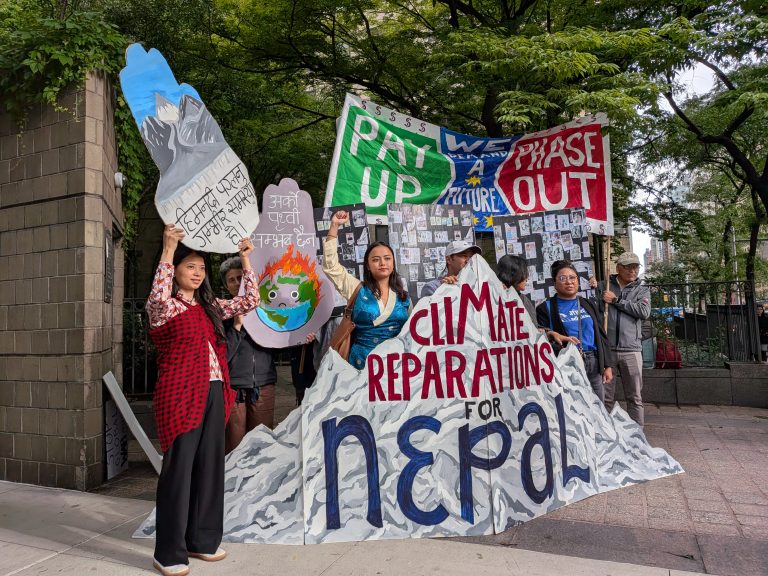
Climate education should therefore connect scientific concepts to people’s lived experiences rather than rely on abstract definitions, she said.
Lhanzom recommended developing educational materials suited to local languages, cultures and lifestyles. Educated young people from local communities could be mobilized to lead awareness programs, she said.
Centralized materials and one- or two-day training sessions are not enough to help people in remote settlements understand complex climate issues.
She also said communities most exposed to climate risks often have the least access to information. Although government policy calls for significant climate funding to be spent locally, implementation remains unclear.
Communities with greater influence and access often have their voices heard more easily, while people in remote, vulnerable areas remain overlooked, she said.
Natural disasters cannot be prevented entirely, but timely warnings and preparation can reduce deaths, Lhanzom said.
“Early warning systems are not a luxury or an optional measure,” she said. “They are essential for survival.”
Despite that need, she said, such systems have not received sufficient priority from Nepal’s three levels of government.
Nepal’s major river systems, including the Karnali, Koshi, Gandaki and Mahakali, are influenced by glaciers. Yet research and monitoring are not equally developed across all vulnerable regions.
Lhanzom said research priorities should be based on risk rather than the popularity or tourism appeal of particular Himalayan destinations. She also called for cooperation with neighboring countries to study mountains, glaciers and cross-border river systems and share information.
Scientists Urge More Research Into Himalayan Hazards
Pradip Khatiwada, an environmental expert at Nepal’s Ministry of Home Affairs, said effective information about climate change and its risks had not reached many people living near rivers and in landslide-prone settlements.
Climate change is a long-term process that alters temperatures, rainfall patterns and seasonal cycles. It can increase the intensity, scale and impact of disasters such as floods and landslides, he said.
But establishing that a specific disaster was caused by climate change requires scientific evidence and research, Khatiwada said.
He said the recent events in the Bhotekoshi region of Rasuwa and in Gorkha could not be understood simply as ordinary floods. In some cases, the destruction appeared to involve not only rising water but also snow, rocks and debris falling from higher elevations.
An analysis of the material carried by the Bhotekoshi flood indicated that more than 70 percent consisted of debris, soil and rocks, while about 30 percent was water or ice, Khatiwada said.
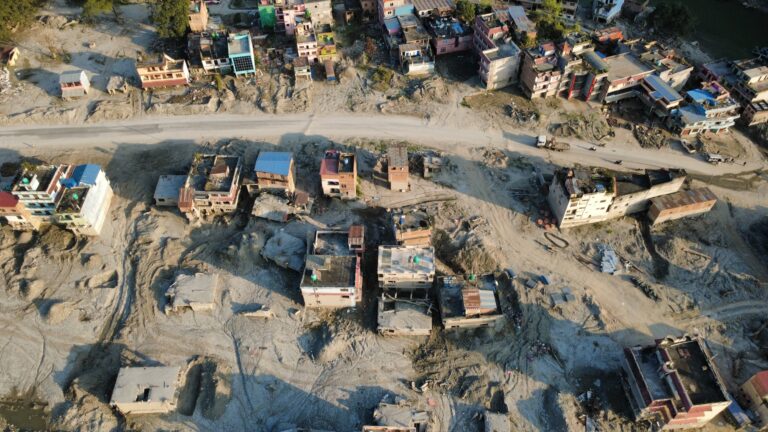
That composition suggests that monitoring river levels and rainfall alone may not be enough to understand the risks.
Researchers must also examine Himalayan geology, rising temperatures and permafrost — ground that remains frozen for long periods — he said.
Khatiwada said Nepal had climate policies, laws and budget allocations, but their impact had not been sufficiently visible at the community level.
Government attention has often focused on environmental impact assessments, paperwork and advocacy rather than practical measures to reduce deaths and damage, he said.
He called for climate risk assessments before settlements are developed, automated weather-monitoring systems and practical climate education extending from schools to local governments.
Early Warning Systems and Himalayan Monitoring
Rajendra Sharma, a technical undersecretary at the National Disaster Risk Reduction and Management Authority, said early warning systems were essential to reducing deaths.
Local residents, he said, tend to understand immediate threats such as floods, landslides, cold waves and droughts more readily than theoretical concepts such as climate change.
In areas including Banke, Bardiya and Dhangadhi, local officials and residents have received information about how to prepare for floods and cold waves, including how to respond to early warnings.
When the Department of Hydrology and Meteorology issues forecasts of floods or heavy rainfall as much as four days in advance, communities in those areas generally have a better understanding of what to do, Sharma said.
But explaining how the intensity of those events relates to climate change remains difficult at the local level.
“Ordinary citizens are more concerned about the problems they face in their daily lives and how to stay safe than about theoretical explanations or debates over climate change,” he said.
For farmers, he added, practical support such as suitable seeds, technology and assistance during droughts or excessive rainfall may be more important than lengthy explanations of climate science.
Sharma said the Department of Hydrology and Meteorology operates about 300 real-time river-level monitoring stations and 500 rainfall-monitoring stations across Nepal.
But the Bhotekoshi disaster showed that monitoring river levels and rainfall alone cannot identify every potential hazard.
He recommended continuous monitoring of Himalayan conditions and risk mapping of individual river systems, with areas classified according to whether they face extreme, moderate or low levels of risk.
Joint studies and information-sharing with neighboring countries are also necessary for cross-border river systems, he said.
Researchers should study not only glacial lakes but also the broader geology of the mountains, temperature changes, permafrost and the risk of falling snow and rocks.
Although it is understandable that glacial lake research has focused heavily on the Koshi and Arun basins, Sharma said, other Himalayan regions should not be overlooked.
Of the 47 glacial lakes identified as potentially dangerous, most are in the Koshi and Arun basins, he said.
But recent events in the Bhotekoshi and Budhigandaki regions show that research must also account for risks associated with rising temperatures and geological conditions, including falling snow and rocks, he said.
A History of Disasters, and Repeated Questions About Preparedness
Major disasters in Nepal over the past several years have repeatedly highlighted the need for better preparation and risk reduction.
On June 15, 2021, floods and landslides struck the Melamchi and Helambu areas of Sindhupalchok district, causing extensive damage.
Later that year, unusually heavy rainfall from Oct. 18 to 20 triggered floods and landslides in several districts, including Doti, Bajhang, Panchthar and Ilam. More than 120 people died.
In 2022, landslides caused damage in Myagdi, Baglung and Sankhuwasabha shortly after the monsoon began. On Nov. 8, a magnitude 6.6 earthquake centered in the Khaptad region of Doti killed six people.
On June 16 and 17, 2023, floods in the Hewakhola River in Sankhuwasabha and in Taplejung damaged hydropower projects and settlements. Landslides in Baglung and Myagdi caused further casualties in August.
On Nov. 3, 2023, a magnitude 6.4 earthquake centered in Ramidanda, Jajarkot, killed 154 people in Jajarkot and Rukum West and damaged more than 62,000 houses.
Disasters continued in 2024.
On July 12, a landslide at Simaltal in Chitwan swept two passenger buses into the Trishuli River, leaving more than 60 passengers missing or later declared dead.
On Aug. 16, a glacial lake outburst in Thame village in Solukhumbu swept away more than 20 houses and a school.
On Oct. 11 and 12, exceptionally heavy rainfall triggered floods and landslides in Kavrepalanchok, Lalitpur, Kathmandu, Dhading, Makwanpur and other districts. More than 240 people died, and major damage was reported to the BP Highway and hydropower infrastructure.
During the 2025 and 2026 monsoon seasons, floods and landslides in the Bhotekoshi-Trishuli watershed caused extensive damage in Rasuwa, Nuwakot, Gorkha, Dhading and Tanahun.
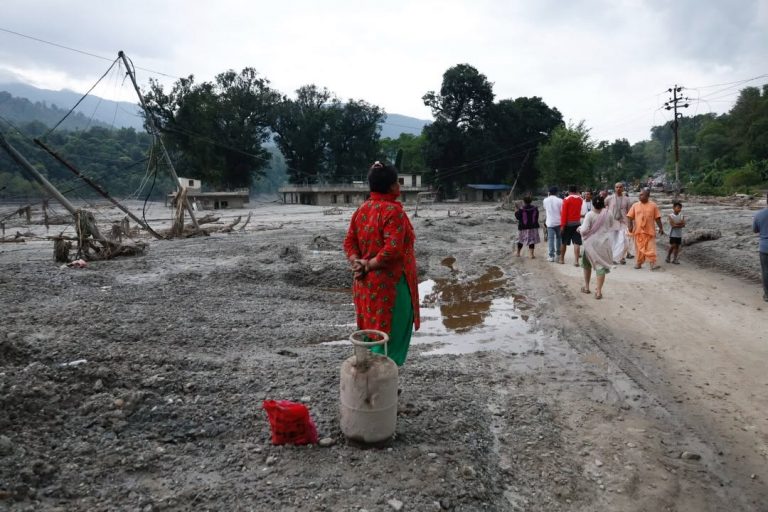
According to figures released by the disaster authority, those events killed more than 130 people and displaced thousands of families.
The disasters have repeatedly demonstrated the importance of identifying risks before they materialize, issuing timely warnings and ensuring residents can reach safe locations.
Although natural disasters cannot always be prevented, deaths can be reduced when people receive warnings early enough to evacuate.
Experts say that requires warnings in local languages, community-level drills and better identification of settlements at risk.
Climate Diplomacy Abroad, Uncertainty at Home
At the United Nations climate conference, COP31, held in Antalya, Turkey, from Nov. 9 to 22, Nepal sought to put the climate risks facing Himalayan countries on the international agenda.
Nepal worked with Bhutan and Kyrgyzstan to push for a separate agenda item on Himalayan issues. The proposal did not secure a distinct place on the conference’s formal agenda.
The conference presidency agreed to further consultations and a research dialogue in 2027-28.
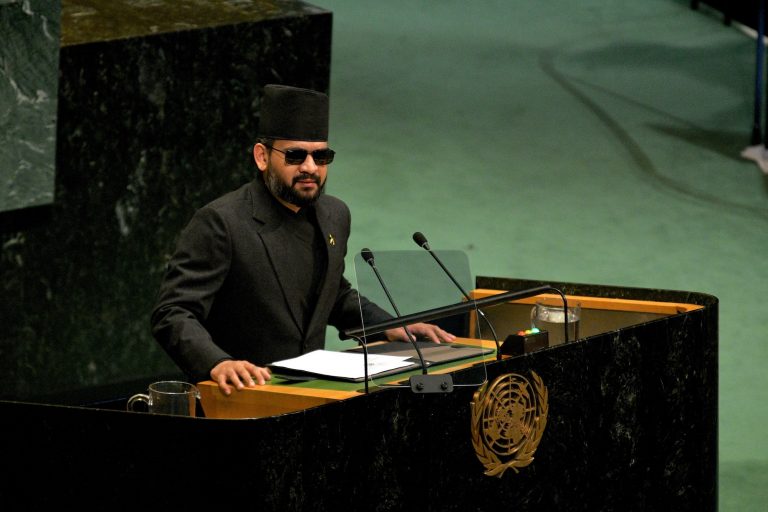
Earlier, Prime Minister Balendra Shah had also drawn considerable attention with his speech at the United Nations.
For families displaced by the Bhotekoshi disaster, international climate conferences remain distant concerns.
They are less interested in the mechanics of climate finance or international agreements than in knowing when their homes will be rebuilt and when their families can begin earning a living again.
Nepal contributes less than 0.1 percent of global greenhouse gas emissions. Yet communities in the country, which has made a negligible contribution to the problem, are experiencing some of its most serious consequences.
Raising Nepal’s voice at international forums is not enough, however. Communities also need to understand local risks, receive effective early warnings and have access to safe places to live.
For survivors, the immediate concern is the uncertainty surrounding their future.
They want to know when the government will build their homes, where they will be resettled and whether they will be allowed to return to their former communities.
At international forums, Nepal is calling for climate justice and compensation for loss and damage. But for flood survivors in the Bhotekoshi region, justice means something more immediate: a safe home, a livelihood and the chance to rebuild their lives.
Nearly three months after the disaster, families living in temporary shelters are still waiting for concrete government decisions.
They no longer need announcements about the prime minister’s and ministers’ participation in another international conference. They need the means to begin their lives again.
