





The number of active international students in the United States fell by about 42,000 from July to August, according to the latest figures from the Department of Homeland Security’s Student and Exchange Visitor Information System.
Active student records declined from about 1.15 million in July to approximately 1.11 million in August, a decrease of nearly 3.7%, according to the SEVIS Data Mapping Tool. The figures track F-1 academic students and related nonimmigrant categories.
Looking for job?
Click hereThe monthly snapshot, published on the government’s Study in the States website, counts students in the United States under relevant visa classifications. It excludes dependents and other nonimmigrant groups.
Asia leads broader declines
Asia continued to account for the overwhelming majority of international students in the United States, though most major source countries recorded declines during the month.
India remained the top source country, with 333,314 active student records in August, down 4,916 from 338,230 in July. China was second, with 197,802 students, down 6,666 from 204,468 in July.
South Korea, Brazil and Canada rounded out the top five source countries. Each recorded a month-to-month decline of more than 1,000 students.
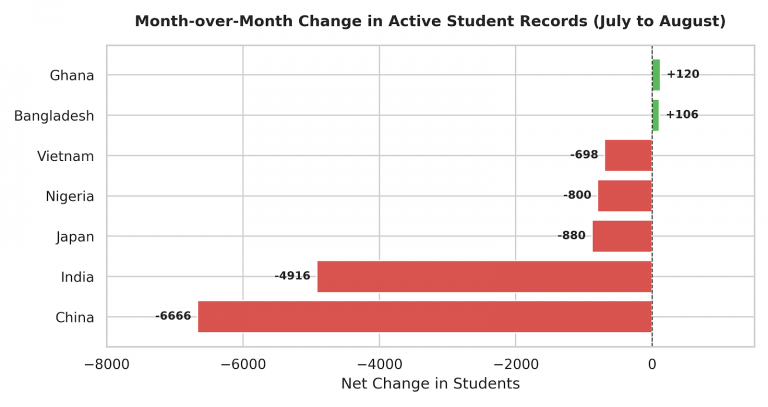
Japan recorded a decrease of 880 students, or 6.9%, to 11,929. Nigeria fell by 800 students to 21,311, while Vietnam declined by 698 to 29,412.
A small number of countries bucked the overall downward trend. Ghana added 120 active student records, reaching 13,940, while Bangladesh increased by 106 students to 25,437.
Nepali student count falls nearly 3,000
The number of active Nepali students in the United States fell by 2,973 over five months, according to SEVIS data. The total declined from 34,853 in March to 31,880 in August.
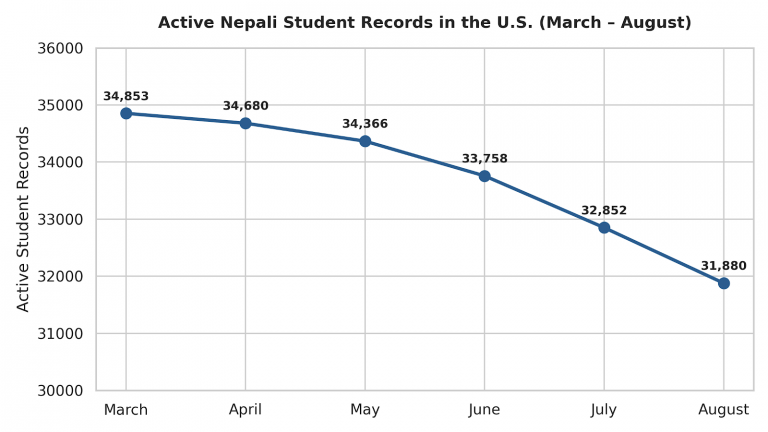
DHS-maintained SEVIS figures show the decline accelerated through the spring and early summer. The active student count stood at 34,680 in April, fell to 34,366 in May and then dropped to 33,758 in June. It declined further to 32,852 in July and 31,880 in August.
The monthly decreases were 314 students from April to May, 608 from May to June, 906 from June to July and 972 from July to August.
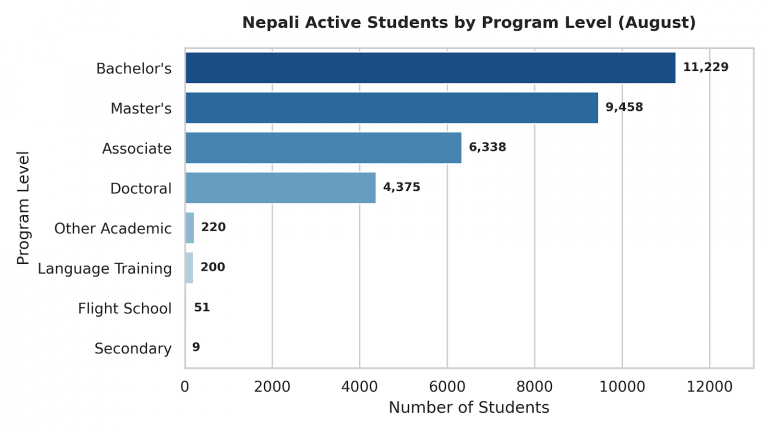
Of the 31,880 active Nepali student records in August, 17,914 were for men and 13,966 were for women.
Bachelor’s degree programs accounted for the largest share, with 11,229 Nepali students. Master’s programs enrolled 9,458 students, followed by associate degree programs with 6,338 and doctoral programs with 4,375.
Another 220 students were listed in other academic programs, while 200 were enrolled in language-training programs. Flight schools accounted for 51 students, and nine Nepali students were enrolled at the secondary school level.
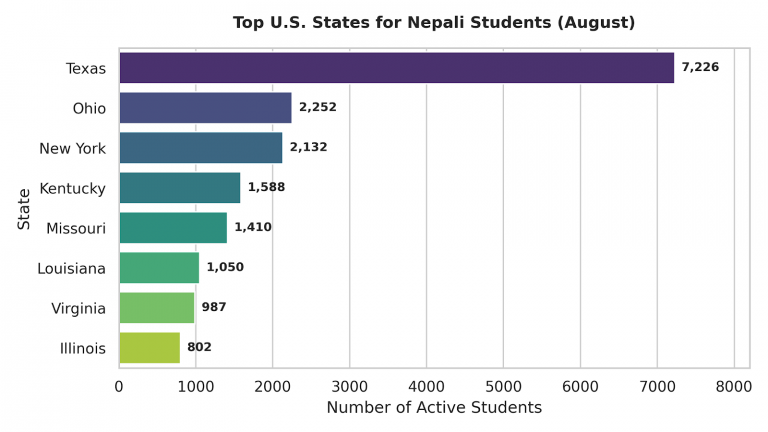
Texas had the largest number of active Nepali student records, with 7,226. Ohio followed with 2,252, while New York had 2,132. Other states with sizable Nepali student populations included Kentucky, with 1,588; Missouri, with 1,410; Louisiana, with 1,050; Virginia, with 987; and Illinois, with 802.
What SEVIS terminations mean
SEVIS is the federal system used to track international students and exchange visitors in the F and M visa categories. When a SEVIS record is terminated, a student’s immigration status is no longer considered active. The student generally cannot remain in the United States to continue studying unless the record is reinstated or the student changes status.
Not every SEVIS termination, however, reflects an enforcement action or visa cancellation. Records may also be terminated when students graduate, transfer schools, change programs, take authorized withdrawals or otherwise complete or end their studies.
Nepali students have experienced notable SEVIS disruptions over the past year. Reports in 2025 described thousands of international students, including Nepalis, whose records were terminated and later reactivated in some cases amid broader federal data changes and policy shifts.
Despite the recent decline, Nepal remains a significant source country for students studying in the United States. An August 2026 DHS report listed 31,880 Nepali students with active records across bachelor’s, master’s, associate and doctoral programs.
Attorney cites broader concerns
New York-based immigration attorney Keshab Raj Seadie said the decline in international student records should not be viewed solely as a seasonal fluctuation.
“The significant decline in international students, including the nearly 3,000 decline in active Nepali students in only five months, should be viewed as more than just a seasonal fluctuation,” Seadie said. “It is also a warning sign that the United States is becoming a more difficult and less attractive destination for international students.”
Seadie said that over the past year, international students have faced heightened visa scrutiny and screening, uncertainty involving SEVIS records, concerns about maintaining lawful status and anxiety over access to practical training and employment after graduation.
For students from Nepal, India and other countries, he said, a U.S. education is a major financial commitment. Tuition, housing, health insurance and other living expenses can require families to spend tens of thousands of dollars each year.
“Students naturally evaluate that investment against their ability to complete their education, obtain OPT employment and eventually pursue professional opportunities in the United States,” Seadie said.
He said the elimination of duration of status, scheduled to take effect Sept. 15, 2026, would add another layer of uncertainty for F-1 students. Under the rule, students would be admitted for fixed periods rather than for the duration of their academic programs and, in some cases, would need to seek extensions of stay from U.S. Citizenship and Immigration Services.
Seadie said the new regulations also reduce the post-completion departure period and impose additional restrictions affecting academic mobility and transfers.
He added that finding qualifying employment through Optional Practical Training, including the STEM OPT extension, has become increasingly difficult for some graduates. Greater scrutiny of employers, particularly consulting and staffing arrangements, combined with a challenging professional job market, has led students to question whether the cost of a U.S. education continues to justify the potential career opportunities, he said.
Still, Seadie cautioned against attributing every monthly decline in SEVIS records to immigration enforcement.
“Some reduction is seasonal and results from graduation, completion of OPT, transfers and normal departures,” Seadie said. “Nevertheless, when declining student numbers are combined with reduced visa issuance, restrictive immigration policies and growing uncertainty regarding post-graduation employment, there is a broader trend that policymakers and American universities should take seriously.”
International students contribute tuition revenue, talent, innovation, research capacity and billions of dollars to the U.S. economy, Seadie said. He warned that students who view the United States as too expensive, unpredictable or unwelcoming may instead pursue education in Canada, Europe, Australia and other destinations.
“Once that talent pipeline shifts to competing countries, rebuilding America’s position as the preferred destination for the world’s best students may be considerably more difficult,” Seadie said.
New York-based immigration attorney Bashu D. Phulara said the overall decline in active international student records may be partly seasonal, but the reduction among Nepali students warrants closer attention.
“The overall drop of 42,000 active international students from July to August is partly seasonal, as many programs end and graduates leave,” Phulara said. “But the Nepali numbers tell a more serious story.”
“Active Nepali student records have fallen by nearly 3,000 in just five months — from 34,853 in March to 31,880 in August — with the decline accelerating every month,” he said. “This is not normal seasonal fluctuation. It tracks the sharp drop in U.S. study visa issuances to Nepali students after the 2024 peak.”

Phulara said DHS’ final rule ending duration of status for F-1 students, scheduled to take effect Sept. 15, 2026, would create additional compliance requirements and uncertainty for current and prospective students.
Under the rule, students would receive a fixed period of admission generally tied to the program end date listed on their Form I-20, subject to a four-year cap, along with a shorter grace period, he said. Students who need additional time for Optional Practical Training, STEM OPT, program extensions or transfers would need to file an extension-of-stay application with U.S. Citizenship and Immigration Services.
“This is a significant shift,” Phulara said. “It increases compliance pressure, creates new filing requirements and adds uncertainty for current and future students.”
Combined with stricter visa processing and falling student numbers, he said, the environment for Nepali students in the United States has become more challenging.
“The data and the new rule both point in the same direction: Students and families need careful, proactive legal planning more than ever,” Phulara said.
Longer-term shift
The monthly decline comes amid longer-term changes in student movement from Nepal to the United States. Data from Nepal’s Department of Immigration shows that 45,634 Nepali students went to the United States from 2020 through early August 2026.
Annual U.S. study visa issuances to Nepali students increased from 316 in 2020 to 5,033 in 2021, 7,542 in 2022 and 8,241 in 2023. The total peaked at 14,205 in 2024 before falling to 8,123 in 2025, amid immigration policy changes and stricter visa vetting.
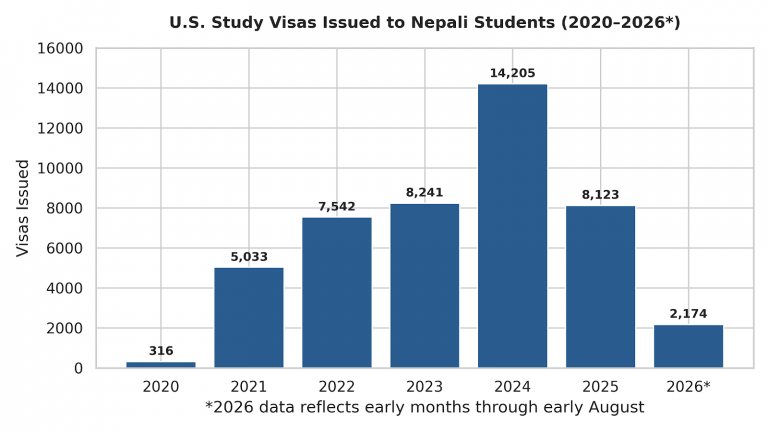
In the first months of 2026, 2,174 Nepali students received U.S. study visas, according to Nepal’s Department of Immigration.
Separate data from the Institute of International Education’s Open Doors report showed that 24,890 Nepali students were enrolled in U.S. higher education during the 2024-25 academic year. That was a 48.7% increase from 16,742 students in the previous academic year.
The August SEVIS data was released shortly after DHS published a final rule on July 17 establishing fixed periods of admission and new extension-of-stay procedures for F nonimmigrant students, J exchange visitors and foreign media representatives.
Editor’s note: This report has been updated to include additional analysis from New York-based immigration attorney Bashu D. Phulara.
