





NEW YORK — More than half of immigrants facing removal proceedings in U.S. immigration courts do so without an attorney or accredited representative. Among Nepali nationals, however, the share of people without representation has declined sharply.
Nationally, 53.67% of individuals in immigration court lacked legal representation in fiscal year 2026. Of 3,195,137 active pending cases nationwide as of the end of June, 1,714,722 involved people without an attorney or accredited representative listed in court records, compared with 1,480,415 cases with representation. TRAC reported 3.19 million pending immigration court cases at the end of June 2026.
Looking for job?
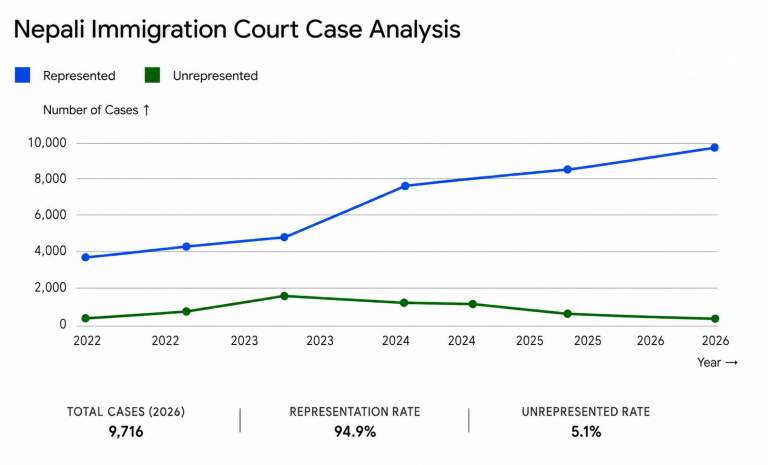
Click hereBy contrast, 495 of 9,716 pending cases involving Nepali nationals in 2026 are unrepresented, a rate of 5.1%, according to immigration court data compiled by the Transactional Records Access Clearinghouse. The data reflects a substantial drop from 2023, when 1,700 of 6,451 known pending cases involving Nepali nationals, or 26.3%, were unrepresented.
A Growing Caseload With Growing Representation
The decline in unrepresented Nepali cases comes even as the overall Nepali caseload continues to expand. Pending represented cases involving Nepali nationals rose from 3,775 in 2022 to 4,751 in 2023, jumping sharply to 7,858 in 2024, 8,993 in 2025, and reaching 9,221 in 2026.
At the same time, unrepresented cases fell steadily after peaking at 1,700 in 2023. Unrepresented cases were previously recorded at 354 in 2021 and 673 in 2022, representing 15.1% of the total caseload that year. Following the 2023 peak of 26.3%, the unrepresented tally dropped to 997 cases in 2024 (11.3%), 664 cases in 2025 (6.9%), and 495 cases in 2026 (5.1%).
Regional court data indicates that the active Nepali caseload is heavily concentrated in major metropolitan areas. New York leads the nation with 3,728 total pending cases involving Nepali nationals, including 3,605 represented cases and 123 unrepresented cases, leaving an unrepresented rate of 3.3%.
San Francisco follows with 2,118 total cases, where 2,073 are represented and 45 are unrepresented, reflecting a 2.1% unrepresented rate. San Antonio handles 1,522 total cases, with 1,459 represented and 63 unrepresented, or a 4.1% unrepresented rate.
Other jurisdictions handling notable portions of the Nepali caseload include Concord, New Hampshire, with 420 cases; Denver with 311 cases; Baltimore with 250 cases; Dallas with 183 cases; Boston with 107 cases; Chicago with 97 cases; the New York Varick Street court with 91 cases; Sacramento, California, with 90 cases; Newark, New Jersey, with 68 cases; and Sterling, Virginia, with 66 cases.
High Stakes in Immigration Court
Despite the decline among Nepali nationals, attorneys and advocates say the 495 people still without representation face substantial risks in removal proceedings.
Unlike criminal defendants, immigrants in removal proceedings are generally not entitled to government-funded counsel. Federal law provides that a person in immigration court may be represented by counsel of their choosing, but “at no expense to the Government.” Congressional Research Service notes that authorized representatives can include attorneys registered with the Executive Office for Immigration Review and accredited representatives registered to practice before the immigration courts.
An American Immigration Council analysis of cases completed from fiscal year 2019 through fiscal year 2024 found that 26.9% of represented respondents received removal orders, compared with 61.8% of unrepresented respondents. Among non-detained respondents, people without legal representation were more than two and a half times as likely to receive removal orders as those with counsel.
“U.S. laws are often extensive and complex,” said Ramesh Shrestha, a New York-based immigration attorney. “Legal experts widely agree that U.S. immigration law is just as complex and intricate as U.S. tax law.”
Shrestha said immigrants in removal proceedings must meet court deadlines, prepare and submit evidence, identify possible forms of relief and satisfy legal burdens of proof, often without prior knowledge of immigration law.
Bashu Phulara, another New York immigration attorney, said Nepali immigrants should also be wary of middlemen and unqualified people who market themselves as immigration legal-service providers.
“Many Nepali immigrants are often misled by middlemen and unqualified non-attorneys,” Phulara said. “Instead of seeking competent, licensed and ethical attorneys, they turn to so-called legal helpers who offer services for less money. Worse yet, they end up paying large sums to non-attorneys.”
Phulara urged immigrants to verify that anyone providing immigration legal services is a licensed attorney or a federally accredited representative before signing documents, filing applications or appearing in immigration court. The U.S. Citizenship and Immigration Services similarly advises immigrants to obtain legal advice only from a licensed attorney or an accredited representative working for a Justice Department-recognized organization.
