



Attorney General James and Governor Hochul Defend NY Ban on Local Cooperation with ICE

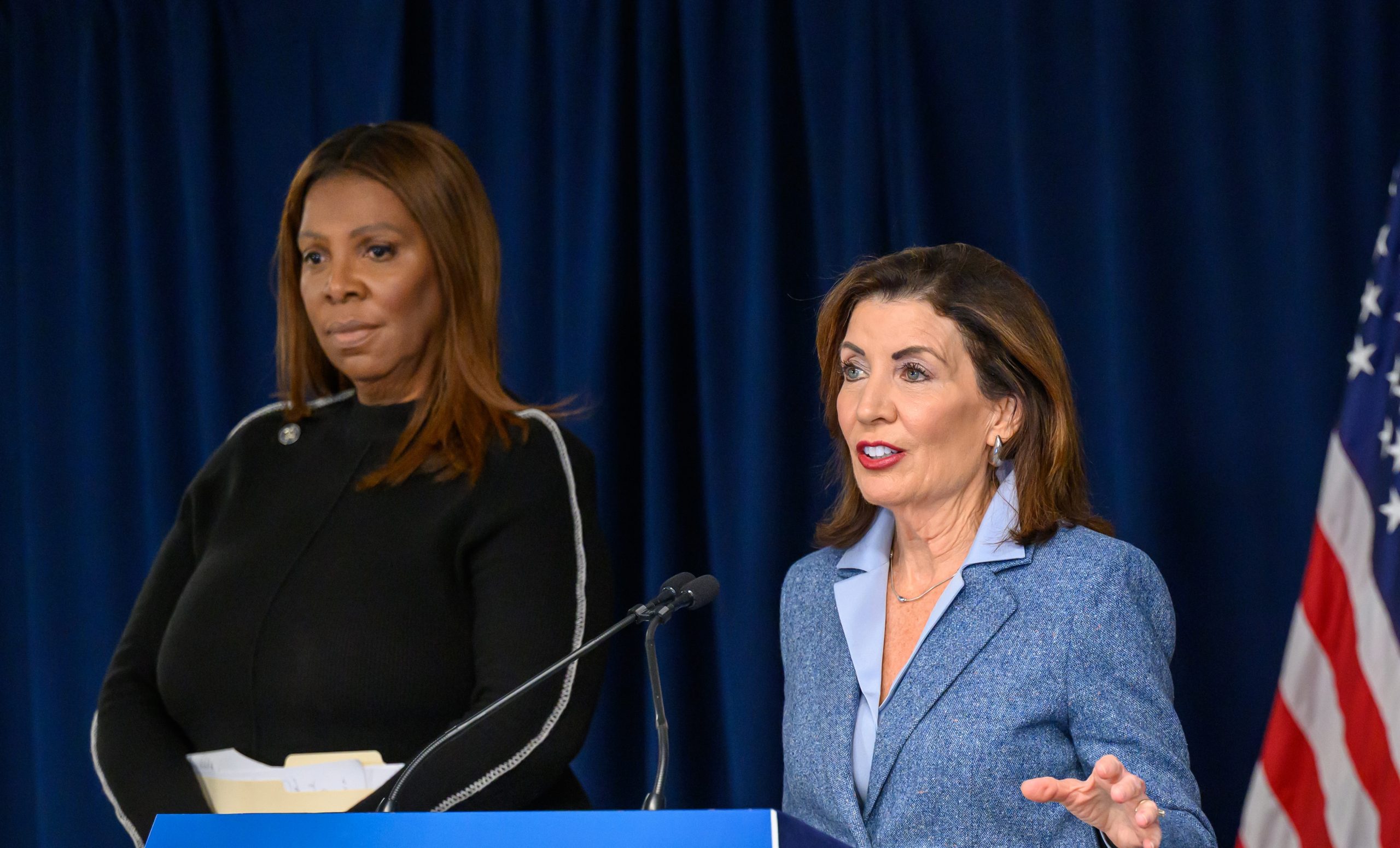
Governor Kathy Hochul and Attorney General Letitia James in 2025. (Susan Watts/Office of Governor Kathy Hochul)
New York Attorney General Letitia James and Gov. Kathy Hochul on Tuesday defended the state’s ban on 287(g) agreements after a federal judge declined to block the law while the legal challenge moves forward.
The U.S. District Court for the Northern District of New York denied the federal government’s request for a preliminary injunction against New York’s ban on agreements between local law enforcement agencies and U.S. Immigration and Customs Enforcement, or ICE.
“We have said from the start that New York’s ban on 287(g) agreements is legal and will keep our communities safe,” James and Hochul said in a joint statement. “Local law enforcement should be focused on local matters, and New York taxpayers should not have to foot the bill for any collaboration with ICE.”
The officials also said they remain opposed to the use of masked agents. “While the court enjoined enforcement of New York’s mask ban, we stand firm in our belief that masked agents do not make New York safer, and our offices are reviewing all legal options at this time,” they said.
A federal judge on Monday blocked New York from enforcing laws that prohibit federal agents from wearing masks and require them to visibly display identifying information while on duty, but allowed the state’s measure ending local cooperation with federal immigration authorities to move forward.
In a 51-page decision, U.S. District Judge Mae A. D’Agostino granted in part and denied in part a motion by the U.S. Department of Justice for a preliminary injunction against Hochul and James.
The ruling temporarily halts key transparency provisions enacted as part of New York’s state budget legislation in May, while preserving the state’s ban on voluntary intergovernmental immigration agreements.
Mask, ID rules blocked
D’Agostino ruled that the federal government is likely to succeed on its claim that New York’s Face Covering Act and Identification Act violate the Supremacy Clause under the doctrine of intergovernmental immunity.
The laws would have subjected officers from federal agencies — including the FBI, ICE, the Drug Enforcement Administration and Customs and Border Protection — to state criminal penalties for concealing their faces or failing to display visible agency identification while interacting with the public. First offenses carried penalties of up to 15 days in jail, while later offenses were punishable as misdemeanors.
D’Agostino rejected the state’s argument that the restrictions fell within New York’s traditional police powers to promote public safety and law enforcement transparency.
“The United States may perform its functions without conforming to the police regulations of a state,” D’Agostino wrote, citing U.S. Supreme Court precedent. “Because the Face Covering and Identification Acts take direct aim at regulating the federal agents in their function of enforcing federal law, the Court finds these provisions likely run afoul of the intergovernmental immunity doctrine.”
The judge said decisions about officer gear, uniforms and identification protocols belong to federal officials, not state lawmakers. The injunction bars state and local officials from enforcing the mask and identification rules against federal personnel while the lawsuit proceeds.
287(g) ban upheld
While giving the Justice Department a victory on the officer conduct rules, the court denied its request to block New York’s Termination Act.
Set to take effect Aug. 25, the law prohibits state and local law enforcement agencies, correctional facilities and detention centers from entering into, renewing or maintaining agreements with federal authorities under Section 287(g) of the Immigration and Nationality Act. The section allows local police to be deputized to perform certain federal civil immigration enforcement functions. The law also voids contracts housing civil immigration detainees in state and local facilities.
The Justice Department argued that the state law interfered with federal objectives, discriminated against the federal government and violated the U.S. Constitution’s Contracts Clause.
D’Agostino rejected those arguments, finding that federal immigration law does not compel state or local governments to assist in civil immigration enforcement.
“Section 1357 gives the states and local governments the option to enter into agreements with federal immigration officials to assist with immigration enforcement,” the court wrote, noting that New York is “not bound by that hope or expectation.”
The judge concluded that the state had a legitimate public purpose in preserving local law enforcement resources and public safety, and that the federal government failed to show the state acted out of self-interest or violated constitutional contract protections.
The lawsuit, filed by the federal government in June in the Western District of New York before being transferred to the Northern District, is one of several legal challenges nationwide over state efforts to regulate federal law enforcement practices and limit participation in federal immigration operations.
The preliminary injunction blocking enforcement of the mask and identification mandates will remain in place until the court issues a final judgment.
Murad Awawdeh, president and CEO of the New York Immigration Coalition, condemned the injunction and said masked agents create “a dangerous environment” because they can operate without transparency or accountability. He praised the court’s decision to uphold the end of 287(g) agreements, saying New York police should not be “officially deputized to do ICE’s dirty work.”