



25% of Nepali Removal Orders Over 28 Years Issued Under Trump in 18 Months; Relief-Grant Rate Falls to 7.6%


Nepali passport
In just 18 months, U.S. immigration courts issued 1,162 removal orders to Nepali nationals between January 2025 and June 2026—accounting for 25% of all removal orders recorded for the group over the past 28 years, according to Executive Office for Immigration Review records compiled by TRAC.
When combined with Donald Trump’s first presidential term, courts have issued a total of 2,006 removal orders to Nepali nationals across both terms, representing 43.24% of the 4,639 total removal orders recorded in the dataset since 1998. In fiscal year 2025 and the first nine months of fiscal year 2026, removal orders remained the dominant outcome in the Nepal docket, far outpacing grants of relief and case closures.
Relief Granted at 7.6%
For fiscal year 2025, the data show 1,837 total case hearings involving Nepalis. Of those, judges issued 569 removal orders and granted relief in 378 cases—which represents 20.58% of total hearings. Additionally, 249 cases were terminated, and 223 were recorded as “no Notice to Appear (NTA) filed.”
Other outcomes included 185 credible-fear cases in which fear was not found, 94 credible-fear cases in which fear was found, 87 voluntary departures, and 23 other closures. Smaller categories included 13 “credible-fear other” cases, 11 “withholding-only other” cases, two prosecutorial-discretion outcomes, two “asylum-only other” cases, and one “withholding-only” case not granted.
Removal orders were the single largest outcome in fiscal year 2025, followed by grants of relief and terminations. Grants accounted for just over one in five total outcomes (20.58%), or 39.92% of direct merits decisions.
For the first nine months of fiscal year 2026, the Nepal docket recorded 941 total case hearings through the reporting period. Judges issued 634 removal orders, while 88 cases were terminated, 73 ended in voluntary departure, and 72 resulted in grants of relief, representing 7.65% of total hearings. Other outcomes included 30 credible-fear cases in which fear was not found, 29 “no NTA filed” cases, six other closures, five credible-fear cases in which fear was found, three “credible-fear other” cases, and one asylum-only case in which relief was not granted.
The fiscal year 2026 figures show an even more removal-heavy outcome mix than fiscal year 2025. Removal orders accounted for the clear majority of resolved cases, while grants of relief fell to a much smaller share of the docket—accounting for just 7.65% of total outcomes and 10.20% of direct merits decisions.
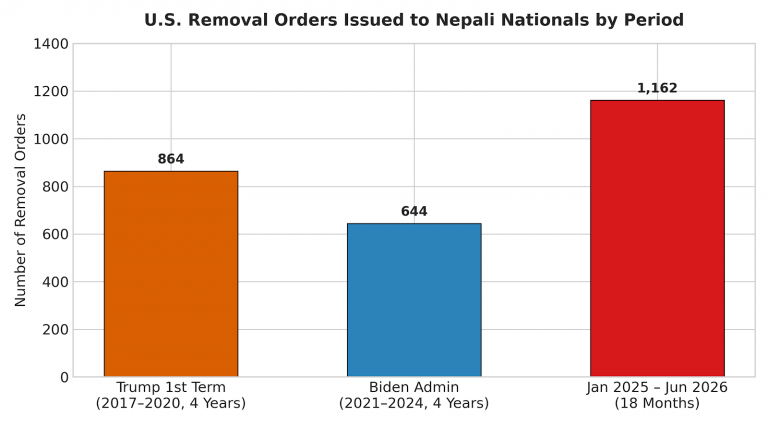
The pace of removal orders for Nepali nationals has climbed dramatically in the most recent period. Judges issued 1,162 removal orders between January 2025 and June 2026, representing more than a quarter of the total recorded over 28 years and far exceeding the totals registered under the Biden administration and Trump’s first term.
In calendar year 2025 alone, judges issued 783 removal orders for Nepali nationals, with the monthly total rising from 26 in January to a high of 112 in October. In the first six months of calendar year 2026, immigration judges issued another 379 removal orders, keeping the monthly pace at an average of nearly 63 orders.
Judges issued 644 removal orders for Nepali nationals during the Biden administration, from January 2021 through December 2024, and 864 during Trump’s first term, from January 2017 through December 2020. The 2025 total alone exceeded the four-year Biden total.
Historical Relief Grant and Removal Trends
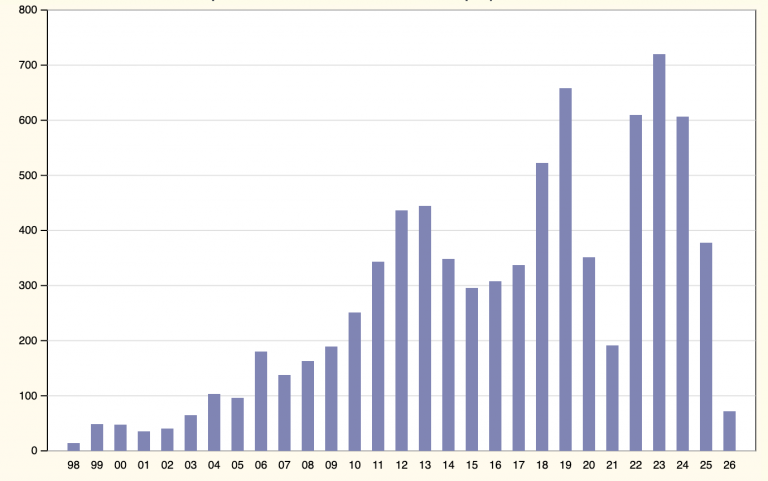
At the same time, relief grant totals for Nepali nationals have been volatile over the long term and notably lower in the most recent year. Courts recorded 720 grants of relief in 2023—the highest annual total on record—followed by 607 in 2024, before a sharp drop to 378 in 2025 and 72 in 2026. While courts were issuing more removal orders in 2025 and 2026, they were granting relief at a far lower rate than during the 2023 peak.
The grant-of-relief pattern has fluctuated widely over time. Totals were 14 in 1998, 35 in 2001, 41 in 2002, 65 in 2003, 103 in 2004, and 96 in 2005 before rising to 180 in 2006 and 189 in 2009. Relief grants later climbed to 251 in 2010, 343 in 2011, 436 in 2012, and 445 in 2013, holding in the 300s through much of the mid-2010s before peaking in 2023.
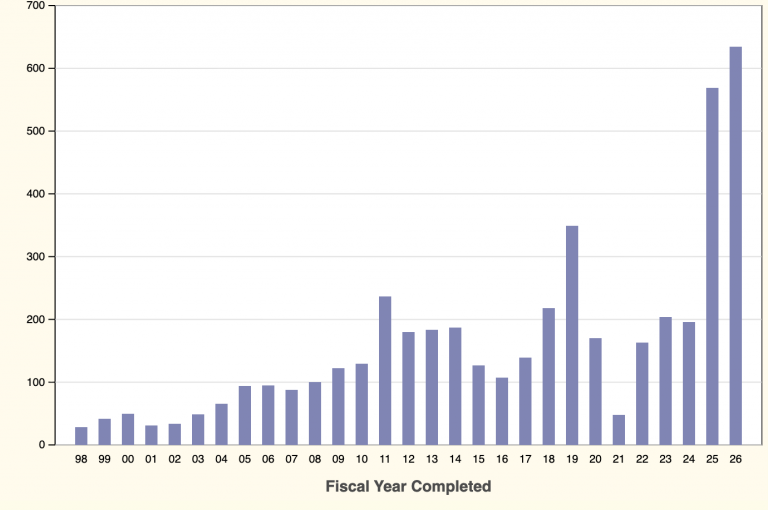
A fiscal-year view of the removal-order data reveals a similar upward trend, with 569 removal orders in fiscal year 2025 and 634 in fiscal year 2026, both well above earlier peaks. Those totals outpaced previous high-water marks, such as 349 in fiscal year 2019, 237 in fiscal year 2011, 218 in fiscal year 2018, and 204 in fiscal year 2023.
Removal orders for Nepali nationals were relatively modest in the late 1990s and early 2000s before gradually rising. The dataset includes 28 orders in 1998, 42 in 1999, 50 in 2000, 31 in 2001, 34 in 2002, 49 in 2003, and 66 in 2004. Orders then climbed to 94 in 2005, 95 in 2006, 88 in 2007, and 100 in 2008.
The numbers increased further in the 2010s, with 122 in 2009, 129 in 2010, 237 in 2011, 180 in 2012, 183 in 2013, 187 in 2014, 127 in 2015, 107 in 2016, 139 in 2017, 218 in 2018, and 349 in 2019. The total dipped to 170 in 2020 during the COVID-19 pandemic before rising again to 48 in 2021, 163 in 2022, 204 in 2023, and 196 in 2024, leading up to the sharp jump in 2025 and 2026.
The 783 orders in 2025 alone were more than four times the total from 2024 and nearly double the combined totals from 2021 and 2022.
(Editor’s note: This report uses two TRAC compiled Executive Office for Immigration Review data sets, one organized by fiscal year and one by calendar year, to more accurately reflect the Trump and Biden administrations.)