Nepali diplomats, migration experts, diaspora leaders, and civil society representatives on Friday called for stronger protection mechanisms for migrant workers and greater recognition of diaspora communities as key partners in migration governance.
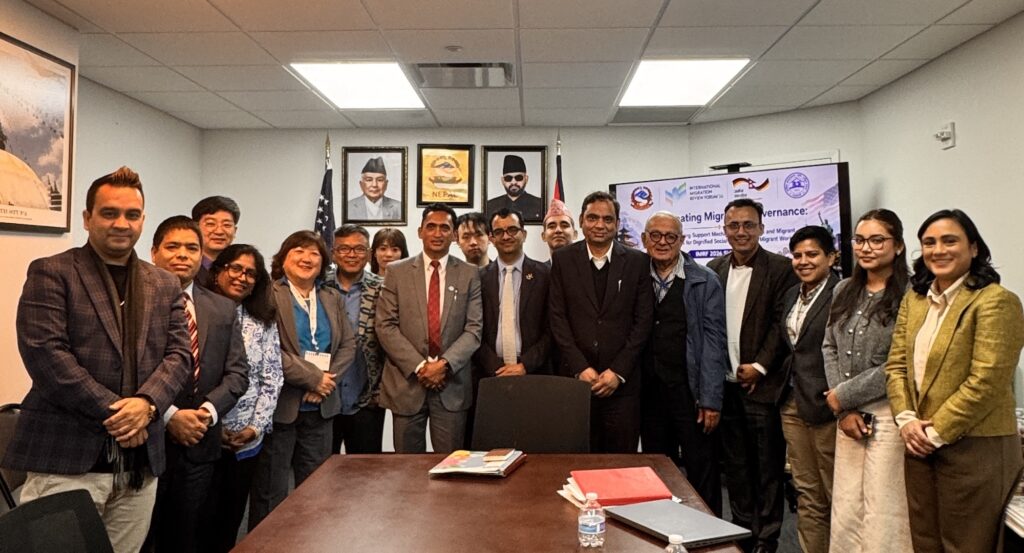
The Consulate General of Nepal in New York, in collaboration with the National Network for Safe Migration (Kathmandu), the German development agency GIZ, and the International Migration Review Forum (IMRF) 2026, organized an interaction program titled “Co-Creating Migration Governance: Strengthening Support Mechanisms of Diaspora and Migrant Communities for Dignified Social Protection of Migrant Workers.”
The discussion, held on the sidelines of the International Migration Review Forum (IMRF) 2026, focused on co-creating migration governance and strengthening support systems for migrant workers through coordinated action by governments, international agencies, and diaspora organizations.
The event brought together Nepal’s Permanent Representative to the United Nations and current President of the UN Economic and Social Council (ECOSOC), Lok Bahadur Thapa; Nepal’s Consul General in New York, Dadhiram Bhandari; International Organization for Migration (IOM) Regional Director for Asia-Pacific, Iori Kato; and representatives of the National Network for Safe Migration (NNSM), trade unions, and Nepali diaspora groups in the United States.
Participants said migration should be seen not only as an economic reality but also as a human rights and dignity issue requiring more inclusive and better-coordinated policies.
Click here to read this news summary in Nepali.
Lok Bahadur Thapa, speaking as Nepal’s UN representative and ECOSOC president, said migration is a natural and historic human phenomenon that must be governed through rights-based, inclusive, and human-centered policies focused on dignity, protection, and international cooperation.
Thapa emphasized that safe, orderly, and regular migration remains a global responsibility requiring stronger partnerships among governments, civil society, international organizations, and migrant communities. “We all have a shared commitment to make migration safer, more orderly and more regular,” Thapa said, praising migrant advocates and diaspora representatives for their engagement in the International Migration Review Forum process and their contributions to strengthening migration governance globally.
He described the Global Compact for Safe, Orderly and Regular Migration as an “indispensable framework” for international cooperation and balanced migration governance around the world. Thapa said migration has always been an integral part of human history and human aspiration, noting that people throughout history have moved in search of better opportunities despite difficult and dangerous journeys. Recalling a recent visit to Africa, Thapa said he reflected on early human migration patterns after visiting a museum in Addis Ababa.
“This is part of human history and part of human aspiration,” he said. “Everybody would like to make a better life, and people are on the move despite challenging pathways.” He said migration has become one of the defining features of today’s interconnected world and noted that Nepal itself has a centuries-old tradition of labor migration. Referring to Nepal’s migration history, Thapa said Nepalis historically traveled to India and regions that are now part of Pakistan for employment opportunities, while large-scale labor migration to the Gulf region and Malaysia accelerated during the 1980s and 1990s. Today, he said, Nepalis live and work in more than 100 countries around the world, with Non-Resident Nepali Association organizations active in more than 90 countries.
“Everywhere I go, I see Nepali restaurants, Nepali culture and Nepali people,” Thapa said. “Our people are everywhere.” Thapa emphasized that Nepali migrant workers contribute not only to Nepal’s economy through remittances but also significantly to the economies of destination countries. He said discussions about migration often focus heavily on remittance inflows while overlooking the labor, entrepreneurship, and economic contributions migrants make abroad. Drawing from his experience as Nepal’s ambassador to Belgium, Thapa said he once documented hundreds of Nepali-owned restaurants operating in Brussels that were generating employment and economic activity locally.
“They are investing, creating jobs and contributing to the productive economies of destination countries,” he said. Thapa added that migrants also contribute through skills transfer, technology, social networks, and cultural exchange. Despite those contributions, Thapa said migrant workers often endure immense hardship, exploitation, and social vulnerability.
“Behind these contributions lies the story of immense sacrifice, hardships and resilience,” he said. He noted that many migrant workers continue to face unsafe working conditions, wage exploitation, discrimination, inadequate social protection, and limited access to legal remedies. He also highlighted the particular vulnerabilities faced by women migrant workers, especially in parts of the Middle East where labor protections may be limited. Drawing on his experience serving as Nepal’s labor attaché in Saudi Arabia from 2004 to 2008, Thapa said he personally witnessed the challenges Nepali migrant workers faced abroad, including cases where workers struggled to access police protection, legal support, or compensation.
He said repatriating deceased migrant workers and securing compensation for their families often remained difficult and expensive processes. Thapa said Nepal has significantly expanded its migration governance framework in recent years through legal, policy, and institutional reforms. He said Nepal has increasingly adopted a “whole-of-government” and “whole-of-society” approach to migration management, something he said was largely lacking when he worked in labor migration issues two decades ago.
According to Thapa, Nepal has introduced several major initiatives, including the National Migration Policy, National Implementation Strategy Framework, National Employment Promotion Decade, and anti-human trafficking policies aligned with the Palermo Protocol. He also highlighted the expansion of local employment service centers, digitized recruitment systems, and labor agreements with 13 destination countries. “We are trying to make migrant services more transparent, more effective and more accessible,” he said.
Thapa recalled helping establish migrant information services inside Nepal’s passport office while serving as director general of the Department of Passports, saying access to accurate information and pre-departure orientation had long been major weaknesses in Nepal’s migration system. Thapa said Nepal has also expanded social protection systems for migrant workers over the years.
He noted that during his early years working on labor migration issues, Nepal had virtually no formal welfare mechanisms for migrant workers abroad. Since then, however, Nepal has established foreign employment welfare funds, insurance systems, medical assistance programs, and compensation mechanisms for migrant workers and their families. “These are some of the major reforms we have achieved,” he said.
He added that Nepal is also attempting to strengthen reintegration and re-employment support for returnee migrant workers, including entrepreneurship and small business support programs. According to Thapa, Nepal has also strengthened engagement in regional migration platforms including SAARC initiatives, the Abu Dhabi Dialogue, and the Colombo Process. Despite reforms, Thapa acknowledged that Nepal still faces serious migration-related challenges.
He pointed to illegal migration pathways, deceptive recruitment practices, labor exploitation, trafficking, insufficient orientation programs, and weak coordination among countries of origin, transit, and destination. He also warned that foreign employment has become increasingly expensive for Nepali workers, pushing many migrants into debt before departure. “Government is trying its best to reduce migration costs, but unlawful practices are still continuing,” he said.
Thapa said poor data-sharing systems and fragmented migration governance structures also continue to weaken migrant protection efforts. He noted that different stages of migration are handled by different government agencies, often with limited coordination among them. “Recruitment, remittance, repatriation and reintegration are still fragmented,” he said.
Thapa repeatedly emphasized the importance of diaspora organizations and migrant communities in migration governance. “In this regard, diaspora and migrant communities are major stakeholders and co-creators of governance,” he said.
Recalling his time in Saudi Arabia, Thapa said he worked closely with Nepali community organizations and encouraged the formation of Nepali diaspora coordination mechanisms to support distressed workers. He said community organizations often serve as first responders during crises and possess critical grassroots networks, cultural understanding, and lived experience that governments alone cannot replicate. “Nepali associations and migrant support networks have been the first responders in times of crisis,” he said.
Thapa recalled situations in Saudi Arabia when community organizations helped coordinate the repatriation of stranded Nepali workers at a time when institutional support systems and international assistance mechanisms were still limited. Thapa said migration governance must ultimately focus on protecting human dignity and ensuring migrants are respected and empowered throughout every stage of their journey. “Migration is fundamentally about human dignity, human aspiration and the search for better opportunities,” he said.
He called for governance systems that value migrant workers not only for their economic contributions but also for their humanity. “Let us work together to build governance systems that place human dignity at the center,” Thapa said.
He reaffirmed Nepal’s commitment to working with governments, U.N. agencies, civil society organizations, and diaspora groups to promote more inclusive and rights-based migration governance systems worldwide.
In his remarks, Consul General Dadhiram Bhandari called for Nepal to move beyond a remittance-dependent economic model and focus on deeper diaspora engagement, digital connectivity, and migrant worker protection during remarks at a migration governance forum in New York.
Bhandari said Nepal must now focus on transforming its “remittance economy” into a “remittance-plus economy” that leverages the skills, investment, technology, and expertise of Nepalis living abroad. “The discussion now should focus on how to take this remittance economy to a remittance-plus economy,” Bhandari said.
Bhandari said migration and diaspora affairs are core responsibilities of Nepal’s diplomatic missions abroad. “We are here to facilitate, support and champion the cause of the diaspora for national development,” he said. Bhandari said Nepal’s government has elevated migrant worker safety and security as a major foreign policy priority.
Referring to remarks made earlier by Nepal’s foreign minister, Bhandari said the protection of migrant workers and diaspora communities is now among the government’s top diplomatic concerns. “The safety and security of migrant workers is one of the major foreign policy priorities of the government,” he said.
He noted that a large proportion of Nepal’s youth population now lives abroad either as migrant workers or members of the diaspora, making migration governance an increasingly important national issue. According to Bhandari, the government is also working to better connect diaspora communities to Nepal through digitization and digital economic initiatives. “In today’s world, especially in the last four or five years, nothing is impossible no matter where you are,” he said. “Through digitization, diaspora communities can remain connected and contribute to the home country.”
Bhandari acknowledged the major economic role migrant workers play in Nepal’s economy, noting that millions of Nepalis abroad contribute more than one-quarter of Nepal’s gross domestic product through remittances. He said labor migration has become a defining economic reality for Nepal, with between 4 million and 5 million Nepalis estimated to be living abroad across more than 100 countries.
While remittance flows remain important, Bhandari argued Nepal should now focus on encouraging diaspora investment, entrepreneurship, and knowledge transfer. “We have talked a lot about brain drain and remittance economy,” he said. “Now our discussion should focus on brain circulation.”
He said modern technology now makes it possible for diaspora communities to contribute expertise, innovation, and investment to Nepal even while living overseas. Bhandari said Nepal should increasingly view diaspora communities not only as remittance senders but also as long-term investors and development partners. Bhandari also highlighted challenges faced by Nepali migrant communities in the United States, arguing that migration discussions in Nepal often focus too narrowly on the Gulf and Malaysia. “When we talk about migration governance, we should not see things only from the Middle Eastern or Malaysian lens,” he said.
He noted that the Consulate General’s jurisdiction on the U.S. East Coast includes a large and diverse Nepali population spread across nine states. According to Bhandari, the community includes both highly educated professionals and vulnerable migrant populations, including undocumented immigrants and workers with limited language skills. He warned that many Nepalis in the United States still struggle with English proficiency and understanding local laws despite living in a developed country.
Referring to recent programs within the Nepali community, Bhandari cited data indicating that a significant portion of Nepalis in the U.S. have limited English-language comprehension. “Forty percent of them do not even understand English,” Bhandari said, emphasizing the continuing need for community-based outreach and Nepali-language information services.
“So when we see things from Kathmandu, we think that those who landed in the U.S. are well off. But this is not always the case,” he added. Bhandari said Nepal’s diaspora community includes both highly successful, well-connected professionals and more vulnerable migrant populations who often remain disconnected from one another. He described the diaspora as consisting of “two strata” — one highly educated, technologically advanced, and economically successful, and another facing legal, linguistic, and economic difficulties.
“Our effort is to connect them and produce synergy,” he said. Bhandari argued that stronger connections between these groups could create broader economic and social benefits both for Nepalis abroad and for Nepal itself. He said such collaboration could improve migrant support systems, strengthen diaspora investment, and contribute to Nepal’s long-term economic development.
Bhandari emphasized that migration governance must evolve to reflect changing migration patterns and the growing importance of global diaspora communities. He said Nepal’s migration policies should not focus solely on labor export but also on long-term engagement with global Nepali communities. “We have a long and proud history of migration,” he said. “Now the question is how to effectively govern people on the move.”
Bhandari welcomed continued collaboration among governments, diaspora organizations, migrant advocacy groups, and international institutions to strengthen migration governance and migrant worker protection. He said stronger diaspora engagement, digital connectivity, and investment partnerships could help ensure both the safety of migrant workers and stronger long-term connections between Nepalis abroad and their homeland.
IOM Regional Director for Asia and the Pacific Iori Kato called for stronger global cooperation, dignified social protection systems, and deeper engagement with diaspora communities during remarks. Kato said migrant workers and diaspora communities play a critical role in global development but continue to face barriers in accessing healthcare, legal protection, and social security across borders.
Kato commended Nepal for its continued engagement in international migration governance and highlighted its role as one of the champion countries of the Global Compact for Migration since 2020. “Nepal’s continued engagement and leadership deserve special recognition,” he said.
According to Kato, Nepal has emerged as an important voice in promoting ethical recruitment, legal migration pathways, and stronger protections for migrant workers in regional and global migration discussions. He noted that Nepal has played a leading role through platforms such as the Colombo Process and regional dialogues between Asian and Gulf countries. Kato also referenced the Asia-GCC Dialogue co-organized by Nepal and IOM in Kathmandu last year, which brought together governments from Asia and Gulf countries to discuss migrant welfare and labor mobility.
Kato said the International Migration Review Forum should serve not only as a platform for policy discussions but also as an opportunity to translate global migration commitments into practical improvements for migrant workers and their families. “The International Migration Review Forum calls on us to turn commitments under the Global Compact for Migration into real change for migrant workers and their families,” he said.
Drawing from IOM’s work across Asia and the Pacific, Kato said diaspora communities have become increasingly important actors in disaster response, recovery efforts, and long-term development initiatives. He referenced discussions during the regional Global Compact for Migration review forum held in Bangkok in February 2025, where diaspora engagement in humanitarian response and community resilience emerged as a major theme.
Kato emphasized the enormous economic contribution migrant workers make through remittances. According to Kato, global remittance flows are now approaching nearly $1 trillion annually and, in many countries, exceed both official development assistance and foreign direct investment combined. “Remittances are reaching the magnitude of $900 billion to $1 trillion,” he said.
He said remittance income supports education, housing, healthcare, and entrepreneurship for millions of families worldwide. However, Kato stressed that financial contributions alone do not guarantee safety or dignity for migrant workers. “Income does not provide security,” he said. “What truly protects migrant workers is access to dignified social protection.”
A major focus of Kato’s remarks centered on the need for comprehensive and portable social protection systems for migrant workers. He said migrant workers frequently face withheld wages, workplace injuries, lack of healthcare access, and fear of deportation, especially those in irregular immigration situations. “Social protection must be accessible, portable and dignified across borders,” Kato said.
He explained that effective protection includes access to healthcare without fear, compensation for workplace injuries, social security benefits that remain available after returning home, and legal support systems migrants can trust. Kato also acknowledged continuing barriers facing migrant workers, including limited information, language obstacles, and lack of access to services in remote or informal workplaces. “Benefits are often not portable, and services may not reach informal workplaces,” he said.
Kato repeatedly emphasized the critical role diaspora and migrant communities play in supporting vulnerable migrants. He said diaspora organizations often provide trusted information, crisis support, and direct assistance long before governments or international organizations can intervene. “They provide trusted, community-based support,” Kato said. “They share information in familiar languages, connect migrants to services and mobilize help in times of crisis.”
According to Kato, diaspora organizations also help families dealing with sudden disruptions, labor abuse, or loss of income. He argued that collaboration between governments, civil society organizations, consular offices, and diaspora networks makes migrant protection systems more effective and trusted. “This is why partnership lies at the heart of IOM’s diaspora engagement,” he said.
Kato outlined IOM’s global diaspora engagement strategy, which he described as centered around the principles of “engage, enable and empower.” As both the U.N. migration agency and coordinator of the U.N. migration network, IOM works with governments and diaspora communities worldwide on migration governance, humanitarian response, and development initiatives, he said. Kato said IOM supports member states through diaspora mapping, contribution analysis, and evidence-based engagement strategies designed to better integrate diaspora communities into national development efforts.
“In South Asia and elsewhere, this has helped mobilize skills for health, education and disaster response,” he said. He added that IOM also assists governments in developing diaspora strategies and action plans aligned with national development goals, the Sustainable Development Goals, and the Global Compact for Migration. Kato warned against treating diaspora engagement as temporary or project-based work dependent solely on donor funding.
“Sometimes diaspora engagement is reduced to a project, and a project is only as good as the money,” he said. He argued that long-term diaspora engagement must become part of permanent national systems supported through domestic resources and sustained institutional partnerships.
According to Kato, stronger connections between diaspora communities and families back home can also help create more sustainable financial and development partnerships. Kato noted that migration within the Asia-Pacific region is growing rapidly and now represents one of the world’s largest intraregional migration systems. “You may be surprised to know that more migration is happening within Asia and the Pacific,” he said.
He stressed that stronger regional cooperation among countries of origin, transit, and destination is therefore essential for effective migration governance. Kato said such cooperation is particularly important for ensuring portability of social security contributions and migrant benefits across borders.
Looking ahead, Kato identified three priorities for future migration cooperation. First, he said diaspora and migrant communities must be meaningfully included in migration governance systems through a “whole-of-society” approach. “It should not only be a whole-of-government approach, but a whole-of-community approach,” he said.
Second, Kato emphasized the need for deeper cooperation between countries of origin, transit, and destination to improve labor protections and ensure migrants can access benefits after returning home. Third, he called for stronger institutional support for diaspora and migrant organizations themselves, including financing, referral systems, capacity-building, and trusted information channels. “All of these organizations need support to become agents of transformation,” he said.
Kato urged governments, diaspora groups, and international organizations to sustain collaboration beyond the International Migration Review Forum. “We do not finish today only because IMRF closes today,” he said.
He reaffirmed IOM’s commitment to supporting governments and diaspora communities worldwide in building more inclusive and rights-based migration systems. “Together, we can strengthen dignified migration governance and expand social protection,” Kato said. “Together, we can co-create safe, orderly and regular migration for the benefit of all.”
Speaking at the event, Executive Director of Aaprabasi Mahila Kamdar Samuha (AMKAS) in Nepal, Vijaya Rai Shrestha, called for stronger protection systems, safer migration pathways, and greater inclusion of women migrant workers in migration governance. Rai said migration is an unavoidable global reality, but women migrant workers continue to face systemic discrimination, unsafe migration routes, and exclusion from social protection systems.
“Migration is a global phenomenon. We cannot stop migration,” Rai said. “Migration and mobility are our right. But women are still curtailed in their mobility.”
Rai, whose organization AMKAS Nepal works primarily with returning women migrant workers, focused much of her remarks on the vulnerabilities faced by undocumented Nepali women working abroad, especially domestic workers in Gulf countries and other destinations. Rai criticized Nepal’s long-standing restrictions on women’s labor migration, arguing that migration bans have pushed many women into irregular and unsafe migration channels.
According to Rai, Nepal first imposed restrictions on women migrant workers in 1998. The ban was partially lifted in 2003 following advocacy efforts and later eased further after Nepal introduced the Foreign Employment Act in 2007. However, Rai said many restrictions and barriers continue to affect women migrant workers even today. “It’s not that we want the government to send women abroad without preparation,” she said. “But because of the ban, women are still vulnerable.”
She argued that restrictive policies have unintentionally strengthened illegal recruitment networks and trafficking operations rather than protecting women. Rai warned that Nepal’s open border with India continues to be widely used by traffickers, brokers, and local agents to move women through undocumented migration routes. “Women are migrating through the open border, and traffickers and local agents are luring them,” she said.
According to Rai, many women leave Nepal through irregular channels without documentation, legal contracts, or proper preparation, leaving them highly vulnerable to exploitation abroad. She said the government still struggles to effectively prevent illegal migration and trafficking despite years of policy reforms and awareness campaigns. Rai said undocumented women migrant workers employed as domestic workers remain among the most vulnerable migrant populations.
Because many migrate through illegal channels, she said they are often excluded from official pre-departure orientation programs, skills training, and language instruction. “They migrate without skill training. They migrate without language training,” Rai said.
Once abroad, language barriers and lack of legal knowledge leave many women unable to defend themselves against abuse, exploitation, or harassment, she added. “Most of them do not even know the laws Nepal has for them,” Rai said. “How can they know the laws of the destination country?”
She said undocumented status also prevents many women from accessing government protection systems and legal remedies when problems arise overseas. Drawing from AMKAS Nepal’s direct experience operating shelters for returning women migrant workers, Rai said a large percentage of returnees continue to come back through undocumented channels. According to Rai, between 75% and 80% of women staying at AMKAS shelters are undocumented migrant workers despite decades of advocacy and reform efforts.
“After two and a half decades of work in this sector, women still come back as undocumented workers,” she said. Rai said many returnees remain unaware of their legal rights, available support programs, or government protection mechanisms. Even when they return safely, undocumented women are frequently denied access to government welfare schemes and social protection programs because they did not migrate through official systems, she said.
“They are denied the schemes that the government has for migrant workers because they are undocumented workers,” Rai said. Rai argued that women continue to face exclusion and vulnerability throughout every stage of migration — from recruitment and departure to employment abroad and reintegration after return.
“Women are still denied many of the rights migrant workers should have,” she said. She said migration governance discussions often focus heavily on international frameworks and policy forums while failing to adequately include the voices of migrants themselves. Although she praised global migration platforms such as the Global Compact for Migration and the International Migration Review Forum, Rai said many migrant representatives remain frustrated by limited participation of actual migrant workers.
“Where are the voices of migrants?” she asked. “We need to hear directly from them.” Rai said migrant-centered policymaking requires meaningful participation from workers with lived migration experience rather than symbolic representation alone. Despite her criticisms, Rai acknowledged that Nepal has made significant progress on migration governance and social protection compared with many other South Asian countries.
“We have to appreciate our government also,” she said. “Nepal has done a lot compared to other South Asian countries.” She highlighted the creation of social protection programs, welfare funds, and social security initiatives for migrant workers as important reforms. However, Rai said many women still lack practical access to those systems, especially undocumented workers and women employed in informal sectors.
“Most women still do not have access to the social security fund,” she said. Rai also emphasized the importance of diaspora organizations and migrant support groups in protecting vulnerable women abroad. She said Nepali diaspora communities and organizations such as the Non-Resident Nepali Association often provide critical support to women migrant workers facing abuse or crisis situations in destination countries. “They play a very important role,” Rai said.
However, she argued that diaspora organizations themselves require stronger institutional support and capacity-building to effectively assist vulnerable migrants. “We still need to build the capacity of these diaspora groups,” she said.
Rai said migration itself cannot and should not be stopped. Instead, governments and international organizations must focus on making migration safer, more informed, and more dignified. “Whether we like it or not, migration will continue,” she said.
According to Rai, safer migration depends heavily on stronger skills training, language education, pre-departure orientation, and better coordination between countries of origin and destination. “We can make migration safer, dignified and better managed if we really work on skill training, language training, pre-departure orientation and healthy collaboration between origin and destination countries,” she said.
Speaking on behalf of the Non-Resident Nepali Association’s International Coordination Council (NRNA ICC), Tika Dhakal called for stronger international coordination, expanded migrant support systems, and deeper diaspora engagement.
Dhakal said migrant workers make significant contributions to both countries of origin and destination but continue to face exploitation, weak legal protections, and limited access to support services. Dhakal emphasized that migrant workers play a vital economic and social role in both Nepal and destination countries around the world.
“Migrant workers make valuable contributions to both source and destination countries,” he said. However, despite those contributions, Dhakal said many migrant workers continue to face serious challenges, including labor exploitation, lack of legal protection, and restricted access to healthcare and social services. He noted that women migrant workers and undocumented migrants remain especially vulnerable to abuse and exploitation. “Women and undocumented migrant workers are especially vulnerable,” he said.
Dhakal highlighted the important role played by diaspora communities and migrant-led organizations in assisting vulnerable workers abroad. According to Dhakal, diaspora groups frequently provide emergency assistance, legal support, rescue coordination, awareness programs, and community-based services for migrants facing crises. “Diaspora communities and migrant-led organizations have an important role in supporting migrant workers,” he said.
He said organizations such as NRNA often become informal support networks for Nepalis abroad, especially in emergencies involving labor disputes, immigration problems, or humanitarian crises. Dhakal said both Non-Resident Nepali Association USA and the NRNA International Coordination Council have actively worked to support migrant workers during difficult situations.
According to Dhakal, NRNA has coordinated closely with the Government of Nepal, Nepali diplomatic missions, and international partners to assist Nepalis abroad. He said NRNA has collaborated with the International Organization for Migration and other organizations to strengthen migrant support systems and improve coordination during crises. “NRNA USA and NRNA ICC have been actively working to support migrant workers during times of crisis,” he said.
Dhakal also highlighted awareness programs organized by NRNA for Nepali students and migrants overseas. He said NRNA recently organized webinars for Nepali students in Australia focused on safe migration, health awareness, and access to support services. According to Dhakal, such programs are important because many young Nepalis traveling abroad for education or employment lack adequate information about immigration systems, labor rights, and available support mechanisms.
He emphasized that awareness and education are critical tools for reducing exploitation and helping migrants make informed decisions. Dhakal called for stronger collaboration among governments, civil society groups, diaspora organizations, and international institutions to improve migrant worker protection systems globally. “We must work together to strengthen diaspora engagement through better coordination,” he said.
Dhakal specifically called for expanded migrant support centers, legal assistance programs, emergency response systems, and stronger partnerships between governments and community organizations. He argued that migrant support systems should be more accessible, better coordinated, and more responsive to the realities faced by vulnerable migrant populations. Dhakal emphasized the importance of creating migration systems rooted in dignity, rights, and protection.
“Together we can build a safer, more dignified and rights-based migration system for all migrant workers,” he said. Dhakal said stronger international partnerships and community-based engagement would be essential for improving migrant protection and strengthening migration governance in the years ahead.
Syed Uddin Pasha of the Asia Pacific office of the International Trade Union Confederation called for stronger labor protections, fair wages, and rights-based migration governance during remarks.
Pasha emphasized that migrant worker protection must move beyond policy discussions and become a practical reality for workers on the ground. He said international migration frameworks and regional agreements are important, but their impact depends on whether protections actually reach migrant workers and their communities.
“We have a lot of discussions about instruments — whether it is GFMD, IMRF, Abu Dhabi Dialogue, Doha Declaration or the Colombo Process,” Pasha said. “But whatever discussion is happening at such platforms, we have to make sure that it should percolate down to the people.”
Pasha stressed that trade unions and diaspora organizations play a critical role in translating international migration commitments into real protections for workers. According to him, labor unions and migrant organizations are especially important in ensuring access to social protection, fair wages, and workplace rights.
“That’s why the role of diaspora organizations is very crucial,” he said. “That’s why the role of trade unions is very crucial.” Pasha argued that social protection should never be treated as charity or voluntary assistance but as a fundamental right of workers. “This is not charity,” he said. “This is the right of the workers.”
Pasha said governments in both countries of origin and destination have a responsibility to create decent jobs and safer labor systems so that migration becomes an option rather than an economic necessity. “Migration should not be a compulsion, but it should be a choice,” he said.
He called for what he described as “environment-friendly jobs with just transition,” emphasizing the need for fair labor opportunities and sustainable employment systems. According to Pasha, governments must adopt a rights-based approach to migration governance that prioritizes worker dignity and labor protections.
A major focus of Pasha’s remarks centered on wage-related abuses faced by migrant workers. He said many migrants continue to experience underpayment, delayed wages, or complete wage theft in destination countries. “Sometimes workers are not getting proper wages,” he said. “We have also seen wage theft, where workers are denied wages completely.”
Pasha said trade unions across Asia and destination countries continue working with local affiliates and labor organizations to address wage exploitation and advocate for stronger enforcement of labor protections.
Pasha also highlighted gender-based discrimination and exploitation faced by women migrant workers. According to him, women workers are often subjected to greater abuse and labor exploitation compared with male migrant workers. “We have seen that women workers are more exploited compared to their male counterparts,” he said.
Pasha said trade unions have a responsibility to fight discrimination and ensure equal protection for women workers throughout the migration process.
Discussing Nepal’s migration policies, Pasha referred to government restrictions preventing women under age 30 from traveling abroad as domestic workers. He acknowledged that the policy may have been introduced to protect women from exploitation but argued that the restrictions have also created unintended consequences. “Maybe that was a good approach from the government to protect women migrant workers,” he said.
However, Pasha explained that many Nepali women continue migrating through irregular channels by first traveling to India, where Nepalis can move freely without passports due to the open border. According to him, many then obtain Indian identification documents and passports before traveling onward to Gulf Cooperation Council (GCC) countries and other destinations. “They are coming to India very easily,” he said. “From India, they can make Aadhaar cards, get passports and then go to GCC countries.”
Pasha warned that such irregular migration pathways often expose women to even greater exploitation and trafficking risks. “We have to see how we are going to reduce exploitation,” he said. “It should not be about simply telling them not to migrate.”
Pasha highlighted the role Nepali trade unions are playing in supporting migrant workers through international labor solidarity networks. He noted that several Nepali labor unions affiliated with international trade union federations are actively engaged on migration issues. According to Pasha, organizations including GFONT, NTUC, and ANTUF work alongside diaspora organizations and NGOs to advocate for migrant worker rights. “These unions are also working on migration issues with diaspora and NGOs,” he said.
Pasha explained that Nepali labor unions have signed bilateral cooperation agreements with labor organizations in destination countries such as Bahrain, Malaysia, and South Korea. He cited partnerships with organizations including Bahrain’s General Federation of Bahrain Trade Unions, Malaysia’s trade union congress, and South Korean labor federations. “These are the things we are doing in terms of protecting migrant workers’ rights,” he said.
Pasha expressed concern about newly introduced trade union regulations in Nepal. Although he did not elaborate in detail, he said labor organizations are closely watching how the new rules will be implemented and whether they could affect labor solidarity and organizing efforts. “We are a bit concerned about how it is going to be implemented,” he said.
According to Pasha, strong trade unions in Nepal are important because they help build international labor solidarity networks that can support migrant workers abroad. Pasha urged governments, labor organizations, and diaspora groups to focus on practical solutions that directly improve migrant workers’ lives. He said migration governance should prioritize labor rights, social protection, and equal treatment for all workers regardless of immigration status.
Pasha emphasized that international agreements and policy discussions must ultimately result in safer working conditions, fair wages, and stronger protections for migrants at the community level. “Social protection is very important for migrant workers,” he said. “This is a rights-based approach.”
Pradeep Pariyar Thapa, representing the diaspora in the United States, said Nepal is experiencing an unprecedented migration crisis driven by corruption, lack of opportunity, and the large-scale departure of young people from the country. Thapa argued that Nepal’s migration challenges cannot be understood only through labor rights and remittance discussions but must also be viewed as a national demographic and political crisis.
“Nepal’s total population is around 29 million, and six to eight million people are outside Nepal,” Thapa said. “That means around 20% of the population is abroad.”
Thapa compared Nepal’s migration rate with neighboring and developed countries, arguing that Nepal’s level of outmigration is exceptionally high.
According to him, India’s diaspora population is about 3.5% of its total population, Pakistan around 4%, Bangladesh 7%, Sri Lanka 10%, China 3.5%, the United States 1.5%, and Japan around 1%. “You cannot compare Nepal with these countries,” he said. “Nepal is way ahead in this kind of exodus of youth.”
Thapa argued that Nepal’s migrant population consists largely of young, educated, and voting-age citizens, creating serious long-term consequences for the country’s future. “The old people, children and some adults remain in Nepal,” he said. “The youth are leaving.”
Thapa described Nepal’s current political leadership as “pro-youth” and “pro-migrant,” saying the government’s goal is not simply to send workers abroad but to eventually create conditions that encourage young people to return home. “Pro-migrant does not mean they want to send migrants,” he said. “They want to bring back the youth so that we can rebuild Nepal.”
He specifically referenced the leadership associated with Kathmandu Mayor Balendra Shah and the Rastriya Swatantra Party, saying they are attempting to create reforms that address migration pressures and youth frustration. According to Thapa, Nepal ultimately needs stronger job creation, economic opportunity, and social safety systems to reduce forced migration. “We need to create jobs and a safety net in Nepal,” he said.
Throughout his remarks, Thapa repeatedly blamed corruption and political mismanagement for Nepal’s large-scale migration. “That means the previous governments were so corrupt they made every youth leave the country,” he said.
Thapa argued that many educated Nepalis living abroad did not leave solely for economic opportunity but because they felt they had no viable future inside Nepal. “We were forced to come here to pursue our future,” he said.
Referring to members of the Nepali diaspora in the United States, including journalists and professionals, Thapa said migration often resulted from frustration with corruption, weak governance, and lack of institutional trust. “Some people say migrants are clever and educated, that’s why they left,” he said. “No. Our country was so corrupt.”
Thapa argued that migration policy should be developed through direct consultation with diaspora communities, migrant organizations, and grassroots networks abroad. According to him, diaspora organizations and political networks operating in dozens of countries are often closest to the realities faced by exploited migrant workers. “The policy should be from the bottom up,” he said.
He noted that the Non-Resident Nepali Association operates in around 90 countries, while political and community networks associated with the current ruling movement are active in around 40 countries. “If the government consults us, NRN and grassroots organizations in every country, we can represent the migrants who are exploited,” he said.
Thapa said diaspora organizations and migrant advocates are involved daily in rescue efforts and support work for vulnerable Nepalis abroad. “We rescue migrant workers every day,” he said.
Thapa argued that the best long-term strategy to reduce migrant exploitation is to reduce the conditions forcing young people to leave Nepal in the first place. “To stop exploitation, we must stop bleeding our young population,” he said.
According to Thapa, no other country at Nepal’s scale has such a large share of its population living abroad. “No single country has 20% of its population outside,” he said. He warned that continued outmigration of educated youth could create lasting economic and social challenges for Nepal.
During his remarks, Thapa sharply criticized some labor organizations in Nepal, arguing that certain unions had become politicized and disconnected from workers’ interests. Referring to major trade union federations linked to traditional political parties, he alleged that some organizations benefited from corrupt political systems rather than genuinely advocating for labor rights. “These are not neutral labor organizations,” he said.
Thapa also referred to recent controversies involving buildings allegedly constructed on government land and controlled by politically affiliated unions. According to him, such practices contributed to public distrust and weakened Nepal’s governance systems. “Those organizations are the ones that exploited our country,” he said.
Despite his criticism of past governance failures, Thapa praised recent outreach efforts by Nepali diplomatic officials in the United States. He specifically commended Dadhiram Bhandari for engaging more actively with the Nepali diaspora community. “He is working tirelessly to reach out to the diaspora community,” he said.
As an example, he referenced a recent gathering organized at the consulate that brought together dozens of Nepali graduate students. According to Thapa, such engagement helps strengthen connections between Nepal and its overseas communities while encouraging skilled diaspora members to remain involved in national development.
Thapa emphasized the importance of improving Nepal’s labor agreements and migration governance systems to protect citizens working abroad. He said Nepal must pursue more dignified labor treaties and stronger international protections to reduce exploitation of migrant workers. “There are many people working tirelessly so that Nepal can at least have dignified conditions,” he said.
According to Thapa, the long-term solution lies not only in improving overseas protections but also in rebuilding Nepal itself so migration becomes a choice rather than a necessity.
Journalist Kishor Panthi warned that illegal migration from Nepal to the United States has reached a concerning level, calling it a “dangerous situation” for Nepali migrants due to increasing deportations and low asylum approval rates. Panthi said recent data shows a sharp rise in undocumented Nepali migration, particularly during the Biden administration period.
Panthi cited data indicating that more than 10,000 Nepalis crossed into the United States without visas in recent years. “During the Biden administration, more than 10,000 Nepalis crossed the border without visa,” he said. “It’s a very dangerous situation for Nepalis.” He said this trend has created long-term legal and humanitarian risks for Nepali migrants, many of whom now face uncertain futures in the United States.
According to Panthi, the situation has worsened under the current immigration enforcement framework, with asylum approval rates for Nepalis falling below 20%. “Right now, the Trump administration is deporting them back because the asylum approval rate is less than 20% for Nepali people in the USA,” he said. He warned that the combination of low approval rates and increased enforcement has left many Nepalis vulnerable to detention and deportation proceedings.
Panthi also presented estimates suggesting that a significant number of Nepalis in the United States currently lack legal status or are stuck in immigration backlogs. “In our data, there are around 15,000 people who do not have legal status in the USA right now,” he said.
He cited information obtained from USCIS and immigration court records, noting that many Nepalis are currently trapped in lengthy asylum processes. “There are around 10,000 pending asylum cases in Immigration Court and around 5,000 pending asylum cases in the United States,” he said, referring to Nepali applicants.
Panthi urged the Government of Nepal to take stronger measures to discourage illegal migration and improve awareness among potential migrants. “I would like to suggest to the Nepal government that it should work to stop illegal migration,” he said. He added that coordination between Nepal and the United States appears to be improving in addressing irregular migration.
“I have seen reports that the Nepal Embassy in the USA is sharing a lot of information about illegal migration and immigration issues,” he said. “They are working together right now, which is good.”
Panthi emphasized that responsibility should not lie only with governments but also with the private sector and community organizations. “The private sector also should raise awareness against illegal migration,” he said. He argued that misinformation and lack of awareness often contribute to risky migration decisions.
Panthi stressed that illegal migration trends must be addressed urgently both in Nepal and globally, warning of long-term consequences for migrants and governments alike. “We all should work to stop illegal migration and illegal immigration right now, in the context of the USA or worldwide,” he said.
Trade union leader Laxman Basnet raised serious concerns over unsafe and irregular migration practices from Nepal, warning that misinformation, exploitation by middlemen, and weak governance are putting thousands of Nepalis at risk abroad. Basnet said large sums of money are being charged by unauthorized agents to send Nepalis to countries like the United States and Canada, often with false promises of easy earnings and legal settlement.
Basnet said many Nepalis are paying exorbitant amounts—often through informal channels—to reach destination countries. “There are some misconceptions,” he said. “People think you can easily go to the United States and earn a lot of money. They are paying fifty lakhs, sixty lakhs, seventy lakhs rupees to reach the United States.”
He also cited a recent case of fraud involving migration to Canada and other countries. “This morning only, somebody cheated Nepali people with seventy-five lakhs for Canada and two or three other countries,” he said.
Basnet warned that misinformation about foreign job opportunities is spreading rapidly in Nepal, often leading young people into debt and exploitation. He said many migrants are misled into believing that foreign countries offer easy money and immediate employment.
“This is not a country where you can go and pick dollars and come back,” he said. “They have to know this.” He stressed that Nepali diaspora communities, media outlets, and online platforms should play a stronger role in correcting false narratives.
Basnet urged Nepalis living abroad to actively help prevent misinformation by sharing accurate information about migration realities. “The diaspora here can help by giving the right information to Nepali people through media and online services,” he said.
He said misleading information is coming from both Nepal and abroad, making the situation more complex. “This kind of information has to be disbursed properly to Nepali media,” he added.
Basnet cautioned that migrants who enter countries illegally or overstay visas face serious legal consequences, including deportation to third countries. “If you spend that kind of money and get caught here, the next day you will be sent back,” he said. “And we don’t know where you will be sent—El Salvador, Rwanda. Nobody will look for you.” He said such risks are rarely explained to prospective migrants before they leave Nepal.
Basnet emphasized the need for Nepal to reform its migration system to make it more transparent and accessible while eliminating exploitation by intermediaries. He called for a “pre-conception process” beginning at the local ward level to better regulate migration flows. “The migration process has to be simplified,” he said. “It should start from the bottom—at the ward level.”
He also suggested that financial transactions related to migration should be monitored by local authorities to prevent fraud. Basnet strongly criticized the role of intermediaries, often referred to as “Bicholia,” who facilitate overseas employment recruitment through unofficial means. “These middlemen must be removed,” he said. “They are part of the problem and they are also partners in spreading misinformation.” He urged the government to strictly regulate recruitment agencies and ensure transparency in overseas employment processes.
Basnet highlighted the situation of Nepali women working abroad, particularly in Gulf countries and parts of the Middle East, saying many face unsafe working conditions. “Even with restrictions, thousands of women still go abroad every year,” he said. “Around one hundred thousand women are in very difficult situations.” He said stronger protection mechanisms are needed to ensure the safety and dignity of female migrant workers.
Basnet also raised alarm over the rising number of deaths and serious health problems among Nepali migrant workers abroad. He said approximately 20,000 Nepalis have died over the past decade due to medical complications and road accidents while working overseas. He added that road accidents remain the leading cause of death among migrant workers.
Basnet pointed to serious health impacts among returnee migrants, particularly those working in Gulf Cooperation Council (GCC) countries. He said many Nepalis suffer from kidney-related diseases due to harsh working conditions, dehydration, and lack of access to clean water. “In Kathmandu alone, around 30% of kidney disease cases are from returnees from GCC countries,” he said.
Basnet warned that continued unsafe migration trends could have severe long-term consequences for Nepal’s population structure and economy. “If this continues, Nepal will become youthless,” he said. “Only diseased and old people will remain in the country.” He stressed that migration reform, awareness campaigns, and strict regulation of recruitment practices are urgently needed to protect Nepal’s future workforce.
Basnet urged the government, researchers, media, and recruitment stakeholders to work together to ensure transparency in foreign employment processes. He said clearer accountability is needed regarding whether employers or recruiters are involved in illegal fees or exploitation. “Everything has to be made clear,” he said. “Otherwise, this will become a national crisis.”
Lubha Raj Neupane, Executive Director of the Rural Oriented Youth Movement Nepal (ROYM Nepal), moderated the high-level side event. During his remarks, Neupane presented global migration data, noting a steady increase in the number of international migrants worldwide. He said that by 2025, more than 300 million people are living outside their countries of birth, representing around 3.7% of the global population. He also highlighted the rapid growth of migration over recent years, noting that the figure was around 281 million in 2020.
Neupane said the United States remains the largest host country for international migrants, with approximately 46 million foreign-born residents, followed by Germany with around 12 million. He emphasized that global migration patterns continue to expand due to economic disparities, labor demand, and demographic changes across regions.
Focusing on Nepal, Neupane described the country as one of South Asia’s major labor-sending nations, with a significant proportion of its population working abroad. He said around 7.5% of Nepal’s population is currently living overseas, driven largely by limited employment opportunities at home. He added that approximately 85% of Nepali migrant workers travel to Malaysia and Gulf Cooperation Council (GCC) countries for employment.
Neupane underscored the critical role of migrant workers in sustaining the global economy, particularly in the service sector. He said the service industry accounts for about 66% of global migrant employment, with women making up nearly 80% of that workforce. He highlighted that many women migrant workers are employed in care work and domestic labor, often in undocumented or informal conditions. “No products or services in the world are delivered without the contribution of migrant workers,” he said.
Neupane emphasized the importance of diaspora communities in advancing safe and regular migration systems, describing them as a “vital but underutilized stakeholder group.” He said diaspora communities can bridge gaps between countries of origin and destination by providing social networks, practical knowledge, advocacy, and institutional partnerships. However, he warned that in many cases, migrants still rely on irregular and unsafe pathways, often paying large sums of money to intermediaries.
Neupane argued that diaspora participation in migration governance must be institutionalized and brought into formal policy mechanisms. He said this approach is increasingly necessary in the current global migration landscape, where irregular migration continues to rise. He stressed that structured engagement with diaspora groups could significantly improve migrant protection systems and reduce exploitation.

NepYork News Staff
View More PostsNepYork News Staff comprises a dedicated team of reporters and editors collaborating to gather, verify, and report essential local news and information. They focus on delivering concise news items that are relevant to the community. NepYork utilizes authentic news coverage and cultural representation to make visible the diverse and vibrant experiences of Nepali individuals, ensuring their stories are heard and valued.