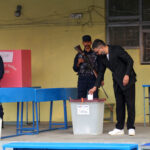
Nepal’s federal parliamentary elections on Thursday recorded the lowest voter turnout in 45 years, falling to just 58%. According to Election Commission officials, approximately 11.36 million of the 19.6 million eligible voters cast their ballots.
This figure marks a sharp decline from the 61% turnout in the 2022 House of Representatives elections and is a stark departure from the 70.9% participation rate seen during the 2022 local elections.
By comparison, the first general election in February 1959 saw a turnout of only 42.18%, followed by a 52% turnout in the 1981 National Panchayat elections. However, in the decades following the restoration of democracy, voter enthusiasm generally trended upward. Participation reached 65.15% in the 1991 elections, 61.86% in the 1994 mid-term polls, and 65.79% during the third parliamentary elections in May 1999.
The most significant peak in engagement occurred during the Constituent Assembly era, where turnout hit 61.7% in April 2008 and reached a historic high of 78.34% in November 2013. Subsequent federal elections saw a gradual decline, with 68.67% in 2017 and 61.41% in November 2022.
While the local level elections in May 2022 saw a robust 70.9% turnout, political analysts now point to a deep-seated disillusionment among the youth in a nation where the median age is only 25.
Economic instability, geographic barriers to polling stations, and general political fatigue—persisting since the drafting of the 2015 Constitution—have left many citizens feeling that their vote holds little power to enact change.
The mobility of the Nepali population further complicates the electoral landscape. Immigration Department data shows that air arrivals in February surged by 28% to 148,623, compared to 115,584 the previous year.
This spike was driven largely by migrant workers and students returning specifically for the March 5 vote, representing a much higher increase than the 3% growth seen in 2025. Despite this influx, the vast majority of Nepal’s estimated 4 million overseas citizens remained unable to participate.
This includes 2.5 million people working abroad, with 1.7 million concentrated in Gulf countries—specifically 700,000 in the UAE and nearly 400,000 in Saudi Arabia.
A primary hurdle for these citizens is the absence of external voting mechanisms. Unlike the 1967 National Panchayat election or the 1980 referendum, modern Nepal offers no provisions for postal or embassy-based voting.
For the large Nepali communities living in India, the United States, Australia, and Japan, the cost and logistical burden of traveling home to vote remain prohibitive. While political parties issued frantic calls for citizens to return to their home districts, many laborers cited job insecurity and high travel costs as insurmountable barriers.
The demographic shift appears to be accelerating rather than slowing down. Even as some returned to vote, 149,895 Nepalis departed the country in February alone—a 20% increase in outflows. This included a 33% jump in foreign employment permits, which surpassed 80,000 in a single month.
Between October and February, departures outpaced arrivals by 39,000, suggesting that for many Nepalis, the search for economic survival abroad has become a more urgent priority than participating in the domestic political process.

Susan Shrestha
View More PostsSusan Shrestha is a Europe-based journalist. He covers a wide range of topics, from local matters to global affairs. Shrestha previously worked as a reporter for Khasokhas in Nepal.