





‘We Survived, but Life Has Become Unbearable’: Flood-Ravaged Betrawati Awaits Resettlement


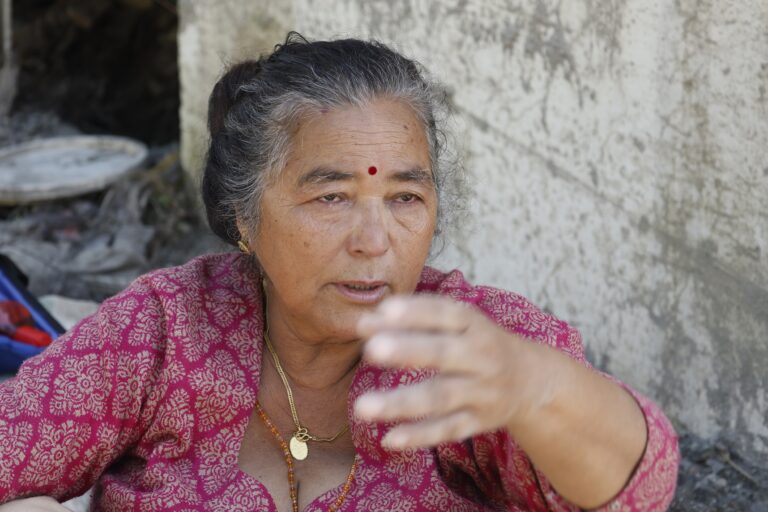
Mithu Dangol, 65, now lives in a rented home after floods buried her house and farmland. Her son, the family’s breadwinner, remains missing. “We survived, but life has become unbearable,” she says. Photo: Dipendra Dhungana/NepYork
BETRAWATI, Nepal — There was a time when visitors arriving in Betrawati found a bustling market town. Shoppers crowded its stores, and vehicles moved steadily along its roads. Straddling the boundary between Uttargaya Rural Municipality in Rasuwa and Bidur Municipality in Nuwakot, the settlement was a place of historical and religious significance, where daily life revolved around trade, farming and a close-knit community.
Betrawati was home to 299 households and a population of 1,256. More than 500 shops operated here. A school, a health post, ward offices and local government buildings served residents of surrounding settlements.
Looking for job?
Click hereToday, Betrawati is a different place.
On August 26, 2026, devastating floods in the Bhotekoshi and Trishuli rivers did more than alter the town’s appearance. They tore apart the lives of the people who lived here. Within minutes, the water swept away homes, businesses, farmland and community infrastructure built over decades. Some families lost relatives to the rivers. Others fled their homes to survive. For many, the place where they had spent their lives is now almost unrecognizable.
Betrawati was among dozens of settlements struck that morning by flash floods and debris flows along a 45-mile stretch of the Trishuli River in Nepal. The reported death toll in Nepal stood at at least 1,455, with another 5,285 people missing. The flood carried some victims’ bodies as far as 160 miles into neighboring India.
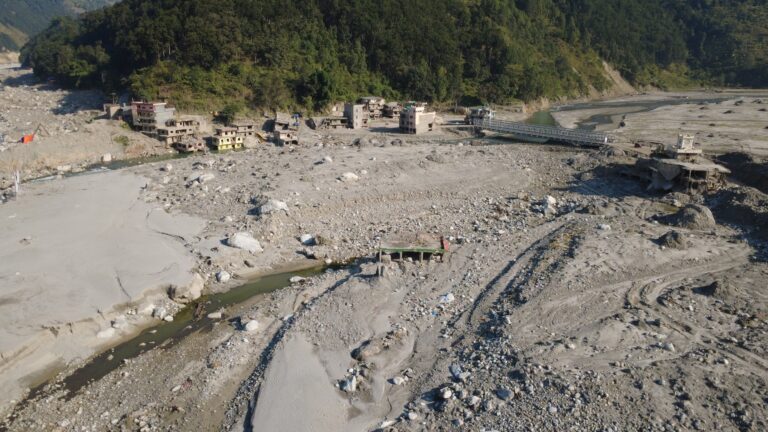
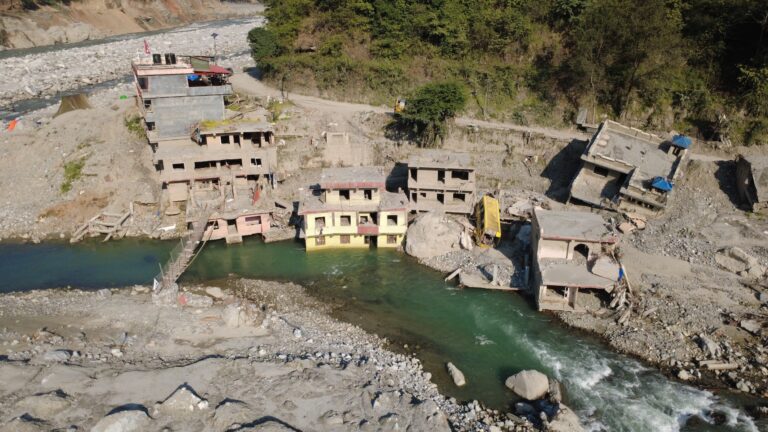
In Betrawati, the floods washed away most houses and shops or buried them beneath mud and rocks. Schools, a health post, two ward offices and two rural municipality buildings were damaged. Temples, religious sites and historic landmarks also suffered damage. The river, which once flowed through a channel roughly 30 meters wide, spread across more than 500 meters in some places.
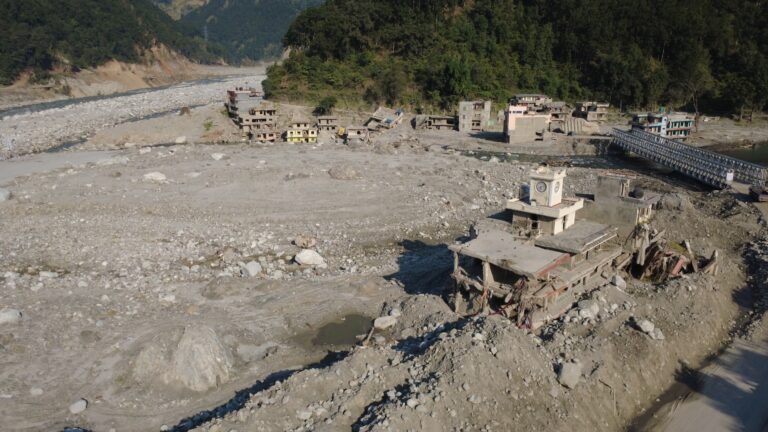
To understand the scale of Betrawati’s destruction, one need only look at how its geography has changed. The river has abandoned its old course and carved a new one. Piles of rocks and sand cover the sites of former homes. Farmland has become a stony riverbed. Even the old boundaries between roads and residential areas have disappeared.
Nearly two and a half months after the floods, the struggle in Betrawati was not yet about rebuilding. It was about clearing what remained.
Residents were searching for the places where their houses had stood. Some looked for foundations; others searched for buried belongings. Some families were still waiting for news of missing relatives.
At the edge of the wreckage, 65-year-old Mithu Dangol was moving sand and rocks, trying to dig out what remained of her home.
The tears had not stopped.
Ten Minutes’ Warning, a Lifetime of Pain
For Mithu, the memory of that day remains terrifying. During smaller floods in the past, people sometimes went to watch the river rise. This time, however, the sound and force of the water were different. Recognizing the danger, police officers used loudspeakers to urge residents to move to safety.
For many, the warning came too late.
Mithu was at home with her daughter-in-law and two grandchildren. The children were getting ready for school. No one imagined that the river could cause destruction on such a scale.
“In the past, when there were floods, people would go to the bridge to watch,” Mithu recalled. “But that day, the police were going around announcing, ‘A huge flood is coming. A massive surge of water is on its way. Please move somewhere safe.’”
The river had once been far from her house. Fields, open ground and a resting platform beneath a peepal tree stood between her home and the water. To reach the river, people had to cross that open land. She had never imagined that even a major flood could reach her house.
“There was so much open ground between our house and the river. There was a platform beneath a peepal tree. You had to cross all that land to get to the river,” she said. “Now the river is right here.”
Even the police officers issuing warnings were caught in the flood, she said. Some officers involved in rescue efforts were swept away.
“We found out only 10 minutes beforehand and called my daughter. I had just climbed the stairs from downstairs to the upper floor. Then I shouted to my youngest daughter, ‘Run, run! Go to Uncle Panchasute’s cowshed!’” she said.
Family members fled across terraced fields. Mithu believes trees near the house briefly held back some of the water, giving them time to escape. Without help from the police, she said, they might have been swept away, too.
“If the police hadn’t pulled us out, the flood would probably have taken us as well. We survived, but life has become unbearable.”
The water came so quickly that people barely had time to think about where to run or how to protect their families. Even the oldest residents of the community, Mithu said, had never witnessed such devastation.
“Where could anyone run in so little time? Even the elderly people around here say they had never seen anything like this in their lives. People didn’t have time to believe such a huge flood was coming and get away,” she said.
The force of the water did not simply sweep away homes. It separated families. Some people had no idea where their relatives had gone. Others could no longer identify the places where their houses once stood.
A Buried Home, a Missing Son
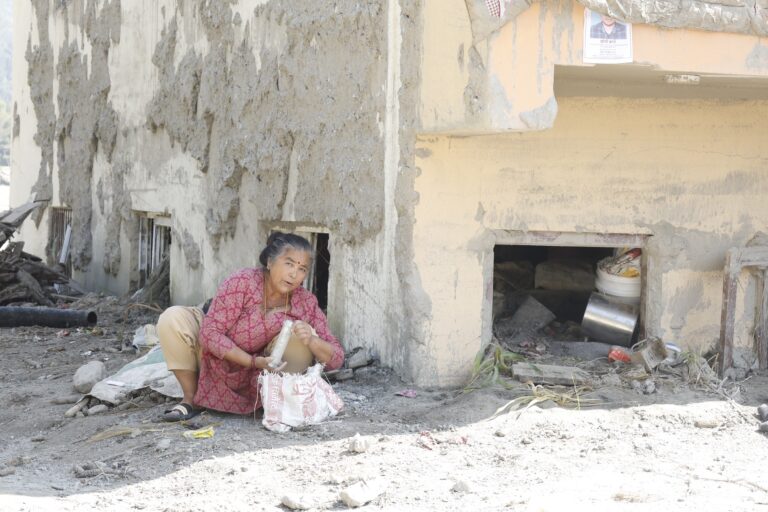
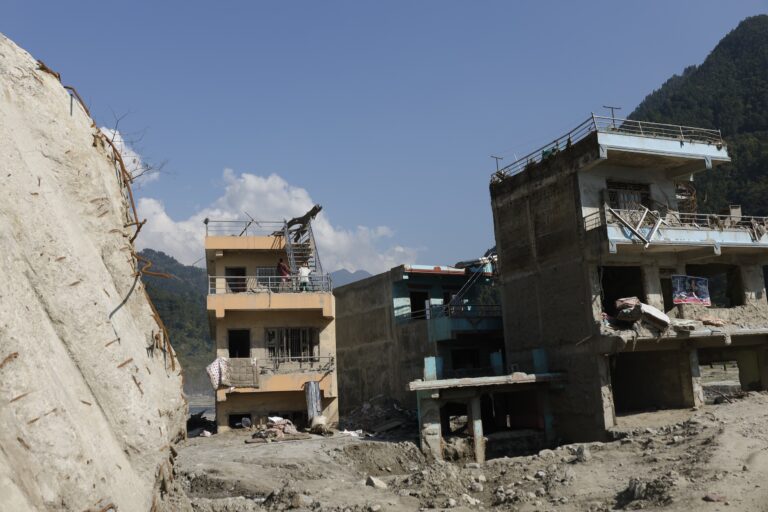
The flood did not completely demolish Mithu’s house. Its reinforced-concrete structure remains standing.
But it can no longer be called a home.
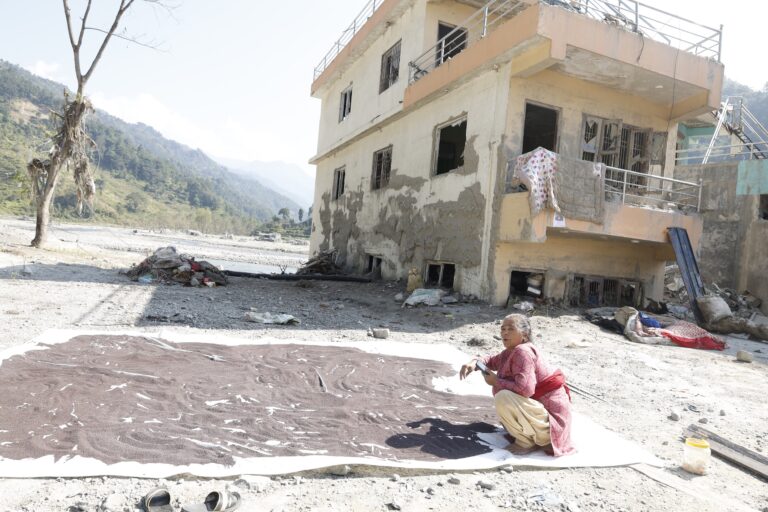
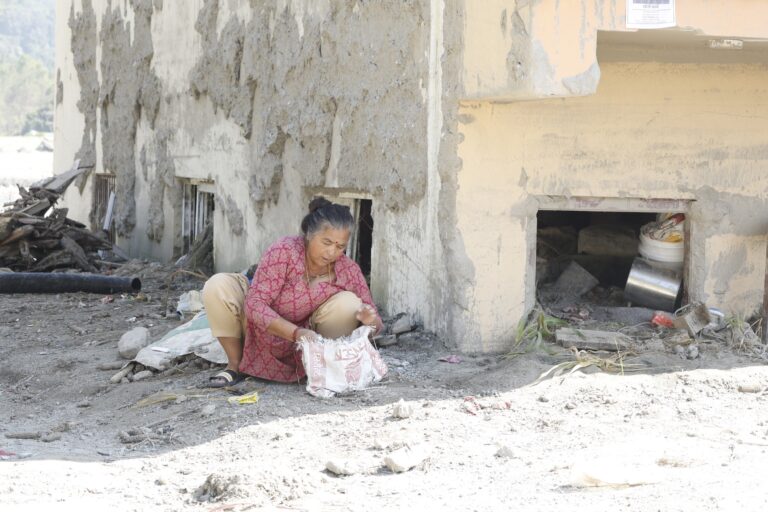
Sand, rocks and sludge have buried both floors. The mud packed inside the rooms has hardened like cement.
From the outside, the structure may appear intact, but it is uninhabitable. Windows, doors and other belongings have been damaged. Large logs, steel rods from hydropower facilities and equipment from a fuel station lie scattered around the property. Some of the logs came to rest on the roof.
Mithu and her daughter-in-law have tried to clear the mud themselves. But excavating two buried floors is far beyond what they can manage.
“For the past few days, my daughter-in-law and I have been going inside and struggling to pull a few things out,” she said. “None of it is usable.”
Among the buried belongings, they found several pathi of mustard seeds, a traditional unit of measurement. Nearly 70 days after the flood, Mithu had managed to recover the seeds and was drying them.
Yet the loss of her house and possessions is not her deepest pain.
Her 41-year-old son is missing.
He was the family’s main breadwinner and worked at a hydropower project. The household depended on his earnings. Since the flood, the family has received no definitive information about what happened to him.
“My 41-year-old son, the main pillar and support of our family, disappeared in this flood. He worked at a hydropower project,” Mithu said. “I heard there were 51 people there, but only one staff member was found. My son and all the others are still unaccounted for.”
She said her son had been farther upstream when the flood struck. The water caught him there, too. Since then, the family has been unable to establish his whereabouts.
For Mithu, his disappearance means more than the absence of a family member. The person who supported the household, the son she relied on in her old age and the foundation of the family’s future all vanished at once.
Other families nearby have suffered similar losses. Mithu said a mother and her 26-year-old daughter, who lived beyond the clock tower, were swept away. Their bodies were recovered 11 days later. Their house was also carried downstream and deposited near Mithu’s home.
She recalled another elderly man being swept downstream and deposited in a field.
Nearly 70 days after the disaster, memories of the missing — and uncertainty about their fate — continued to haunt families in Betrawati.
Once Landlords, Now Tenants
Mithu’s family once lived in its own home and rented out part of the building. Tenants operated a clothing and accessories shop there, providing the family with rental income.
Now their circumstances have been reversed.
Although the building remains standing, both floors are buried. The family cannot live there and is paying rent elsewhere.
“People used to rent space in my house. They had a clothing shop,” Mithu said. “Now we have to live in a rented place ourselves.”
For her, the reversal carries a bitter irony beyond the loss of a house. A family that once provided others with shelter and space to run a business must now depend on someone else for a place to live.
With their home uninhabitable, their farmland unusable and their breadwinner missing, the family’s financial situation has deteriorated. Paying rent and meeting daily needs leave little room to plan for a longer-term recovery.
Rocks Where Rice Once Grew
Mithu’s family once owned a large field that produced 40 to 42 muri of paddy a year, measured in traditional grain units. Farming helped meet the household’s food needs. Their house and land provided a measure of financial security.
That field no longer exists — at least not as farmland.
“We had a large field that produced 40 to 42 muri of paddy. The flood washed it all away and turned it into a riverbed,” she said. “Where there used to be rice, there are now only huge rocks and mud.”
She had hoped that restarting cultivation might at least help feed the family. But looking at the land now, even that prospect seems out of reach.
“We used to get 40 to 42 muri of paddy. It would have been something if we could grow even 15 or 20 muri now,” she said. “But we can’t even do that. It has all become riverbed — nothing but rocks.”
Some upland farmland near the house remains. But it has become overgrown, and the biggest obstacle is irrigation.
“What use is having land if you can eat only when it rains, and go without when it doesn’t?” she asked. “Even if you work hard to grow something, it dries up without water.”
The flooded fields cannot be restored simply by turning over the soil. They are buried under rocks and sand. With the irrigation channel also damaged or unusable, an immediate return to farming appears unlikely.
The flood took not only the family’s house and fields but also the livelihood they had relied on for years.
“The son who earned and fed us is gone. We have no home to live in. The relief we’ve received may feed us for a few days, but what happens after that?” she asked. “How do we survive? Who will support us?”
A Market Town That Must Shop Elsewhere
Betrawati was once an important shopping center for people across Rasuwa and nearby settlements. Residents came here for daily necessities and other goods.
“Our shops used to supply so many people from Rasuwa district. They got everything from here. They could buy whatever they needed right here,” Mithu recalled.
Now residents must travel to another market even for basic purchases. The old commercial bustle has disappeared. With shops, warehouses and homes swept away, local sources of income have vanished, too.
A town that once served as a center for household goods and trade is now struggling to secure basic services for its own residents.
Another Crisis for Those Who Survived
The outer structure of Mithu’s house survived, but it offers no safe shelter.
She said there were not enough workers or equipment to remove the large logs, steel rods from hydropower facilities and fuel station equipment scattered around the property, or the timber lodged on the roof. The house remains uninhabitable, and access around it is difficult.
After the flood, she heard promises that help would come to clear the house. The ward office, she said, was expected to assist with removing the debris. But that assistance had not materialized.
“I heard the ward would bring relief and arrange for the place to be cleared. I kept thinking they would come today or tomorrow, but no one came,” she said. “When we call, they say they are working on it. But where can we see that work?”
Mithu said a nongovernmental organization had given her 30,000 rupees, or about $200, after the flood. Around that time, she also tried to recover belongings buried inside the house. She washed and attempted to salvage the mustard seeds and other items she found.
But such assistance cannot resolve the larger problems of clearing the building, securing housing and supporting the family.
The river’s changed course has made the question of resettlement more complicated. Water and rock deposits now occupy places where homes and neighborhoods once stood. In some areas, old paths have disappeared.
Mithu said regular electricity and drinking water services were also unavailable in the settlement.
“If electricity and water were provided, other people would build houses here, too,” she said. “We would live here as well.”
With the River Closer, Returning Home Brings Fear
For Mithu’s family, returning home is not simply a matter of clearing debris. The river has changed course, raising a more troubling question: What would happen if another flood came?
The water once flowed far from the house, beyond fields, open ground and the resting platform beneath the peepal tree. Now it runs close by.
“There was so much open ground between our house and the river. There was a platform beneath a peepal tree. You had to cross that ground to reach the river,” she said. “Now the river is right here.”
She said fear of another flood would make it impossible to remain in the house during the monsoon. Even if people spent some daylight hours there, they would need to leave for somewhere safer in the evening.
“Before, even during the monsoon, we stayed at home all day. We would start feeling afraid only in the evening,” she said. “Now we can’t stay here during the rains at all. Even when it is time to sleep, we would have to stay awake.”
The flood destroyed more than buildings. It shattered residents’ longstanding sense of safety. Places once considered well beyond the river’s reach are now exposed to danger.
Mithu wants a home again. But she does not know whether it is still possible to live safely on the same site.
How Can $2,000 Build a Home?
Mithu has heard that the government plans to provide flood survivors with 300,000 to 400,000 rupees, or approximately $2,000 to $2,667. She does not believe that amount would be enough to resettle her family.
“What will 300,000 or 400,000 rupees do for people like us who have lost everything?” she asked. “Even a small corrugated-metal shelter can cost 600,000 to 1 million rupees — or more.”
She said she had heard of plans to help some families who owned land on the Nuwakot side build homes. But she complained that similar support had not reached the affected settlement on the Rasuwa side.
She hopes to find a place on higher ground near Nilkantha School. A small shelter there, she believes, could give her family a chance to begin again.
“If only someone could find us a place and build a small shelter,” she said. “We don’t need a big house. If we had somewhere to live, perhaps we could run a small shop and feed ourselves.”
So far, however, she said she had received no clear information about resettlement.
“No one comes to this neglected place of ours. There isn’t even a road,” she said. “What can I say about our ward representatives and leaders? At election time, they come door to door with folded hands, saying, ‘Namaste.’ But when we are in trouble, no one comes back.”
She alleged that people with political connections or influence receive attention while financially vulnerable families have no one to hear their concerns.
“It seems this society is only for those who can make themselves heard,” she said. “After my son was taken by the flood, everyone began looking down on us, too.”
Two Children’s Education and a Family’s Future
Mithu’s household now includes her youngest daughter, her 32-year-old daughter-in-law and two young grandchildren — a 9-year-old granddaughter and a 6-year-old grandson.
She also has another daughter with an intellectual disability. Since the disappearance of the family’s breadwinner, responsibility for their welfare has fallen on Mithu.
The flood took more than their home and possessions. It dismantled the financial structure that had sustained the family.
Her grandchildren’s schooling is another major concern. Some organizations offered to enroll the children in private schools after the flood, she said. But she fears they could be forced to leave if the family cannot keep paying the costs.
“With no one left to support us and our finances so weak, how could we afford to keep them in a private school?” she asked. “They might study for a week or two, only to have to come back because we couldn’t pay.”
What she wants is dependable support that would allow the children to continue their education.
“I wish someone would willingly help them study,” she said.
When she thinks about the family’s future, she returns to her son. Her daughter-in-law is only 32. Two small children need to be raised and educated. Her daughter also needs care.
“How will I feed them all now? How will I educate them? How will I raise them?” she asked. “The river took the one who earned for us.”
Searching for Safety Without Leaving Home Behind
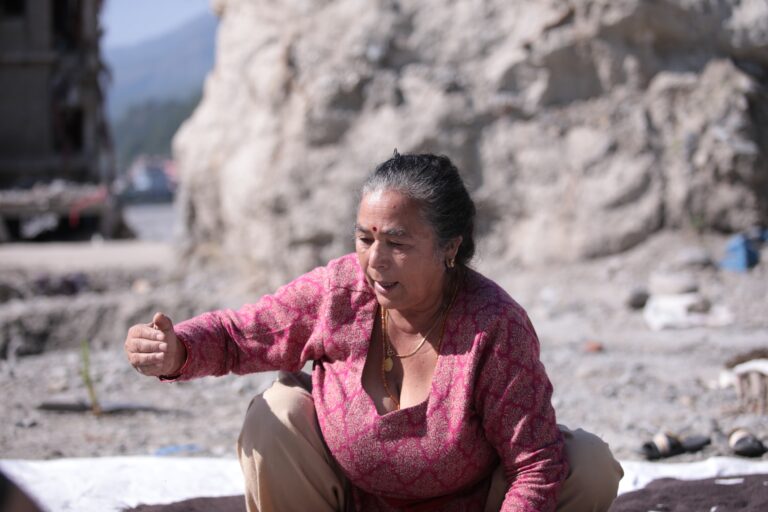
At 65, Mithu faces the prospect of starting over with little to build on. She has no usable farmland, lacks the physical strength for manual labor and has no place to open a small shop.
“At 65, I can’t farm. I don’t have the strength, and I don’t have the land,” she said. “My body can’t carry heavy loads or do physical labor. What am I supposed to do at this age?”
A small shop might offer a way to support the family. But that would require both a place to live and space to do business. She has neither.
Despite everything she has lost, she does not want to leave Betrawati.
Her home was here. Her fields were here. Her son’s life was rooted here. The family’s years of memories belong to this place. Betrawati is not simply an address; it is the ground on which they built their lives.
“The place where we poured our sweat and spent our lives was like heaven,” she said. “My heart won’t let me leave it. However stony and barren it has become, my heart is still here.”
Her son’s home, work and family history are bound to the same place.
“My son’s heart is here. Everything of his is here. Where can I go, leaving all of that behind?” she said. “Somehow, we will stay here. My heart is rooted in this soil.”
Yet she is troubled by the question of whether that same ground can ever be safe again.
“I survived the flood. But after surviving, even the thought of dying is frightening,” she said. “I wish the government would resettle people like us somewhere safe. But I cannot go far from this area.”
At night, the scenes return: frightened people, shouting and the scramble to escape. She cannot sleep. Worries about tomorrow and the wait for news of her son do not leave her.
Even in her deepest distress, she said, her grandchildren give her a reason to keep living.
“Many times, I have felt that I didn’t want to live anymore,” she said. “Then I think of my little grandchildren. I look at their faces and see my son’s face, and I want to live again.”
Life Amid the Ruins
Nearly 70 days after the flood, the list of work needed to restore life in Betrawati remained long.
Debris had to be cleared. Families without homes needed safe shelter. Drinking water and electricity had to be restored. Children needed to remain in school. Families stripped of their livelihoods needed a path back to self-reliance.
Harder still was finding answers for those who did not know what had happened to their missing relatives.
For Mithu, the immediate need is not simply a relief payment. It is safe housing, help clearing her home, land she can cultivate or another means of earning a living, and assurance that her grandchildren can continue their education.
She does not want to abandon her home community. But she does not know whether returning to the same place would be safe.
Her tears have scarcely dried since the day of the flood. Yet her worries extend beyond the hardships of old age. The futures of two young grandchildren, the life of her daughter-in-law, the care of her daughter with an intellectual disability and the wait for her missing son all weigh on her at once.
She does not know where the flood took her son. She does not know how much remains buried inside her house. She does not know whether crops will ever grow again where her fields once lay.
One thing she has managed to hold on to is her determination not to leave Betrawati.
But determination alone cannot keep her family safe. That will require secure resettlement, a sustainable livelihood and continued education for the children.
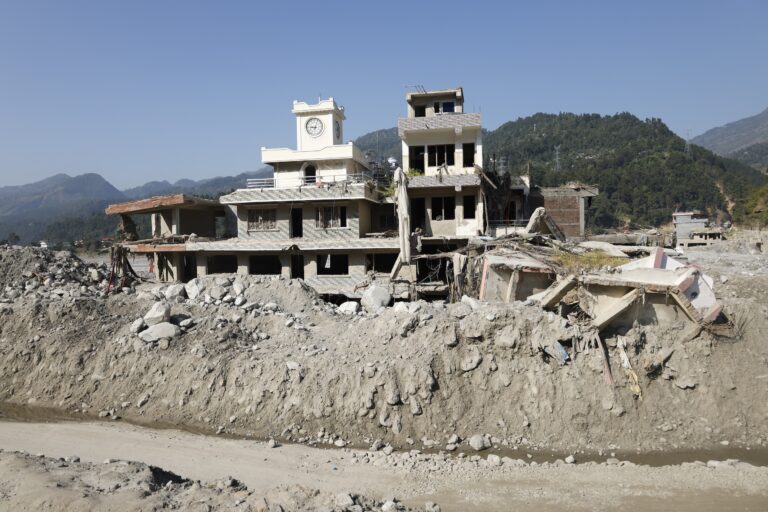
In a town once filled with the bustle of more than 500 shops, people now search for pieces of their past among rocks, sand and wreckage.
Mithu is one of them. She is still trying to recover belongings from her buried home. Still waiting for news of her son.
A woman who once rented out space in her own house so others could run a business is now a tenant herself. The fields that produced more than 40 muri of paddy are covered in rocks. Even the possibility of returning to her own home remains uncertain.
Her home may now be buried beneath stone and sand.
But for Mithu, Betrawati is still home.
(All dollar amounts are approximate, converted at an exchange rate of $1 to 150 Nepali rupees.)