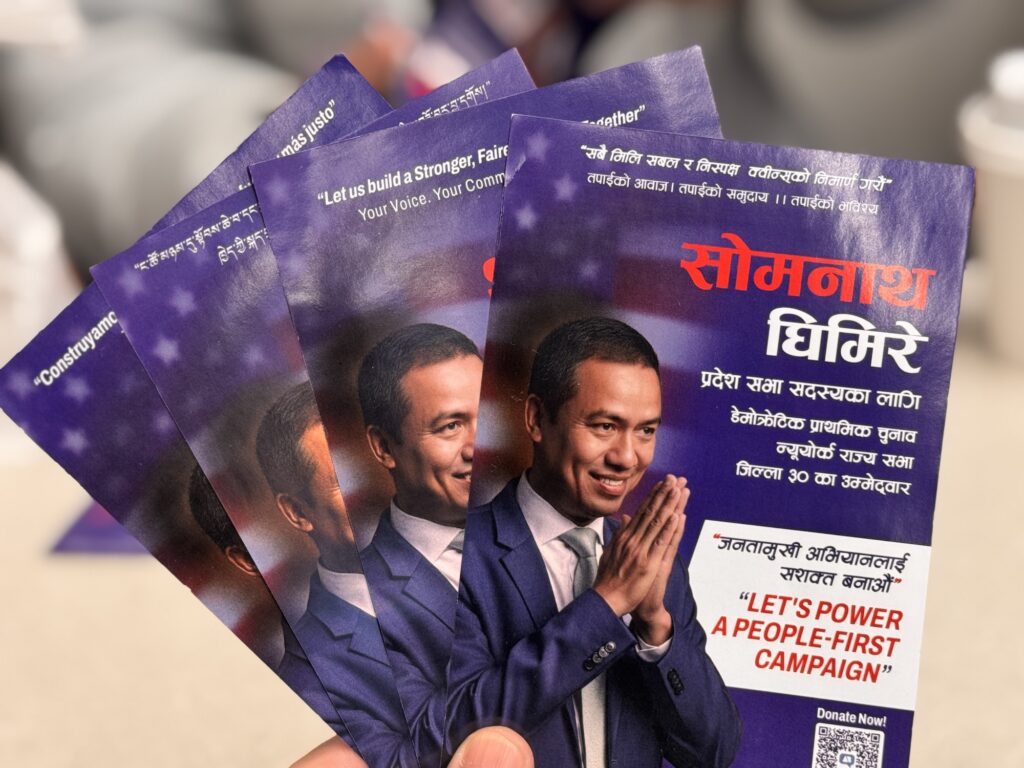
Somnath Ghimire, a Democratic candidate for New York State Assembly District 30, says his campaign is rooted in transforming years of grassroots community advocacy into state-level policy, with a focus on working-class residents, language access, affordable housing and public services.
Ghimire, who lives in Woodside and has long been active in community organizations, is running in the Democratic primary scheduled for June 23, 2026. The general election will be held Nov. 3, 2026. The seat is an open race this year, following incumbent Assemblymember Steven Raga’s announcement that he would not seek re-election to the Western Queens district.
Ghimire earned a high school diploma from Don Bosco School and a bachelor’s degree from Magadh University in 1995. His professional background includes work as a community advocate.
In an interview with NepYork, Ghimire said his candidacy is driven by a desire to translate his community experience into tangible results in Albany, particularly for low- and middle-income working families in Woodside and surrounding neighborhoods.
“My main commitment is to identify what resources and policies can be brought from the state to uplift these communities,” he said. “We will move forward together.”
Language Access and Representation
Ghimire highlighted his ability to speak more than half a dozen languages and his experience working on the 2020 U.S. Census as key strengths in reaching a diverse electorate in District 30.
He said language access remains a central issue for immigrant and minority communities, including Nepali Americans, who often remain underrepresented in mainstream systems.
“I see my primary role as ensuring language accessibility,” he said, adding that he plans to prioritize Nepali-language outreach.
Looking ahead to the 2030 Census, Ghimire said he aims to ensure accurate representation of the Nepali community by developing Nepali-language materials and outreach efforts to prevent undercounting.
“No one should be left out or undercounted,” he said.
Housing and Tenant-Landlord Balance
On affordable housing, one of his core campaign issues, Ghimire rejected criticism that his policies would favor landlords. He said his approach depends on accountability and fairness.
“If landlords are acting unfairly, we will take action and stand firmly for tenants’ rights,” he said. “But for responsible landlords, we need to understand their challenges and build a bridge.”
Ghimire said he plans to advocate for policies that foster cooperation between tenants and landlords while addressing systemic issues, including what he described as a trend of wealthy landlords becoming even wealthier. He said state-level regulation should help create a more equitable housing environment.
Education and Youth Mental Health
Ghimire said increasing funding for public schools and improving teacher training would be a priority. He noted that some schools lack adequately trained teachers in specific subject areas and said Albany funding should be used to strengthen teacher capacity.
He also emphasized inequities affecting South Asian students, saying schools serving these communities often lack equal access to resources. “These schools should be prioritized when allocating funding,” he said.
On youth issues, Ghimire pointed to a growing mental health crisis and proposed regular community sessions with mental health professionals, as well as integrating mental health education into high school curricula. He said he would push for a dedicated 30- to 60-minute mental health class in public high schools.
Health Care Access and System Reform
Drawing on his frontline work during the COVID-19 pandemic, Ghimire said improving access to timely and high-quality health care is a top priority. He highlighted long wait times in emergency departments, citing Elmhurst Hospital as an example, and proposed adopting a digital pre-appointment and queue transparency system.
“Instead of telling patients to wait indefinitely, we can create a system where they know their place in line in advance,” he said, comparing it to digital queue systems used in banks. He said health experts he consulted have responded positively to the idea and pledged to pursue it if elected.
Public Safety Strategy
Ghimire proposed what he called a “triangle model” for public safety, bringing together three groups: NYPD leadership, community leaders from diverse backgrounds, and elected officials.
He said the groups would hold mandatory monthly meetings to analyze crime data, identify high-risk areas, and develop targeted strategies.
“The goal is neighborhood safety and peace,” he said, adding that the model would include coordination with federal, city and state representatives.
Campaign Contrast and Primary Field
Ghimire is running against Shamsul Haque and Patrick Martinez in the Democratic primary. The winner of the June primary will face Republican candidate Brandon Castro in the November general election.
The primary opponents bring distinct professional backgrounds to the race. Haque, a retired NYPD internal affairs lieutenant commander who served 21 years on the force, is centering his platform on public safety reform and economic affordability, including co-sponsoring the NY4ALL Act. Martinez, a local marketing director, serves as a Democratic district leader and a member of Queens Community Board 2, and is running on a platform focused on infrastructure, climate resiliency, and transit improvements.
Ghimire noted that he announced his candidacy earlier than his opponents and questioned their level of engagement during the COVID-19 crisis.
“At a time when even protective equipment was scarce, I put my life at risk and worked on the front lines,” he said. “Where were they during that crisis?”
He added that competition is a healthy part of democracy but said voters should consider candidates’ records of service.
Voter Turnout and Outreach
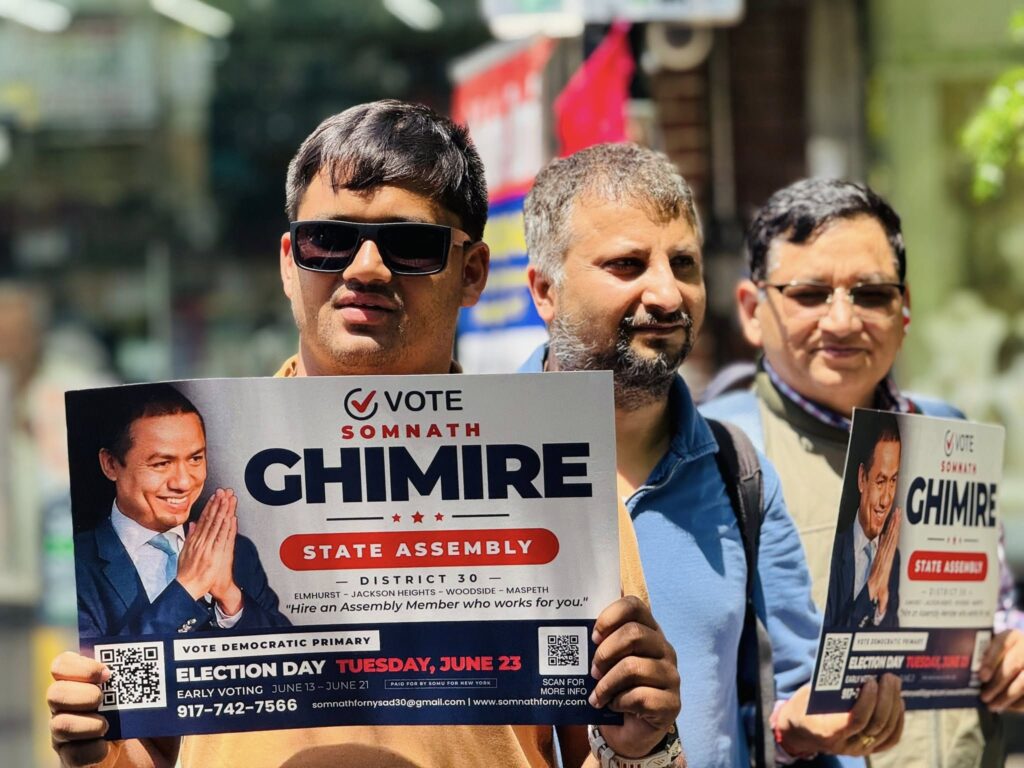
To address low voter turnout, particularly among South Asian and immigrant communities, Ghimire said his campaign is offering free transportation to polling sites.
He said 11 vehicles will operate continuously from the start of early voting on June 13 through primary day on June 23, transporting voters to and from polling locations.
He also stressed the importance of civic participation.
“Voting is the strongest foundation of democracy,” he said. “It is essential that everyone participates.”
Community Engagement and Commitments
Ghimire said voters he has met during the campaign have urged him to maintain his current level of engagement if elected. He cited his involvement in 117 food distribution programs, saying he personally attended each one without exception.
If elected, he said he plans to spend weekdays fulfilling official duties in Albany and return to the district every weekend to meet constituents.
“I will not be a leader who appears only during elections,” he said. “I will always be present in the community.”
Nepali Community Support
Ghimire, who is seeking to become the first Nepali-origin representative from a district with one of the largest Nepali populations in the United States, said community support has grown over time.
He estimated that initially around 45% of the Nepali community openly supported his candidacy. After his name appeared first on the ballot, he said support increased significantly, with 60% to 65% now openly backing him and others expressing quiet support.

Kishor Panthi
View More PostsKishor Panthi is the founder and editor-in-chief of Khasokhas and NepYork. He is the author of three books, “Kampan,” "UNTRANSLATABLE" and “Zero Mile.” He writes about social issues, immigration, and politics.