
A series of high-level visits by U.S. officials in April has drawn attention to Nepal’s evolving foreign policy and economic diplomacy following the formation of a new government.
U.S. Assistant Secretary of State for South and Central Asian Affairs Sameer Paul Kapur visited Nepal in the third week of April. Shortly afterward, Sergio Gor, special envoy to President Donald Trump for South and Central Asia, arrived in Kathmandu for a three-day visit. The back-to-back visits are being viewed as significant in understanding Washington’s interest in Nepal’s new political landscape.
Nepal’s recent general election, which produced a majority government, has attracted international attention. However, the government has yet to clearly articulate its foreign policy direction. A government policy document proposing to transform Nepal from a “buffer state” between India and China into a “vibrant bridge” was met with skepticism from diplomatic experts, and further clarity on foreign policy remains limited.
The visits have brought Nepal back into focus in South Asian regional diplomacy. While the United States initially sought to engage directly with Prime Minister Balendra Shah, that effort did not materialize. Instead, both Kapur and Gor held formal meetings with Foreign Minister Shishir Khanal, Finance Minister Dr. Swarnim Wagle, and Rastriya Swatantra Party (RSP) Chairman Rabi Lamichhane.
Kapur’s Visit and Discussions
During his visit, Kapur discussed strengthening Nepal-U.S. bilateral relations, with a focus on investment promotion, economic reforms, good governance, and infrastructure development. The talks also explored new areas of cooperation between the two countries.

Kapur said Nepal-U.S. relations have historically been strong and expressed confidence in expanding cooperation. He noted that the U.S. administration and public view Nepal’s reform agenda positively. The U.S. Embassy in Kathmandu also said discussions focused on deepening the bilateral partnership and expanding commercial ties.
Gor’s Visit Raises Questions
Although this was Gor’s first visit to Kathmandu, he had previously established contact with RSP leadership. On April 25, he congratulated Lamichhane by phone following the party’s electoral success.
The U.S. Embassy said in a social media post that Washington looks forward to working with Nepal to strengthen economic cooperation. However, Gor’s visit raised questions after he was unable to meet Prime Minister Shah, despite attempts from his side, according to sources.
In meetings with Foreign Minister Khanal, Gor emphasized expanding trade and advancing initiatives under the Millennium Challenge Corporation (MCC). The embassy described the discussions as constructive and productive.
Gor has also been active across the region, meeting leaders in Bangladesh, Bhutan, Sri Lanka and the Maldives. He met Bhutan’s King Jigme Khesar Namgyel Wangchuck and Prime Minister Tshering Tobgay, as well as Indian Prime Minister Narendra Modi.
Some analysts see the missed meeting with Nepal’s prime minister as a lost diplomatic opportunity, while others interpret it as part of a new diplomatic approach under Shah.
Nepal’s acting ambassador to the United States, Sarad Raj Aran, described the visit as focused on economic cooperation and strengthening ties with the new government, rather than geopolitics. He said U.S. engagement in countries like Bangladesh and Sri Lanka has centered on post-transition relations, while in Bhutan it has emphasized human rights.
Aran noted that Nepal has received favorable tariff treatment from the United States but has not fully utilized it. “Nepal has some of the lowest tariff rates in South Asia but has not been able to take adequate advantage,” he said.
He also pointed to the expiration of duty-free access for 77 Nepali products under the Nepal Trade Preference Program, which ran from 2016 to Dec. 31, 2025, as a missed opportunity. The program was introduced by the U.S. Congress to support Nepal’s economy after the 2015 earthquake.
Visa and Immigration Concerns
The United States has recently tightened visa policies for Nepali citizens. Since January, Nepali applicants for visitor visas have been required to post bonds, and the U.S. Embassy has stopped issuing multiple-entry visitor visas. Immigrant visas have also been suspended, affecting those awaiting employment-based and family-based green cards, as well as Diversity Visa applicants.
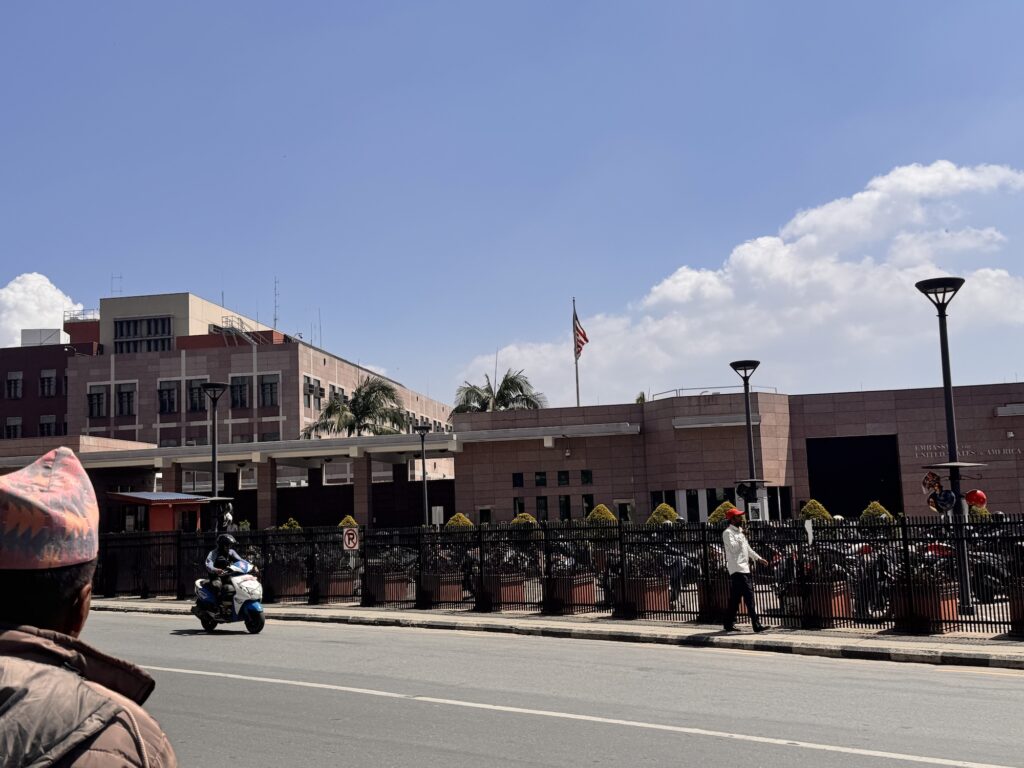
Within the United States, enforcement has increased, with higher deportation rates in recent months. The Trump administration has also revoked Temporary Protected Status (TPS) for Nepalis.
Despite these developments, visa and immigration issues were not raised during the high-level meetings, according to sources at Nepal’s Ministry of Foreign Affairs. “If we fail to raise our concerns at high-level meetings, we risk being in a position where we must accept whatever the U.S. decides,” a ministry source said.
Aran, however, said visa issues are handled at the consular level and are not directly tied to bilateral relations. He attributed stricter policies to past visa misuse, noting that citizens from about 50 countries face similar requirements.
In fiscal year 2024, the overstay rate for Nepalis on visitor visas was 3.12%, while the rate for student visas was 10.25%. The visitor visa overstay rate declined compared to 2023, though some countries with higher rates have not been subjected to bond requirements.
Diplomatic Signals
Analysts say the recent visits indicate growing U.S. interest in understanding Nepal’s policy direction under its new government. While the engagements appeared focused on economic cooperation and reforms, the broader regional context suggests strategic considerations as well.
How Nepal balances its relations with neighboring India and China is likely to shape the future trajectory of U.S.-Nepal ties.

Dipendra Dhungana
View More PostsDipendra Dhungana is a journalist based in Kathmandu with over a decade of experience in photojournalism. His work has been featured in numerous national and international outlets, showcasing the stories and resilience of the Nepali people. He is also a contributing journalist for NepYork.

