



Employment-Based Green Card Categories Remain Largely Stable, September Visa Bulletin Shows


Exterior of the U.S. Department of State Harry S. Truman Building, Washington, D.C. (Official State Department photo by Linda D. Epstein)
The U.S. Department of State released its September 2026 Visa Bulletin, reflecting slight adjustments and continued stability across employment-based immigrant visa categories as Fiscal Year 2026 nears its conclusion on Sept. 30.
U.S. Citizenship and Immigration Services has not yet announced whether applicants seeking employment-based green cards from inside the United States should use the Dates for Filing chart or the Final Action Dates chart for September. For August, USCIS directed applicants to use the Final Action Dates chart. Under that guidance, individuals can submit Form I-485, Application to Register Permanent Residence or Adjust Status, only when their priority date is current under the applicable final action cutoff.
The State Department officially capped the worldwide employment-based preference limit for Fiscal Year 2026 at 186,317. Under Section 202 of the Immigration and Nationality Act, the annual per-country limit is set at 7% of the combined preference total, establishing a base per-country cap of 28,862, which can reach 29,136 when accounting for unused carryover numbers.
According to the September bulletin, employment-based first-preference (EB-1) and second-preference (EB-2) categories remain current for applicants from most countries, allowing eligible individuals to pursue green cards without cutoff delays.
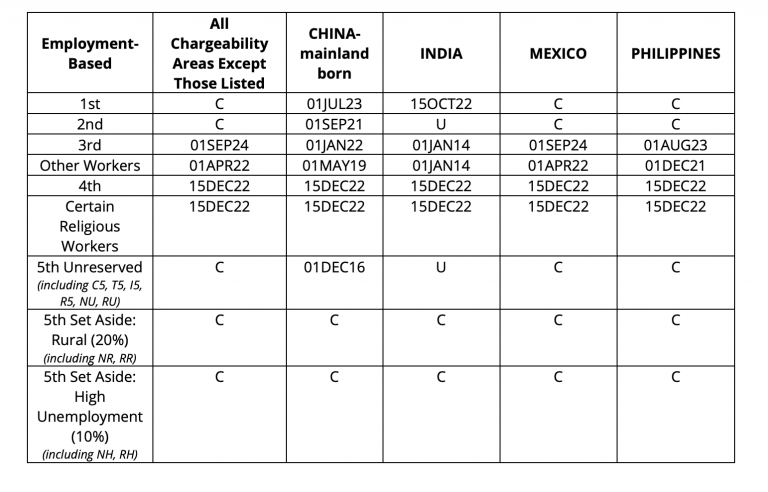
However, backlogs persist for high-demand countries. The EB-2 final action category for India remains listed as unavailable, while mainland China held steady at Sept. 1, 2021. In the EB-1 category, China remained at July 1, 2023, and India at Oct. 15, 2022. Federal officials warned that heavy demand could force retrogression or make the EB-1 category unavailable for India before the fiscal year ends.
In the employment-based third-preference (EB-3) category for skilled workers, final action dates for most countries, including Nepal, held firm at Sept. 1, 2024. Mainland China remained at Jan. 1, 2022. India held at Jan. 1, 2014, and the Philippines remained at Aug. 1, 2023.
The EB-3 category for other workers held at April 1, 2022, for the general chargeability areas and Mexico, while China remained steady at May 1, 2019. Cutoff dates for India and the Philippines stood at Jan. 1, 2014, and Dec. 1, 2021, respectively.
Fourth-preference cases (EB-4), including special immigrants and religious workers, advanced by two months to Dec. 15, 2022, across all chargeability areas.
Under the fifth-preference (EB-5) category, set-aside visas for investments in rural areas, high-unemployment areas, and infrastructure projects remained current worldwide. The unreserved EB-5 category also remained current for most countries, while China held at Dec. 1, 2016, and India remained unavailable.
The release follows a major legal ruling involving overseas consular operations. On Friday, U.S. District Judge Jeannette A. Vargas in Manhattan struck down a Jan. 21 State Department policy that had suspended immigrant visa issuances for nationals of 75 countries, including Nepal. Vargas ruled that the restriction violated federal immigration law, vacated the policy, and ordered affected cases to be returned to consular officers for further processing.
State Department officials noted that while recent cutoff advancements were intended to maximize the use of available visa numbers before Sept. 30, retrogression or category unavailability remains possible if applicant demand exceeds statutory caps.