



Data Shows Only 31.9% of Nepali ICE Arrestees Had Criminal Charges or Convictions

A female ICE ERO officer holds up a badge. (ICE)
For more than a year, senior Department of Homeland Security officials have cited a single statistic as proof that Immigration and Customs Enforcement is targeting the most serious threats: roughly 70% of its arrests involve people charged with or convicted of crimes in the United States.
“Nearly 70% of ICE arrests are illegal aliens who are charged with or convicted of a crime in the United States,” DHS Deputy Assistant Secretary Lauren Bis said in a March 3, 2026, statement.
On Dec. 8, 2025, the department made a similar claim: “70% of ICE arrests are of criminal illegal aliens charged or convicted of a crime in the United States—this statistic doesn’t even include foreign fugitives, gang members, terrorists, and human rights abusers.”
Those figures have become a cornerstone of the Trump administration’s public defense of its expanded interior enforcement campaign. Yet a closer look at detailed arrest records for one nationality, combined with a broader snapshot of who is currently held in ICE custody, paints a more complicated picture — showing that large shares of those swept into the system have neither criminal convictions nor pending U.S. charges.
According to data compiled and processed by the Deportation Data Project, ICE arrested 388 Nepali nationals from February 2025 through February 2026, covering the first 13 months of the current administration. ICE’s internal records show that only 53 of those arrests involved people already convicted of crimes, while another 71 involved individuals with pending criminal charges. Combined, that amounts to 124 people, or about 31.9% of the total.
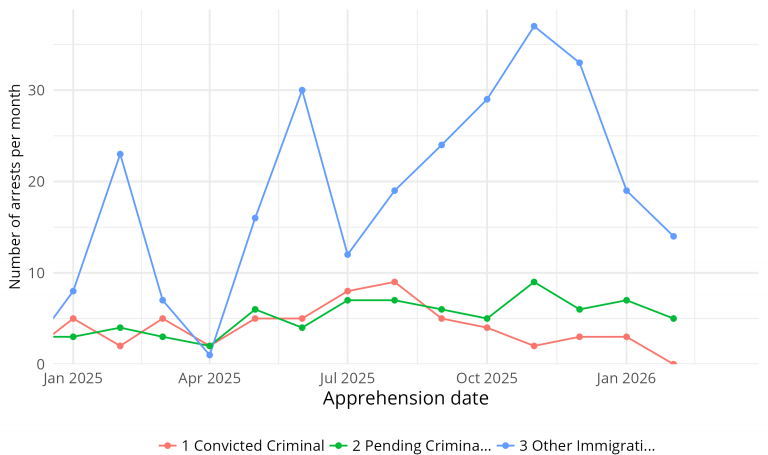
The remaining 264 arrests — roughly 68% — were classified solely as civil immigration violations. Fewer than 1 in 3 Nepali people arrested by ICE had either a conviction or pending charges on their record at the time of arrest.
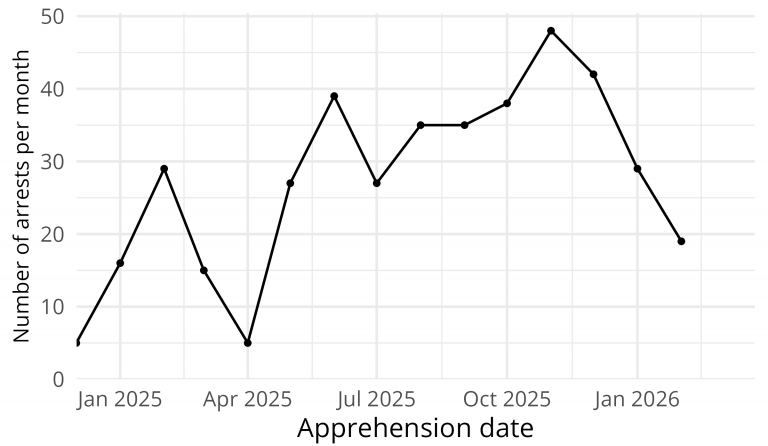
The monthly pattern of those arrests fluctuated but never approached the 70% criminal threshold cited by DHS. Arrests of Nepalis ranged from a low of five in April 2025 to a high of 48 in November 2025. The full monthly breakdown was 29 in February 2025, 15 in March, five in April, 27 in May, 39 in June, 27 in July, 35 in August, 35 in September, 38 in October, 48 in November, 42 in December, 29 in January 2026 and 19 in February 2026.
Demographically, the group was overwhelmingly male: 370 men, 17 women and one person listed as unknown. Of the 388 total, 174 had final removal orders, 195 did not yet have final orders, 19 had an unknown status, and 156 have been deported to Nepal.
A separate, nationwide look at ICE detention facilities points in the same direction. The Transactional Records Access Clearinghouse, or TRAC, at Syracuse University reported that as of July 11, 2026, 46,436 of the 65,765 people in ICE detention — 70.6% — had no criminal conviction. TRAC noted that many of those with convictions were linked only to minor offenses, including traffic violations. Of the overall detained population, 58,231 people (89%) were held by ICE itself, while 7,534 (11%) were detained by Customs and Border Protection.
Where DHS has repeatedly asserted that nearly 7 in 10 ICE arrests involve people with criminal charges or convictions, the Nepali arrest data shows the inverse: roughly 7 in 10 involved only immigration violations. And across the broader detained population tracked by TRAC, more than 7 in 10 had no criminal conviction.
One analysis of more than 1.6 million ICE arrests spanning 2015 through early 2026 found that the conviction rate among arrestees fell to about 34% during the first 14 months of Trump’s second term — near a 10-year low — even as average daily arrests more than tripled from the pre-inauguration baseline.
Trump Administration Deports Around 800 Nepalis
During the first 18 months of the Trump administration, the U.S. deported more than 800 Nepali nationals. However, immigration officials noted that not all of those removed were arrested by ICE during the current administration; many had received final orders of deportation in previous years or had overstayed their legal status long before being processed for removal.
The peak occurred in January 2026, when 101 Nepalis were deported, including a single day in which a charter flight returned 80 individuals—79 men and one woman—directly to Kathmandu. This high volume continued into February 2026 with 95 deportations via chartered flights, followed by 43 in March 2026.
By April 2026, U.S. authorities deported another 45 Nepalis on a single charter flight to Kathmandu, sparking widespread concern within the Nepali community. However, deportations dropped significantly in May 2026 to just 15 individuals, with no charter flights utilized; all deportees arrived on regular commercial flights instead. In June, nine Nepalis were deported.

A majority of recent deportees originate from western districts of Nepal, including Dang, Rukum, Salyan, and Banke. Many had initially entered the U.S. without a visa.
Policy changes under the Trump administration have heightened uncertainty. Temporary Protected Status (TPS) for Nepal formally ended in August 2025, affecting thousands of Nepalis who relied on the designation for work authorization and protection from deportation.
Immediately following these policy shifts, late 2025 saw high enforcement numbers, with 80 Nepalis deported in November and 98 removed in December—including a single day in December 2025 when 75 Nepalis (69 men and six women) were deported at once.
DHS Features 10 Nepalis on “Worst of the Worst” Registry
Amid ongoing scrutiny over its arrest demographics, the Department of Homeland Security (DHS) announced that total arrests displayed on its “Worst of the Worst” website have topped 40,000 nationwide. The database was launched on Dec. 8, 2025.
DHS has featured 10 Nepali nationals on the list, including three recently added entries. The development has heightened anxiety within the Nepali community in the United States.
The latest additions include Shankar Karki of Harrisburg, Pennsylvania; Tanka Parajuli of Dallas, Texas; and Prasiddha Baruwal of Bridgewater, Massachusetts. According to the DHS website, Karki is listed on fraud-related charges, Parajuli on dangerous drug charges, and Baruwal on arson of a public building and robbery-related charges.

The database also features seven other Nepali nationals arrested in various states during previous updates. The entries list Rikesh Thapa of Oakdale, Louisiana, on wire fraud charges; Nabin Shah of Fort Worth, Texas, on fraud, assault, and larceny-related charges; Tekan Kandel of Greeley, Colorado, on false imprisonment of a minor and sexual exploitation charges; Ratul Singh of Dallas, Texas, on robbery charges; Sayanam Ghimire of Elmhurst, New York, on sexual assault charges; Anil Pantha of Dallas, Texas, on enticement of a minor through telecommunications; and Santosh Darjee of Phoenix, Arizona, on drug, identity theft, and vehicle theft charges.
In a statement, DHS Assistant Secretary Lauren Bis said the latest additions include “murderers, pedophiles, rapists, arsonists, drug traffickers, kidnappers, violent assailants, and gang members.” She added that the Trump administration remains focused on transparency as well as arresting and deporting individuals living in the country illegally.
The agency stated that the website allows visitors to search through a subset of individuals arrested across all 50 states. Criminal histories listed on the site include homicide, arson, rape, molestation of a minor, burglary, terroristic threats, armed robbery, kidnapping, assault, fraud, and larceny, according to DHS.