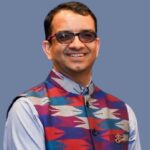
Maryland state Del. Harry Bhandari has built a strong political profile since making history with his first election in 2018 and securing reelection by a wide margin in 2022, while quietly dedicating himself to a deeply human mission beyond politics.
Bhandari, a Nepali American lawmaker, has played a significant role in state policymaking over the past seven years. He previously served as chair of the Joint Asian American Pacific Islander Caucus and currently leads the Land Use and Zoning Subcommittee, where he has focused on making housing more accessible and affordable in Maryland.
His leadership has positioned him among prominent public officials, becoming the first Nepali to reach such a level in U.S. politics. Alongside his political career, Bhandari holds an academic background, having studied at Johns Hopkins University and earned a Ph.D. from the University of Maryland, Baltimore. He is also involved in teaching.
Yet beyond his public office, Bhandari is widely known within the Nepali diaspora for his hands-on humanitarian work, particularly in assisting families during times of crisis. His phone rings constantly with calls from Nepalis across the United States seeking help.
“Sometimes I am on the phone until 2 a.m., working to resolve people’s problems,” Bhandari said.
One of the most emotionally demanding aspects of his work involves assisting with the management and repatriation of the remains of deceased Nepali nationals. He has spent considerable time supporting grieving families through complex legal and logistical processes.
“I have gone to airports more often to receive and send bodies than to welcome people,” he said.
Bhandari has helped resolve 436 complex cases, coordinating the management of more than 450 deceased individuals. Of those, nearly 100 bodies were repatriated to Nepal after completing legal and administrative procedures.
“Every death is difficult, and behind each body there is a painful story,” he said.
During the COVID-19 pandemic, Bhandari faced particularly challenging circumstances, including identifying Nepali individuals among unclaimed bodies transported in trucks.
“Bodies arrived loaded in trucks with tags on their feet. It was extremely difficult to identify which ones were Nepali and to find their details,” he recalled.
He noted that while Nepali cultural and religious practices emphasize swift funeral rites, U.S. legal requirements often delay the process.
“We are in a hurry, but funeral homes and law enforcement must complete their paperwork. This requires patience,” he said.
The process includes obtaining death certificates, verifying next of kin, and coordinating across jurisdictions. In some cases, when no family member claims a body in time, it is transferred to an anatomy board, a situation Bhandari described as deeply distressing.
Funeral procedures in the United States can be expensive. Through his political connections and coordination, Bhandari has helped reduce costs in nearly half of the cases he handled, easing financial burdens for affected families. In some instances, he has also worked with nonprofit organizations to facilitate insurance payouts for families in Nepal.
Originally from Parbat, Nepal, Bhandari has also introduced and helped pass 24 bills in the Maryland legislature focused on consumer protection, access to health care and community welfare, including issues affecting immigrant and minority communities.
Despite his legislative achievements, Bhandari says his goal remains simple: ensuring that no Nepali dies abroad without dignity.
“One Nepali should care for another and stand together in times of hardship,” he said.
Bhandari said the sense of fulfillment he gains from helping grieving families continues to motivate his work.
“The satisfaction that comes from humanitarian service is the greatest satisfaction in life,” he said.

Girija Adhikari
View More PostsGirija Adhikari is a Nepali journalist, author, and press freedom advocate with over two decades of experience. He has worked with leading Nepali radio stations and publications, authored several books and poetry collections, and received top honors, including the Janasewa Shree award from the Government of Nepal. A former central committee member of the Nepal Press Union, he continues to champion independent journalism.