The American dream continues to draw thousands of Nepalis to the United States, but limited access to legal pathways has pushed many to enter or remain in the country without authorization, leaving them vulnerable to deportation.
No clear official data
The Government of Nepal does not have verified data on how many Nepalis are living in the U.S. without legal status. According to a report by Nepal’s National Human Rights Commission, the Nepali Embassy in Washington, D.C., has also said no authenticated figures are available.
However, citing community estimates, the embassy projected that about 5,000 Nepalis were living without legal status in fiscal year 2022-23. The number rose to 7,000 in 2023-24 and is estimated to have reached 9,000 in 2024-25. The embassy has not clarified what categories of migrants are included in these figures.

More broadly, when counting Nepalis with pending asylum applications and those who have received deportation orders but remain in the U.S., the number approaches 18,000. Including visa overstays and those who entered without inspection — particularly via the U.S.-Mexico border — the figure likely exceeds 20,000, nearly double the embassy’s estimate.
Asylum backlog and court cases
Data obtained by Khasokhas through the Freedom of Information Act show 5,702 pending asylum applications filed by Nepalis with U.S. Citizenship and Immigration Services.
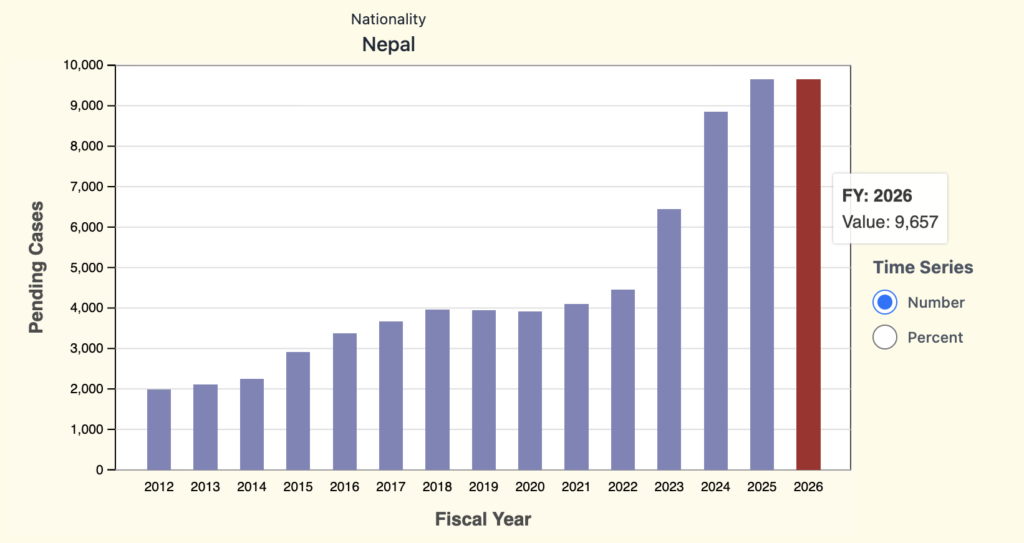
As of March 2026, an additional 9,657 immigration cases involving Nepalis — including asylum claims — were pending in U.S. immigration courts. Combined, more than 15,000 Nepalis currently have asylum-related cases awaiting decisions.
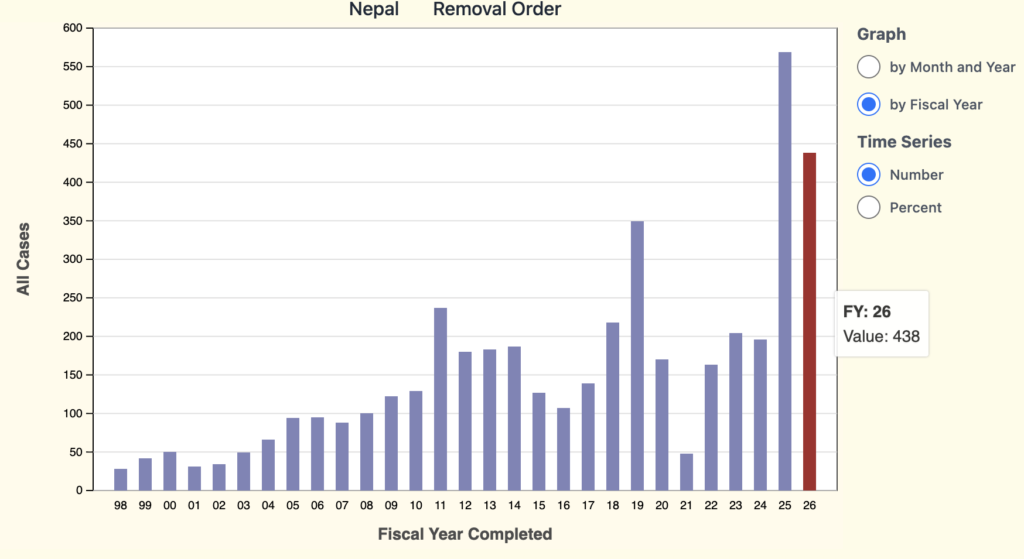
Since 1998, U.S. immigration courts have decided 17,708 cases involving Nepalis. Of those, 4,443 resulted in removal orders, while 757 individuals were granted voluntary departure.
Deportations and enforcement trends
U.S. Immigration and Customs Enforcement (ICE) data released last year indicated that 1,365 Nepalis remained in the U.S. despite receiving final removal orders.
At that time, 3,449 Nepalis had been ordered removed and 608 had been granted voluntary departure. Between fiscal years 2025 and March 2026, an additional 1,007 Nepalis received removal orders and 149 were granted voluntary departure.
From 2016 through March 2026, 2,601 Nepalis were issued removal orders. Earlier data show that between 2013 and 2022, 584 Nepalis were deported and 312 were returned. Between 2003 and 2012, 436 deportations were recorded.

During the final years of the Biden administration (fiscal years 2024 and 2025), 72 Nepalis were deported through ICE.
According to Department of Homeland Security records, nearly 1,200 Nepalis had been deported before the current Trump administration took office in 2025. Since January 2025 through April 2026, more than 760 Nepalis have been deported.
Separate data indicate that around 2,500 Nepalis who have already received removal orders may still be living in the United States.
Risky journeys and smuggling routes
Economic hardship, unemployment and uncertainty about the future continue to drive migration. Many Nepalis pay large sums to smugglers to reach the United States through irregular routes.
The National Human Rights Commission reports that most undocumented Nepalis entered through Mexico. The journey typically spans more than a dozen countries and involves a combination of buses, planes, trucks and boats.

A common route begins in Nepal and passes through India, Russia, Spain, Bolivia, Peru, Ecuador, Colombia, Panama, Costa Rica, Nicaragua, Honduras, Guatemala and Mexico before reaching the United States. The journey can take weeks and includes dangerous stretches such as the Darién Gap between Colombia and Panama.
U.S. Department of Homeland Security data analyzed by Khasokhas show that more than 9,000 Nepalis entered the U.S. without visas via Mexico during President Joe Biden’s tenure, compared with 1,850 during the previous Trump administration.
In the 24 months after October 2022 alone, 6,830 Nepalis entered without visas. In just October and November 2024, 740 Nepalis were encountered at the border — a figure that excludes those who evaded detection.
Crime and deportation
The number of Nepalis deported after criminal convictions has also increased. According to the report, 35 Nepalis were deported in 2023, rising to 68 in 2024 and 220 in 2025.

Following stricter immigration enforcement under President Donald Trump’s second term, deportations have accelerated. In the first four months of 2026 alone, 320 Nepalis were deported, according to Nepal’s Department of Immigration.
Monthly figures show 101 deportations in January, 130 in February, 43 in March and 46 in April.
Additional reporting from New York.

Suraj Ghimire
View More PostsSuraj Ghimire is a Nepali journalist based in Kathmandu. He focuses on political, social, migration, and international issues. He has also worked with various national television networks in Nepal.