On the occasion of World Press Freedom Day, Khasokhas organized a Press Freedom Walk in New York before the formal anniversary program began. The walk, which started from 77th Street and 37th Road in Jackson Heights and ended at 77th Street and 37th Avenue, marked the lead-up to Khasokhas’s 14th anniversary celebration. Journalists and members of the community participated in the walk, which was organized by Khasokhas with support from Mithila Center USA. The formal anniversary program began shortly after the walk reached the venue.

Here is the full transcript of the program:
Suresh Shahi, Moderator: It’s been 14 years now. It’s been a long journey, but at the same time, there is still so much more to do. We have a long way to go. I’ll keep this brief because our Editor-in-Chief is going to talk more about how we started, what we’re doing now, and our plans. I’d like to thank everyone again. We have such wonderful guests here today, so I don’t want to take up too much of your time. I’d now like to invite our Editor, Deepak Pariyar, to come up and welcome you all. Thank you.

Deepak Pariyar: Thank you. On behalf of the Khasokhas team, I would like to extend a very warm welcome to all the guests attending our 14th-anniversary celebration—including our distinguished guests of honor, our readers, listeners, and the eminent personalities joining us from various fields.
For a long time, we have dedicated our voices and our writing to the right to information and the protection of the rights and interests of the Nepali diaspora. Living abroad, we have continued to strengthen our work and our message in favor of social justice for the Nepali community, standing firmly against discrimination, injustice, and oppression. We have used our platform to cover various sectors, always keeping the common man at the center of our thoughts. Our goal is to transform Nepali society, guide it toward a positive path, and foster a deeper connection of love, kindness, and shared ideas among all Nepalis.

Under the leadership of our respected Editor-in-Chief, Kishor Panthi, we have been able to organize and refine this mission. As our team and I continue this incredible journey, I first want to express my heartfelt gratitude to Kishor Panthi. We look forward to moving ahead with even more dedication and better organization in the future.
Holding your love and support in the highest regard, I once again welcome and greet you all. Thank you.
Suresh Shahi: Before we move forward, I would like to request a moment of silence to honor the journalists who lost their lives in the line of duty.
We also have several members of the Khasokhas family who are no longer with us. We remember them today, and I am certain they are with us in spirit, as they were there when this journey first began—specifically Shan Khadka, Robin Jha, and Ashish Khanal. Please stand for a moment as we offer our thanks and prayers for them.
A moment of silence…
This is an incredible event that we have all been looking forward to. It took a great deal of hard work, but we made it happen thanks to your unwavering support. Today, we are launching a special edition magazine. While we may not print this continuously—perhaps transitioning to an annual or biennial format—we are proud of this milestone. I’m sure many of you already have a copy in your hands; we wanted our special guests to have them even before the official launch.
To lead the formal unveiling, I would like to invite Ambassador Lok Bahadur Thapa, Permanent Representative of Nepal to the United Nations and President of the UN Economic and Social Council. Joining him, I invite Mr. Dadhi Ram Bhandari, Consul General of Nepal in New York, and Maryland State Delegate Harry Bhandari, who traveled all the way from Baltimore to be here. This magazine represents at least six months of intense effort, and with your continued support, we hope to make this an annual tradition.
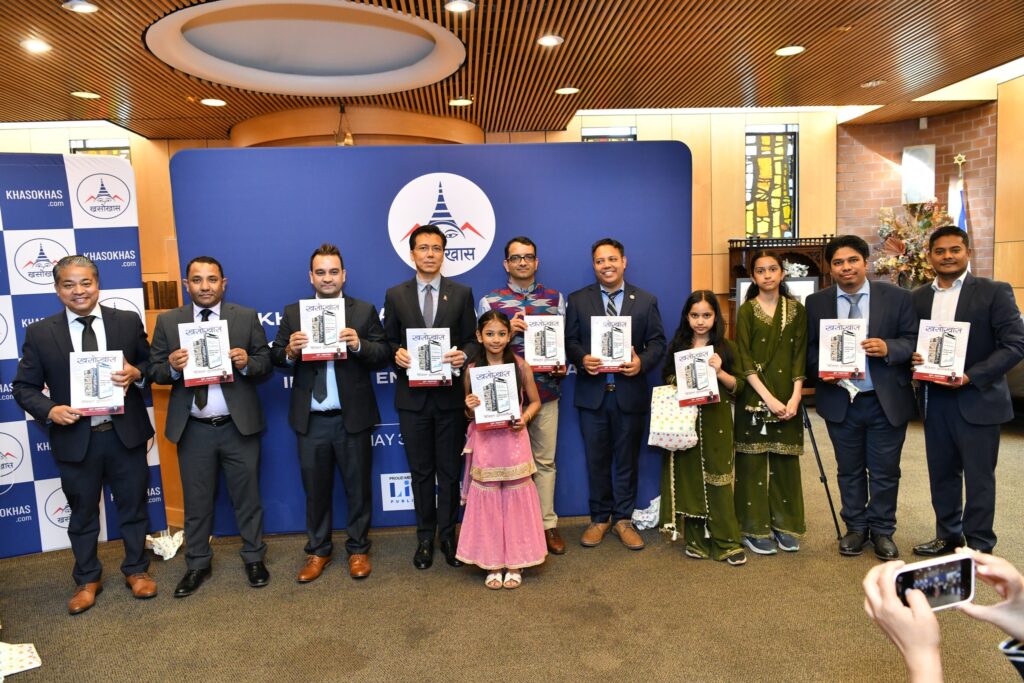
Thank you so much. First, I would like to invite Sree Sreenivasan. Sree is the CEO of DigiMentors, co-founder of the South Asian Journalists Association (SAJA), and co-host of the Annual Nobel Peace Prize Conference in Oslo. He is a renowned independent journalist, author of ‘Sree’s Sunday Note,’ and co-host of a New York Times podcast. It is a long and impressive introduction, but well-deserved.
Sree Sreenivasan: Thank you so much. Hello, everybody. I bring greetings from SAJA, the South Asian Journalists Association. We represent a thousand journalists of South Asian origin, which means we like to say that there are a thousand parents crying that their children became journalists, except the Khasokhas family, because everybody loves you guys. And that’s great. I see my friends Kavita and Jahangir here, and Mitra you will meet in just a moment. I want to say how important the ethnic press, the community media is, and I thought I would show you that by telling you about an article I wrote in July 1996.

That’s thirty years ago. It was in The New York Times, and it says, “As mainstream papers cut back, the ethnic press expands.” And this is all a story about how the ethnic press is becoming more important thirty years ago. And it talks about how the, you know, the traditional ethnic press survived on small kinds of ads, and now they’re getting more interesting ads, and there’s a business proposition here and business future for the ethnic press. So, it was kind of bold to say that then, but you folks have shown the value of it. And because you’re going to meet Mitra, I just want to say one more thing, that the idea of what community media does, it’s different from often what is more traditional media.
And what’s– one of the things that’s different is the relationship that your publication, like Khasokhas and others, have with their own audience. We have Meera here from India Current, for example, and their relationship with their audience, very different from The New York Times, WNYC. Great publications, very important—But what they’re doing is reaching their audience where they are. And the best story I have about this is what happened during the pandemic, and what Epicenter did, that’s Mitra’s publication and community that she’s built. Everybody was telling folks how to get the vaccine, right? You remember? But they did one step further. They helped get the vaccine into the arms of the community and helped them get vaccinated. And there were some traditional journalists who were kind of like, “What is this? This is not journalism. You don’t do that.” But if you believe in service journalism, the ultimate service journalism is keeping your readers alive, and that’s what they did, and that’s why they’re so special.
And that’s just one example of the kind of work the community media does. We need the big boys and big girls who run major media publications, but we need great community publications, and the future is really in places like Khasokhas, and I’m so honored to be here with all of you. And thank you very much, everybody.
Suresh Shahi: Thank you so much, Sree Srinivasan. And let me invite beautiful, uh, Mitra Kalita. Yes, Mitra Kalita. She’s CEO and co-founder at UR- URL Media, and the good thing, Khasokhas is there in URL Media as the partner, as a member. Let’s welcome her.
S. Mitra Kalita: Thank you so much, and congratulations, Khasokhas, on your 14th anniversary. URL Media, which is the organization that I run along Epicenter NYC, as Sree just mentioned, was proud a few weeks ago to welcome Khasokhas into our fold. And just last week, we crossed 50 community media partners around the country.
So for you all to come into this group during a bit of a milestone for us is especially meaningful. I also stand here as your neighbor. I live in Jackson Heights, just a few blocks away. I have turned to this news outlet repeatedly to reach the Nepali community. And is there… I just have to ask this question. Are there any Nepalis here by any chance who’ve lived in Assam or been through Assam? Okay. I’m also an Assamese American, and I have to ask the question because our culture… Oh, thank you. Thank you for proving my point that our cultures are not only similar, but of course, those of you familiar know that the back and forth between our people is very much a part of our identity.

So I just wanted to make sure that I underscore that. A part of our goal at URL Media is to really represent what I think those of us who walked down this strip of 77th Street just demonstrated a few minutes ago, which wasn’t a long walk, thank you for that. It’s a little chilly outside today. But really the need for solidarity among media, community media, corporate media, independent media, public media, I can’t think of a time that we’ve needed it more. And so to begin your celebration with a recognition of what press freedom means to all of us, I think is really, really important. It was very, very meaningful.
URL Media stands in solidarity, not just with your outlets, but really with this belief that we are much stronger together. And then the second part that I just want to talk about, which was alluded to when you said, “When we launched, we went from one restaurant to another to convince them to advertise with us, to support us.” We will not have an independent press, at least in the United States, but also for many of the countries that we hail from, if we don’t financially support that media.
And so URL tries to, in solidarity, stand and sell advertising together, support our community media partners through emergency funds, supporting events, and, you know, also engaging in training and education, and scaling up our partners. But I also turn to all of you who come from different walks. Some of you are running for elected office, some of you are in city government, some of you are fellow media organizations, to really think about the financial support of Kasto Kaz and what that means for not just one sliver of New York City, a vital part of New York City and Nepali Americans, but also what that means for the entire ecosystem.
I think the time for us to treat media as a part of the ecosystem in the same way that we talk about the subway system or health or other elements of our infrastructure, we have to see media in the same way. So continue to support this outlet. So those of you who can, I hope you’re continuing to advertise. And I do hope that you know you can continue to count on URL Media for support. So thank you so much for having us here today.
Suresh Shahi: Thank you. Regarding today’s magazine that we have published, definitely our team put in a lot of hard work. But again, as mentioned earlier, this would certainly not have been possible through our effort alone. Without your support and cooperation, we would not have been able to bring this 14th anniversary special edition of Khasokhas today. So, thank you very much to all of you for your support and cooperation.
Now, our Nepali community already knows a lot about Khasokhas from a long time. However, there are some recent changes we have been making—whether it is video production or incorporating new elements and new parts into our work—how can we better inform the community about these developments?
The main question now is: what should we bring to the community? What are the issues within the Nepali community that, even if they affect only a small number—say, 10 out of 100 Nepalis—still matter? Our goal from the beginning has been to include those 10 people as well, understand their problems, and find ways to provide solutions. That has been our objective from the start, and it remains the same today.
If you have seen our videos, we have produced many news stories and videos related to immigration. Given the current situation and the present administration, we all know that some of our Nepali brothers and sisters are living in difficult circumstances, especially regarding documentation. In such situations, what should be done, how to stay safe, and what actions might be risky—these are the kinds of information we have been sharing.
In the coming days as well, we hope to continue receiving your support, cooperation, and suggestions in the same way. That is the expectation of the Khasokhas team.
Now, to share more about our journey—what has happened at Khasokhas and what is happening now—I would like to invite our Editor-in-Chief, Kishor Panthi, to come forward and speak. Uh, in English, yes.
So, the journey—again, we discussed a little bit about our Khasokhas journey, how it started, and the many changes we have gone through. We started as a print version, then switched to an online digital format. Thanks to COVID-19, we were completely disrupted during that year. We had to stop our print publications entirely due to financial issues.
Although we stopped physical copies, the love and support from the community never stopped. We never reached a point where we felt we had to return to print media just to gain support. That moment never came. So thank you all. Kishore Panthi is here, so let me hand over the mic to him.
Kishor Panthi
Greetings to everyone. We are here on this special occasion. It is the 14th anniversary of Khasokhas, and Khasokhas has completed 14 years and entered its 15th year. Some people and community members may also be curious. Why did we start celebrating the annual anniversary on May 3 instead of January 15, which we had been observing every year? There may be some curiosity about that. This year, we have decided to celebrate the anniversary on May 3, and May 3 is the day on which we renamed White Himal as Khasokhas in 2013. Before that, it was being published under the name White Himal. And because of the weather on January 15, last year I myself fell ill. In some years other friends also fell ill, in some years Deepak Pariyar fell ill, in some years someone else fell ill, and because of the flu at that time, many people had difficulty attending. Because of that, and because the weather is also more pleasant, we moved it to May 3.

And I would like to briefly recall the journey of Khasokhas. When we started Khasokhas in 2012, it was published as the first Nepali weekly published from the United States. Then we published Khasokhas as a tabloid newspaper until 2017. After that, we published Khasokhas as a magazine, and from 2020, as Suresh said, we completely moved Khasokhas to a digital format. And I would like to talk a little about Khasokhas’s performance in 2025. We want to describe 2025 as the year of vertical videos in the fight against misinformation and disinformation. Through vertical videos and live videos, we ran a campaign against misinformation and disinformation in 2025. I would like to present some data here.
We were able to gain a total of 123 million views on social media in 2025. Out of that, we gained 94 million views on Meta for videos and links, and 29 million views on TikTok. We posted more than 1,150 vertical videos on social media in total. And our total followers are now 326K on Facebook and 78K on TikTok. And one interesting thing is that after we started vertical videos on Meta, our earnings from Meta increased by 994 percent last year. This figure refers to the earnings we receive from Facebook through Meta.
During this time, we also did 12 live videos on various topics, including immigration. Especially with immigration attorneys who are here—Ramesh Shrestha, Basu Phulara, Khagendra G.C., and Keshab Seadie—we did 12 live videos on immigration-related topics. In live videos in 2025, total watch time increased by 1,100 percent. And in terms of total watch hours, we had only live video watch time equivalent to 151 days and 14 hours. We did 12 live videos in total.
We also participated in six different events. From mental health to various immigration-related programs, we participated in events such as Hudson Speaks with Bishnumaya Pariyar. We also joined with Minority Empowerment Network with Shreeya Tuladhar. She is not here right now, but her mother is here. We met with them as well. Similarly, we worked with The Greater New York Chamber of Commerce to organize a program with Pradip Shrestha. In that way, we participated in six events.
I would also like to present some data on why Khasokhas has to continue in the Nepali language. Looking at older data, about 50 percent of Nepalis aged five and above in America cannot speak and understand English well. And when we compare English proficiency across the overall Asian American community, it is 26 percent. And among Nepali Americans, 85 percent of people who speak Nepali at home speak Nepali at home. They all speak Nepali at home. Therefore, this data clearly shows the importance of publishing Khasokhas in Nepali.
And in the coming days, as I have always said, community journalism means advocacy. This is not just journalism. It is also social work and advocacy. While mainstream media may finish its responsibility after publishing the news, community media does not finish its responsibility by merely writing the news. We are always advocating for the community, and we are also doing a kind of social work for the community. I believe the impact has been the same way as well. And now the speakers will explain what impact it has had.
Especially in continuing that term, we are never afraid to try new things. There was a time when only something in print was called a newspaper, but now the definition of journalism, news, and newspapers has changed as well. That is why I presented the data on vertical videos earlier. That data also shows how news is shifting. In the age of AI, we are also using those things. Khasokhas is making full use of artificial intelligence. Because of that, it has also become easier for us, and Khasokhas never hesitates to use new technology, new things, and new platforms, and it keeps moving forward.
And over this long 14-year journey, I would like to thank all the advertisers, supporters, community members, and everyone who has supported us. We had run the News Match program in December. In the News Match program, we were able to raise $32,000 in News Match funds. For that, I thank everyone. I would like to thank them very much and hope for their continued participation in future News Match programs.
Similarly, I would also like to mention a few more names here. I would like to thank them too. I would also like to thank the advertisers who provided advertisements and continue to support us for the Khasokhas anniversary special issue. I would like to thank all of them. Let us give them a round of applause.
And once again, I would like to commit that in the coming days, Khasokhas will continue to work as an integral part of the community, as a part of the community. The support and cooperation from the community will continue. It will increase even more. And as part of the community, we are committed to continuing to provide resources on immigration, housing, health care, tax, education, and other topics to help the community. In the coming days, we will continue to move forward by interacting with the community about how we can grow. Thank you all very much for attending today’s 14th anniversary program. Thank you so much.
Suresh Shahi
Thank you very much to our Kishor Panthi. He shared some aspects of Khasokhas. I don’t want to take much time at this moment. I know we have a very lovely and amazing personality here with us, Jahangir Khattak. He has been with us for a long time as a supporter.
Jehangir Khattak: Thank you so much. Congratulations on the fourteenth anniversary of Khasokhas. It has been a long journey, and I have worked much of my life in America with community and ethnic media—hundreds of editors, reporters, and publishers.

Every newspaper goes through a journey, and I have seen the journey of Khasokhas myself—not just as someone who has supported the media, but as someone I know personally, because Kishor is also a personal friend of mine. Over all these years that I have spoken to different publishers, of course, running a newspaper is no joke.
Not just filling the newspaper with meaningful content, but also sustaining it, keeping it running, and doing so in a way where you are educating your own community. Because to me, community journalism is not just about stories that are not being told by the mainstream media—not that they don’t want to, but that they may not have the bandwidth. In some cases, we may also see parachute journalism.
But our community media has also been the organizer of the community. It plays a central role. It is a critical link between the community and the mainstream, so it is a very important vehicle for civic engagement. The communities that are on the sidelines, the communities that are not part of the mainstream—this is the media. This is the link.
That’s why, for the years we have worked with the New York City government, we have always told them that if you want to bring our communities out of the shadows—because many politicians always complain, “Oh, they are in the shadows, they don’t want to come”—we tell them that in New York City, according to the mayor’s office, about 1.8 million New Yorkers speak no English or very little English. That means their primary source of information is the media that produces it in their language.
So if you want these communities to come out of the shadows or to be more engaged at the civic level, you have to empower this media. And our media—when I say our media, I mean community media, Kishor’s media, all those who are covering our communities—they are empowering people, they are doing critical work, and they are there because of the community itself.
The community is the main driver and supporter of these media outlets.
So I am really very grateful, even on behalf of Kishor, to all those people who are supporting Khasokhas and have been supporting it. They are doing very, very important work, because if this link is lost, the community will lose a very important connection with the mainstream.
At a personal level, I have seen many of my colleagues—and it’s not wrong, it’s natural—the media environment has been changing, and it is very challenging. So anyone who is running a newspaper in these times—hats off to them. It’s not a joke.
So again, I think, Kishor, you and your team, Suresh, and all your colleagues deserve all the credit, and of course, all the supporters as well. My humble request to everyone is to please keep supporting this media, because this is your voice.
These are the people who are showcasing who you are, what culture you are bringing, how you are contributing to American society, and how you can empower your own community by amplifying your voice through the columns that these gentlemen are producing. So I think they are doing very important work, and I could speak forever, but I will stop here.
I just want to congratulate you again for your really awesome work. Keep doing it. One last thing I want to say: many publishers are always struggling and complaining. One publisher I have found who never complains is Kishor—never. I have seen it every time I have spoken to him.
He always has ideas—whether it is Facebook, where he is generating some revenue, or Google—he is very enterprising. Very impressive work. So again, congratulations, my friend. I wish you all the best, and thank you again for inviting me. Thank you.
Suresh Shahi: Now, I would like to invite the Permanent Representative of Nepal to the United Nations and President of the Economic and Social Council of the United Nations, Mr. Lok Bahadur Thapa. Please welcome him to the stage. And let’s give him a big round of applause.
Lok Bahadur Thapa: First of all, I am very happy to be here as part of the celebrations of the fourteenth anniversary of Khasokhas, as well as the celebrations of World Press Freedom Day today. On this very occasion, let me extend my greetings and best wishes to all journalists and media persons around the world, and more specifically to the Khasokhas team for their contributions and commitment, especially to the Nepali community based in the USA.

As you know, when we celebrate this important day, we must also recognize that these days it is quite challenging, especially for press freedom. Yesterday, the Secretary-General also spoke about how press freedom is declining around the world, and how journalists are facing censorship, intimidation, and even killings. In this context, I think we all need to recommit ourselves to protecting press freedom.
Because without press freedom, there will be no informed citizens and no informed society. And without an informed society, there will be no justice, no democracy, no sustainable development, and no peace around the world.
For this, let us commit to protecting press freedom, which is a cornerstone of democracy. Let us also support those journalists who are truly committed to this cause. Because it is not only the journalist’s right to protect press freedom—it is also our right to be informed.
Having said this, I listened to the journey that was shared earlier, and I felt very happy. Fourteen years—this journey of continuously connecting the community, informing them, and advocating for them—is truly commendable. Media, especially community media, plays a vital role in connecting communities—with each other, with Nepal, and even with government institutions such as embassies and consulates. The effort to create a synergistic effect by connecting all these stakeholders is truly appreciated, and I would like to thank you and congratulate you for that.
As we discussed, this is not an easy journey, especially in today’s context. Around the world, the media field is facing many challenges due to digitalization, technology, artificial intelligence, and smartphones. In addition, misinformation and disinformation are also major challenges. Furthermore, working within communities can be difficult because communities themselves can be fragmented, with diverse interests.
Despite all these challenges, the way you have continued to inform, advocate, connect, and fight for the rights of the community is highly commendable. Thank you for that.
In the coming days, I believe we can do even more to connect and empower the community. Earlier, information itself was power. Now, clarity of information is the real power, because there is so much information everywhere that individuals often struggle to distinguish what is right and what is wrong. Community media can play a crucial role in clarifying what is beneficial for the community and for the nation.
Secondly, your efforts in preserving and promoting the Nepali language and culture are extremely important. Especially for younger generations growing up here, maintaining a connection to language and culture is vital, and your publications help achieve that.
Looking ahead, I believe there are a few areas we can focus on. One is continuing your important work on immigration through interviews and live programs. Similarly, collaboration with the consulate and embassy could be strengthened, creating more interaction between the community, the government, and institutions.
Another important area is engaging the younger generation. Media like yours can serve as an intermediary to connect them more effectively. Third, cultural promotion can be further strengthened through collaboration with official missions. Fourth, we should focus on economic diplomacy—trade, investment, and technology—and media can facilitate discussions on these topics.
I was also happy to hear about recent programs, including one at Harvard, though I could not attend due to travel. Such programs can also be expanded through media platforms.
Finally, I would like to emphasize the importance of bringing United Nations-related discussions more into the community. While some efforts are being made, there is still room for more. Many global frameworks—whether related to AI, trade, development, or institutions like the World Bank and IMF—are discussed at the United Nations. Bringing those discussions to the community level can help people better understand how global decisions impact them and countries like Nepal.
Similarly, analyzing global events such as the World Bank and IMF Spring Meetings and explaining their relevance to Nepal and the community would be very valuable. This would also help connect experts, policymakers, and the community more effectively.
If we can strengthen these discussions and connections, I believe we can successfully bridge the gap between the community, the country, and government representatives. I would like to encourage you to continue in this direction.
Once again, thank you for giving me the opportunity to share these thoughts at your annual celebration. Despite having just returned from travel and dealing with jet lag, I did not want to miss this event. Thank you very much, and once again, my best wishes to you.
Suresh Shahi: Thank you very much to Mr. Lok Bahadur Thapa. He shared important thoughts about community media and its relationship with the community, and we are very grateful for his valuable suggestions. Now, I would like to invite our next guest, Mr. Dadhiram Bhandari, Consul General of Nepal in New York. Please come forward.
Dadhiram Bhandari: Greetings to everyone. While being in New York, Khasokhas.com has played a role for the past fourteen years in informing the Nepali community, raising awareness, and amplifying the concerns of the Nepali community. Today, we have gathered here to celebrate its fourteenth anniversary. On this occasion, I would first like to extend my heartfelt congratulations and best wishes to the Editor-in-Chief of Khasokhas, Mr. Kishor Panthi, and his entire team. Congratulations—it is a milestone.

Today is also a special day. As previous speakers have already mentioned, it is World Press Freedom Day, and press freedom is directly linked to democracy and to our fundamental rights. On this occasion as well, I would like to congratulate all journalists and all citizens.
Many things have already been said. How many of you know what “Khasokhas” means? Do you know its meaning?
From there, I would like to begin my remarks. As our Permanent Representative mentioned, today there is an abundance of information, but not necessarily verified information. People are searching for what the truth is—what verified truth is. The importance of verified information is very high today. The meaning of Khasokhas is verified truth, verified information. I believe Khasokhas should commit to bringing verified truth to its readers and truly embody its name in practice. I am not sure which regions in Nepal use the word, but in some areas, people say “Khasokhas” when something needs to be verified. You chose a meaningful name, and I offer my best wishes.
Today, there is an overflow—almost a flood—of information, which makes verified information even more important. I do not want to repeat what previous speakers have said, but we should take pride in the work Khasokhas has done for the Nepali community and the Nepali diaspora. Looking at the 2026 report by Reporters Without Borders, Nepal is among the leading countries in South Asia in terms of civic space and media freedom. For that, we are all deserving of appreciation, and we must work to expand it further. Of course, there are many things we still need to do together.
The civic space and media freedom in Nepal today are a matter of pride. Our constitution guarantees freedom of speech and press freedom, and within South Asia, Nepal stands among the leaders. When we interact with friends from other countries, they openly say that Nepal’s civic space and media freedom are very good. This is something to be proud of. On this special day, I would like to acknowledge the contributions of teams like Khasokhas in the diaspora, as well as journalists in Nepal.
Much has already been said about community media. It has a special role, as Kishor Panthi mentioned—advocating, empowering, and consistently following up. In Nepal’s context, community media has an even larger role. As the Khasokhas title song says, “Wherever there are Nepalis, there is Khasokhas.” As the diaspora grows rapidly, your presence everywhere is important. You help inform the diaspora about issues they may not be able to follow themselves, advocate for them, and support their well-being and establishment abroad. I wish you success in this mission and hope you continue focusing on it.
I know you continuously write about certain issues and follow them closely. As our Permanent Representative mentioned, you also connect with government agencies and collaborate with us. In the coming days, we are ready for even deeper cooperation, and we will work on that.
Another important role, as the diaspora grows, is connecting it with its roots and with the country. Community media plays a major role in this. As you presented data on English literacy, translating important information from mainstream English media into accurate Nepali and presenting it to the community is a great service. I follow your work regularly, and the effort you put into it is truly commendable.
I have also mentioned in informal meetings that while you write detailed articles with great effort, you can use AI to summarize them. Highlighting key points at the top would help readers, as attention spans are short, and those interested can then engage more deeply with your content.
Another point is that your audience is not only in the U.S. but also in Nepal. You have readers there as well. Recently, you have started covering various aspects of Nepal–U.S. and North America–Nepal relations. In this, you should also engage people from the diaspora who can contribute insights, opinions, and discussions—whether on voting rights, NRN issues, or other topics. Featuring such voices regularly would help inform policymakers in Nepal as well.
Important community issues include immigration, mental health, education, and also the law of the land. Living in the United States, it is the responsibility of community members to understand and follow the laws, policies, and culture here. Khasokhas can play an important role in raising awareness about this. In difficult times, informing the community is essential, and in normal times, helping them understand the law and culture of the land allows better integration and contribution.
This also serves your purpose of advocacy and empowerment while building a distinct identity for the Nepali community. I saw an example in Pennsylvania during COVID, where the Nepali community provided exemplary service by distributing food while others stayed indoors. This was recognized by federal senators, and they received nearly half a million dollars in federal grants. This shows recognition of the community.
The Nepali community has its own culture, and Khasokhas should continue focusing on how to help the community connect with American society while maintaining its values.
On this anniversary, you have published a special issue. I observed the audience here and the featured individuals. There are many achievers in the Nepali diaspora, and it is important to highlight and network them. You might consider creating a regular column or feature dedicated to diaspora achievements.
Regarding cooperation between the consulate, the Nepal government, the embassy, the permanent mission, and community media like Khasokhas, I have shared some thoughts. Technology has made coordination easier, and being in the same city also helps. Please continue to provide constructive suggestions—we are always ready for them.
Soon after I arrived, we held discussions with you, and we continue to remain in dialogue. Your constructive feedback helps us improve our services. Where we cannot reach, you can alert us. Through cooperation, we can achieve the government’s priority of better public service, better service to the diaspora, and ultimately contribute to the country’s economic transformation.
In that, your role as community media is also important and is recognized in Nepal. We are constantly connected.
Finally, I would like to say that the voices of the diaspora sometimes remain unheard, and they often lack access to city, state, and federal resources due to language barriers or other constraints. Increasing awareness in this area would be a great service. In my interactions with officials, I have seen that the Nepali community has limited access to resources. This needs improvement. Through your media, and in coordination with the consulate, we can work together on this.
We are ready to collaborate in any effort to inform, empower, and strengthen the Nepali diaspora. Let us work together to serve the community.
Once again, on the occasion of World Press Freedom Day and your fourteenth anniversary, I extend my heartfelt congratulations and best wishes. I hope you continue to grow, strengthen your commitment, and fulfill your responsibilities to the community. Thank you.
Suresh Shahi: Thank you very much to Dadhiram Bhandari. Now, without taking much time, I would like to invite our next guest, Kavita Rajagopalan. She has been a journalist for a long time—a media leader, writer, author, and Director of Research and Analysis at the Center for Community Media at the Craig Newmark Graduate School of Journalism, City University of New York, and a global migration and Asian diaspora expert.
Kavitha Rajgopalan: Thank you so much, Suresh, and a very special thanks to my wonderful friend Kishor as well.
It’s been such a pleasure to get to know you over the last five years. I can’t believe how quickly the time has flown. In addition to the fourteenth-year celebration that we’re commemorating today with Khasokhas, we are also so lucky to have NepYork, which was launched almost four years ago to the day.

This is a very, very special moment in global history. It’s complex. We are very, very likely to look only at these moments of struggle, suffering, and trauma.
But during these moments of disruption, we are also given the opportunity to find unbelievable moments of innovation and examples of creativity and resilience. One hundred years ago, almost to the day, Asian Americans were banned from entering the United States altogether. Into that breach, one year later, there was a Chinese American journalist here in this city, in New York City, who founded one of the very early Chinese-language Asian American newspapers in this country, called the Chinese American.
This was one year after his countrymen were banned entirely from the country under the Chinese Exclusion Act. And that example continues today. Khasakhhas and NepYork participate in a very long tradition of in-language and community-based independent journalism for and by immigrants.
At this time, our communities are global. I’ve heard—unfortunately, I don’t speak Nepali—but I understand a couple of words that are borrowed from Sanskrit, since my family is from India as well.
As a fellow South Asian, I can tell you our communities are very, very complex and are becoming even more complex in the diaspora.
What is it that keeps us together, that keeps us in conversation with each other, that keeps us organized against forces that may tear us apart and send our families back overseas or into even more difficult circumstances?
It is community platforms where we can negotiate belonging here and where we can define who we are as one people, despite all of our complexities. And that is the legacy that this outlet upholds. They serve their communities not just on their website and in print, not just here in Jackson Heights, but over the last five years, they have taken a leadership role in demonstrating how community media must serve its members as they grow across the country into regions that are often very hostile to us.
More than twenty-three states have passed laws banning Asian Americans from owning property in the United States. More than twenty-seven states have banned Sharia law, even though we know that most religious organizations are independent. And while we know that more than two-thirds of Asian Americans trust news in their own language, we also know that we live in a climate where much of the news in-language is being produced by state propagandists, major governments overseas, and private actors who operate in bad faith.
It is for this reason that we deserve, and are grateful for, independent, community-owned news. This year, this week, as we commemorate World Press Freedom Day, I cannot leave this room without acknowledging that the United States has fallen to sixty-fourth place among countries in terms of press freedom.
We are now ranked sixty-fourth in the world—a country with a celebrated history of democracy, one of the oldest democracies in the world—that positions itself alongside global democracies like Nepal and India, which are also experiencing declines in press freedom, immigrant rights, minority rights, and religious freedom.
In this landscape, where more and more media outlets are being pushed into digital spaces, where they must engage audiences across the world and meet the needs of global communities, we must also acknowledge that these news media outlets are not only facing resource constraints, but are also navigating transnational repression, widespread disinformation, harassment, cyber activity—primarily from South Asia—and even violence for the work that they do.
So the work they do is not just important for keeping us informed here and connected to a global diaspora, but is part of a long and important tradition. Asian American news in this country was formed in response to imperialism and discrimination. To this day, Khasakhhas and NepYork uphold that brave tradition of promoting community resilience and strength in the face of rising xenophobia, declining press freedom, and resource constraints.
They are driven by a deeper mission, and we are grateful for their work. I’m so glad to be here with all of you today, and I look forward to staying in community with all of you. Namaskar and Dhanyavad.
Suresh Shahi: Thank you so much, Kavitha. And right now I would like to call Harry Bhandari, Mr. Harry Bhandari, Maryland State Delegate, and thank you so much for joining us today all the way from Maryland. Thank you.
Harry Bhandari: It is my honor to be here. It is a very special occasion, World Freedom Day. I am Delegate Harry Bhandari. I have had the privilege of serving in the Maryland General Assembly for the last eight years.

Currently, I am the chair of the House Land Use and Zoning Committee.
A week ago, my mom challenged me. She told me that when there are more Nepalese, especially senior family members, I should not be speaking in English. We were at the same program. So for my mom, I am going to speak in Nepali, and I am sorry that some of you do not understand.
Today is also the 14th celebration of Khasokhas, along with Kishor, Suresh, Rajan, Deepak Pariyar, and the entire Khasokhas team. We have discussed many things this year, and I think the slogan is peace. First of all, how do we bring peace into today’s day?
From the outside, everyone looks happy, everyone looks cheerful, but what is happening inside? We were born in Nepal, and many of you began journalism in Nepal as well. Even when we had no money, Nepali people were happy in the villages. Now, even with money, we are deeply unhappy. Every other week someone seems to pass away, and young boys are committing suicide. So how do we bring peace on a day like today?
How do we build love among ourselves? That is also, to me, a very important business issue. As for diaspora matters, I often say I feel like a jogi, a wandering ascetic. A jogi who stays at home. It feels very enjoyable. I did not mean a jogi of emancipation. Once I go to one place, I will also talk about Kishor Panthi. Maybe because of that shared spirit, that shared feeling, I came here even though there is an election in Baltimore and I thought I should go.
Why did I say jogi? Because wherever you go and feel love, even at the airport you feel love there too. I feel this could be expanded a little. It is like when you sell insurance, you wonder whether that person has insurance or not. Similarly, after becoming a legislator, when I walked in here unexpectedly, others noticed all sorts of things. I saw that Jackson Heights had some damaged asphalt. What is this? The pavement is not fine. You know what is going on where I am, you know what I mean?
Whatever you seek in life, you will find. And beyond that, for peace, confidence in ourselves is also necessary. And why has Khasokhas survived today?
Earlier, the speaker friend said something that, when I remember Kishor Panthi, sometimes it feels like even if he scolds you, it is so sweet to hear the scolding, like a bird’s song. It is hard. It is difficult. There are many things. But he responds rather than reacting. Thank you, Kishor. I was looking at the banner there: inform, empower, advocate.
Without information, without instruction, there is no engagement. If there is no engagement, there is no inspiration either. If you do not even know what the issue is, then nothing can happen. During my own journey, I also came here to New York. I often meet Kishor in times of sorrow. I have met many friends in sorrow in America, seen many friends in sorrow, and I always say that quality connected relationships matter. If you meet a thousand people, it means nothing. But if you meet one quality person, it really matters.
Kishor and my paths are different. Just as today, if we count from 59 BC, it has been two thousand eighty-five years since journalism began, even if it did not start with the word itself, but began with the Romans giving information. Now, two thousand years later, journalism has evolved. Human beings have evolved too. We came from the jungle. Even now, when we sit at home and go into the jungle, it feels good, it brings peace. I feel that instinct and DNA are still there. There is still a power in nature. Because we lived in the जंगल for thousands of years. Right? What I mean is, look at it: the development of human civilization and even the development of writing are not that old. Around 1208, the English language, or English in England, got recognized. After that came the dark age. If you look at the fifteenth and sixteenth centuries, it was completely the dark age. Like the Rana period in Nepal. After that came the Renaissance, and in the eighteenth century, the age of reason began. The books you see now in coffee houses—bringing books into coffee houses began in the eighteenth century. Because knowledge should reach everyone. What had been library knowledge was spread to the coffee house in the eighteenth century.
That is the age of reason. Now in the nineteenth century, New York Times was born, challenges remained, there were economic challenges in the press, but today, after so much progress, we are in the digital age. In the digital age, you yourself become the journalist, and whatever you feel like, whatever emotion you feel, you post it like spontaneous powerful emotion recollected in tranquility, as one poet said. That is how poetry is born, and people just write and post on Facebook. There is definitely a challenge. But information is coming so quickly that verification is also not happening. That is its own matter. Khasokhas is doing that work. Look, there are many things in life that we have to die without ever saying. You feel that too. Sometimes you feel it, sometimes you do not, but I feel it a lot. If you walk near a cemetery, there are places where people are buried. I sometimes stop and look. How many dreams must have remained incomplete? Those dreams do not go anywhere now. Where do the dreams buried in a cemetery go? I feel there must be so many dreams.
When I look at things, what I feel is that I did not believe that people become happy by studying or by having money. Your happiness becomes more meaningful the simpler you are in life. The other day I went to a library. Maybe it was a coincidence. When I first ran for election, the speaker there was Bush, Mike Bush.
I had never seen him, but once I talked to him on the phone, and he held my hand and said, “Look, you are new, and you have energy too. It is very hard down there. Now in 2025, the lobbies are like this. They keep telling me, they keep telling me, they keep telling me. Right?
But what you have to do is stand for the vulnerable person, for the person who has nobody. And whenever you do anything, look in the mirror at night and think about how this bill, this legislation, will affect my mother, how it will affect my children. If you do that, you will always find peace,” he said. The other day I went to that library, and there was a library built in his name in Naples. I stood there still. I communicated even though only in spirit, right?
Today, the role that Khasokhas and other Nepali media have played for empowerment and information is truly commendable. Let us give them a big hand of applause. Let us give it with a little more enthusiasm. That is important.
Maybe our Khasokhas family and Kishor Panthi could have even built a bigger gas station. He has left many things behind and kept working. And many of his friends are involved too. I see many surgeon friends, doctor friends, engineer friends, Nepali friends involved. And I feel that we are building a foundation. People only talk about a foundation when a house collapses. Today, I, as chair of the Asian American House and Senate, worked for two years. I have understood closely the problems of Chinese people and Korean people. Today, there are more than 21 million Asian Americans in the United States. In my state alone, there are five hundred thousand Asian Americans. We have understood discrimination. But what we did not understand is, basically, what is our problem?
Today is also a day for reflection. This is the day of reflections. I think you and we Nepalis, brothers and sisters, I get phone calls. Immigration friends, you probably get many phone calls. “I am a U.S. citizen, what will they do to me?” I say ICE does not do anything.
ICE has no jurisdiction over you. “Can I go or not? What happens if I do this?” The fear inside us, that fear has now affected our community, the Nepali community, the Asian community. And because of that fear, there are mental health issues. Now, you who have the pen, you who have that power, your job as friends is to check the government. To check power. To create accountability. To this day, in the 29 laws I have written myself in Maryland, in every single law I passed, whether it was for deaf and hard of hearing children that became the first in the nation, or fighting against discrimination, banning sex offenders from schools that became the first in the nation.
In every time, your journalist friends’ contribution, their coverage, if it had not happened, I would not have been able to do it. Now, there are challenges. How many of you have come to the General Assembly? I am so proud that I serve in the same General Assembly where Jefferson and George Washington came to make the United States the United States; the assembly was already 150 years old.
Then on the bottom floor there is a Washington Post. I always get stuck when I walk by. Journalism is not a good thing to arrive with. If a reporter comes to you, it is either a good thing or a bad thing. You do not want to be there.
Right? Those who have been covering our stories now have won Pulitzer Prizes. But they never compromise. That is why I am talking about trust. What I mean is that because of the stories you write, this happens or does not happen, but the choice is yours. And the responsibility you are carrying today, the earlier speaker said let us celebrate. There is so much to celebrate. Today there are more than four thousand doctors in America. The other day in Virginia, I met four hundred doctors in one room. There are nurses in similar numbers today. There are entrepreneurs today. Now the time has come to say to the government here, we are not just a burden; we are the engine of the economy.
Whether you are Democrat or Republican, if schools are better and hospitals are better, it is good for Democrats, it is good for Republicans, or it is good for no party. That is how we have to stand up. I was very happy that you used the word lion. Why is the lion a lion? You know, a lion does not move like a snake, it is not as fast as others, and it is not as big as an elephant. But the lion is the king of the jungle. Why is it the king?
Because of its spirit. He thinks of himself as a lion. He thinks of himself. Everything starts with thinking. Therefore, our community did not have numbers before. You know what politicians think more about? They think about the contribution. To win an election, you need, you know, if you send out a flyer saying you are running for election, it costs 80 to 90 cents. If you run for Congress and send out just one mailer, it costs 30 to 40 thousand dollars. In order to run for Congress, you need at least a million dollars.
It is hard. It is difficult. But at the end of the day, our number matters. As we move forward, we need to know that we Nepalis are this many, or Asian Americans are this many. That is where we have to start.
As you know, to tell the truth, if you send out a flyer saying you are running for election, it costs 80 to 90 cents. If you run for Congress and send out just one mailer, it costs 30 to 40 thousand dollars. In order to run for Congress, you need at least a million dollars.
It is hard, it is difficult. But at the end of the day, our number matters. As we move forward, we need to know that we Nepalis are this many, or Asian Americans are this many. That is what we have to start with.
Let Khasokhas keep flowing like a river. Sometimes it is hard. A river formed by the breaking of the Himalayas does not reach every ocean; it splashes. But keep moving like that, grow like a river. That has value. You have been here for fourteen years. I know it is tough.
The light of the sun remains. Even if clouds block it, that is the truth. In that same way, move forward like the sun. Our representative, Lok Bahadur Thapa, said many things. In today’s situation, the attack is not only on press freedom, but I must say clearly that while building this country, many Asian Americans sacrificed, and you have heard that. But now what we must write in our media, what we must speak about, is that African Americans will not fight alone and lose their lives while we simply hope for justice. Latino Americans may fight and get green cards, but now we must fight alongside them too. That kind of unification is what the media must now do. That responsibility has come onto your shoulders, Khasokhas and others like you. Let me tell you a simple truth: all Nepalis here file for asylum. This country is made by immigrants. Everyone knows that clearly. But if you look at the original document, it says life, liberty, and pursuit of social happiness.
In the same legislature where Jefferson and George Washington learned politics, I served for eight years. When you stand against immigrants in America, you are going against the country. This is a country built by immigrants. Hope, aspiration, dream.
But today vulnerable Nepalis, I am not speaking for everyone, come here and file for asylum. They are paying everything they need to pay. But when they go to immigration, to a big building, if they go at nine or ten in the morning, they are only given taxes. Right?
That is not what this country stands for. In Maryland, we passed the Community Trust Act. We said ICE’s responsibility is a federal responsibility. We need our state troopers, our state law enforcement, for ourselves and for the community, and to stop the sharing of information, we passed that law. I felt so proud at that time. I know I got some nasty emails, nasty things.
Now, in the end, I say this: you have received a unique responsibility on your shoulders, Kishor Panthi. When you work by choice, progress does not always happen. When you face challenges with challenges, progress happens before you. Therefore, you are working not just for progress but for community empowerment. To strengthen this, to celebrate the work done for our community, and to think about tomorrow’s life, I would like to say one more thing. When I look at myself, most of us came from Nepal carrying just a suitcase. Now maybe people bring a little money too. In our time, we came with a suitcase and a little dream. I still feel amazed sometimes— the person who worked at that Baltimore gas station, right? This year, one friend said she is a medical doctor. I think you were not born here; I know you very well, we worked together for seven years. But today, speaking from within the legislature with Republicans and opponents, I am so glad.
This country, this is not important; our story is not important. The country, the greatness of this country, is important. Today, a person who worked at a gas station is now in a powerful state like Maryland, deciding how land use and zoning should be done, with four hundred judges there.
Sometimes they have to wait an hour to meet me. I think, look, what is not possible in this country? Tell me. Now your media must bring hope. It must bring peace. And it must say that the next generation, our brothers’ and sisters’ generation, is very good. I myself was able to help bring a Nepali community center worth 900,000 dollars.
I mean, I was able to bring many schools. Many friends have also run for office here. Nepalis should run for office. I tell them, “If you are afraid of losing, you will never win.” So to all friends who run for office, do not think only about whether you will win or lose; be proud of the fact that you fought. We have to lose, we have to lose many times.
Sometimes friends have such a big ego. I told a doctor at Hopkins, “If there were medicine for ego, I think I would make it and give it first to Nepalis.” If we do not support each other, if we do not help each other, it becomes very difficult. And those friends will work for democracy tomorrow, for immigration. As for Nepal, let me say a little: we were born in Nepal, we grew up in Nepal. I hear a lot about dual citizenship, this and that. I have one very simple point: let us now work with data. Let us not go to the Nepal government this and that, meet this party, meet that party. First, let us become like Nepali Americans. Let us say that if a Nepali living in Humla hears that your uncle’s son brought this brother, then we will become something. Think about it: in the next ten years, our representatives will be there. I say with pride that I am proud of Nepali Americans living in America. Every time, even four or five hundred people, Kishor panthi, you helped a lot, thank you so much.
Every time you do something, Nepalis help. Maybe there is no friend here who has not supported GoFundMe. Right? That shows how much love there is. In the next ten years, in the next eight years, as our professional friends and entrepreneurial friends retire, the Nepal government has a choice. Do you want to bring the citizen you were born to, raised in, and invested in, to Nepal and make ten thousand dollars a month from them, or do you want that citizen to settle in Alabama?
Please write this down. And let me tell you something: any Nepali living in America is never a threat to Nepal. I am saying this. Today I see that in every part of the world, when dual citizenship becomes a challenge, every American citizen in America has gone to fight. Therefore, thank you so much. I may have spoken emotionally too. Nepal will not be wealthy unless our roots are wealthy. No matter how well we do, peace will not come again unless that happens. Therefore, today we Nepali Americans are five hundred thousand in number. We also have the responsibility to help in every sector of Nepal, in the places we came from, studied in, and walked in. That work can also be done by you, with a leadership like Khasokhas.
Suresh Shahi: Thank you so much, Delegate Harry Bhandari. And at this time, the City of New York Office of the Mayor, Mayor Zohran Mamdani, sent us a message. We will read that message aloud.

And I would like to move on to our next guest speaker, and I would like to invite Meera Kymal. She is a journalist. She is managing editor at India Currents magazine and founder and producer at the Desi Collective Media. Meera, welcome to the stage, please.
Meera Kymal: Good evening. I just want to start by congratulating the Khasokhas team for their fourteenth anniversary and what a wonderful way to celebrate it by honoring Press Freedom Day. And thank you for inviting me to join your celebration. I’m Meera Kymal. I’m the managing editor of another ethnic media publication based in California. We’re called India Currents, and last month we celebrated our thirty-eighth anniversary since our founding.
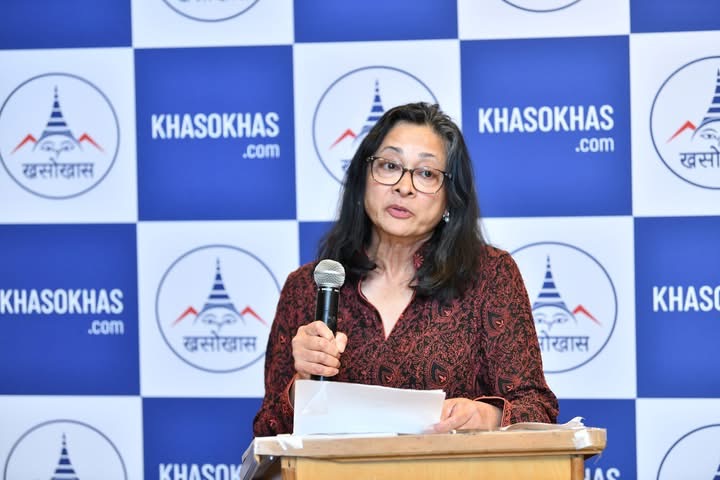
Thank you. We may be on different coasts. We’re on the West Coast. You guys are here on the East, but we share the same purpose. Our community, the South Asian community, is five million strong, and small ethnic media newsrooms like ours are the voices of our people. We’re your voice, and we serve a really critical function. We represent communities, whether they are Nepali, Somali, Afghan, Punjabi, Indian, sharing stories, providing information and resources, and advocating for the issues that matter to you.
And most importantly, we do this through a culturally sensitive lens. And what does that mean? We report on the issues that everybody has been talking about. For example, we report on immigration. How do the latest twists and turns in immigration policy affect you, your families, your livelihoods, and your immigration status?
Our community is aging. There are more people here growing older. So we look at what health issues you’re dealing with and how cuts to Medicare and Medicaid affect you. Our families are multigenerational. Many of us live with parents at home and are caring for older parents and elders. What are the burdens for caregivers, and how do we help them?
And with the elections coming up, you want to know about the contenders running for office. How do they represent your concerns? So these are some of the issues that we as community journalists focus on.
I’d like to give you a few examples of what we call public service journalism. Several people mentioned how that is becoming more important. We’re not just reporting the news.
We’re participating in community events that help the community. What we’ve done in the past is we’ve held community workshops where we invite people in the community and discuss ballot propositions, so when you go to vote, you know what you’re casting your vote for. You understand what the ballot propositions are about.
We’ve partnered with assembly members. Assembly Member Ash Kalra in California, we held a health resource fair because many elders in the community did not know where to go for help or how to get a bus to a medical center. So we gathered all the resources in the community and had a health fair and invited seniors not just from our community, but from the Vietnamese community and the Filipino community.
We made it open to people from other communities so that they could get this information. And another important thing that our organizations are involved with is civic engagement. How do we get our community more involved in participating in democracy? One of the big issues that affects our community is language barriers.
So one of the things we did in the last election was translate how-to-vote information into several languages in downloadable PDFs.
So that’s what we are doing. In addition to reporting on all the news that’s going on, we find ways to help the community and advocate for them. So I want to move on to where we are in this current media ecosystem. We face new challenges. There are attacks on press freedoms, which many of you spoke about, and AI.
Most of you have been on your phones. I’m assuming that’s where you get most of your news from. You’re not really reading newspapers anymore. And as a result, like Kashkas, at India Currents, we’ve become fully digital.
That’s where we disseminate information. But what that means is the digital world has opened the door to what we call rogue players. They are mischief makers, bots, and AI.
They spread rumors and falsehoods, which you all have referred to, misinformation and disinformation. These are not credible sources of news. They spread so much fear. For example, they spread fear of the other, of immigrants, people wearing turbans, or people wearing hijabs.
What’s happening as a result is a spike in racist attacks against these immigrants. They cause confusion in immigrant communities by reporting falsehoods about deportation or about birthright citizenship.
So ordinary people on their phones and tablets have no real way of knowing what’s real or true.
So that’s where community media has a very important role. There are people behind these news outlets. People like Kishor and Suresh, people like myself and my team. We’re real people, we’re not bots, and there are real names, real faces, and we’re providing real independent news.
Our teams, like Khasokhas and India Currents, have deep roots in the community, and that’s why you all trust us. That’s why I think many of you read out so many supporters. You all trust your news platform, and that’s why you’re supporting it, because they are telling authentic stories and there is evidence behind these stories.
It’s not fake. They’re giving you facts based on evidence, and that’s really important for us in today’s world. We need to fight against censorship and whitewashing in news and support independent reporting. Question what you read before you start to spread it. Make sure your source is authentic.
And if you are listening to Khasokhas, you know it’s authentic. A free press is essential for a healthy democracy and to hold powerful groups accountable, not serve as a propaganda tool for the powerful, but be transparent and give ordinary people reliable information that empowers them to make informed decisions, because we believe in freedom of expression.
So I want to say thank you all for coming out to support an independent press and Khasokhas, and it’s been a pleasure to be here this evening. Thank you. Congratulations.
Suresh Shahi: Thank you so much, Meera. And I would like to invite the Chief of Staff from New York State Senator Jessica Ramos’ office, District 13, Mirna L. Velasquez. Please welcome to the stage.
Mirna L. Velasquez: Good evening. My name is Myrna Velasquez. I represent State Senator Jessica Ramos. It’s a pleasure to be with you tonight. I regret that she was unable to accompany you tonight, and I want to congratulate your team at Khasokhas. I hope I did not mispronounce it.

I have been working with your community for a very long time, and I’m just grateful that just yesterday we had a meeting in our office with journalists and district leaders from the Nepali community. It’s very important the work that you have been doing, especially because it’s not only about spreading the news, but also being a good connector to inform your own community.
The reason why we met yesterday is because it’s important to pass this information out to your community, especially because many of them do not speak English. So in order for us to convey an accurate message and educate our communities, it is through these news channels. Many times when we are talking about immigration, which is my area of expertise, many people do not know how to navigate the system.
So by having wonderful connections with newsletter outlets like yours, we can convey not only an accurate message but also let people know how they can take advantage of the services that we provide. In this very interesting time that we are living in, it is very sad that people are taking advantage, that these groups are taking their money and not providing good service.
Anyway, I don’t want to extend because I know you have a very long list, but I just wanted to convey a message. This celebration is very important, especially to the senator, because before becoming a state senator, she served as director of Latino media for former Mayor de Blasio, so this is something she deeply cares about.
So again, congratulations, and thank you so much for inviting us. I really appreciate it.
Suresh Shahi: Thank you so much. Next, I would like to invite Nepali American community leader, activist, and a very good news for the Nepali community, the candidate for New York State Assembly District 30 in Queens, Somnath Ghimire. Please welcome to the stage. Let’s support Somnath Ghimire for District 30 this year. The election is coming soon, so he will speak more about that.
Somnath Ghimire: Thank you. And congratulations to Khasokhas on its 14th year of celebration here today, and many more to come. I wish them all the best in the coming years. I am a Democrat running in the primary election, which is on June 23rd.
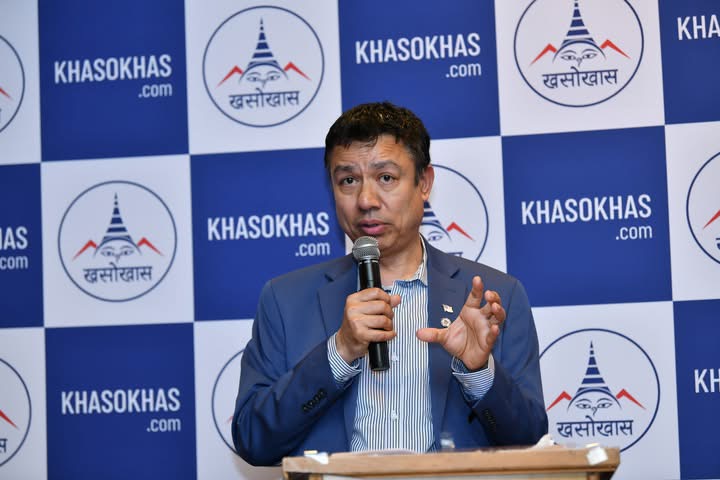
And good news, I’m number one on the ballot. So this is a real time to win. I have been in the community for the last 28 years working for our communities who really need help and uplifting them together. I am the only candidate in the district working from the bottom to the top. That means from the grassroots level, uniting all our AAPI leaders, South Asian leaders, focusing especially on the real needs of the people. And I got the title of serving the people in the district.
So again, please, let’s come together and make this happen. Let’s win it as I’m number one on the ballot. A lot of constituents and voters, when I was knocking on doors, asked me, “Why does your palm card say, ‘Hire an assembly member who works for you’? Why hire, the word hire? Why not elect?” I explain, “Hire is a word that if you donate me a dollar, five, ten, fifteen, whatever, that means you are hiring me to work for the people.”
“Oh, this is a new style of running your campaign?” “Yes, of course. This is a new style of running my campaign. Please hire me again.” I am focusing on four agendas. The first is expanding affordable housing and protecting tenants’ rights. That will be my top priority.
Then full funding for our public schools and local youth programs. I have a plan to bring youth leaders in the district together, connecting them with elected officials and experts so they can share, advise, and uplift youth who are affected by drugs and other challenges in the district.
Then ensuring safer streets and supporting small businesses.
I have a plan for supporting small businesses, focusing especially on women entrepreneurs who lack access to resources provided by the government and the city. If I win, I will bring those resources.
Like Nelson Mandela said, “I win, but I never lose. Instead, I learn.” This is the process of learning I have been going through. The United States is a land of opportunities. Not only economic growth, not only becoming rich, but also opportunities to join the political mainstream.
As a Democrat for the last 22 years, working with the party since Barack Obama, our great president, ran for office, I was inspired. I would say Barack Obama is my political father figure in the United States, who gave me encouragement, education, and most importantly, empowerment to join mainstream politics.
Working closely since then, I ask, why not me? As Martin Luther King Jr. said, “I have a dream.” We all have a dream.
I never thought, as an immigrant in 1996, as an F1 student, that I could run for this seat in the New York State Assembly. But here I am standing in front of you all, and please let us work together.
This is the real time to work, and this is the real time to win. We will win together. Thank you so much for the opportunity.
Suresh Shahi: Thank you and all the best. And next, I would like to invite community advocate, small business champion, and Democratic candidate for the New York State Assembly District 37, Melissa Orlando. Welcome to the stage.
Melissa Orlando: Thank you, Suresh. Thank you, Khasokhas, for having me here today. Good afternoon. Namaskar. Today is an auspicious day. Not only is it the 14th anniversary of Khasokhas, but it is also World Press Freedom Day. My name is Melissa Orlando, and I am honored to be here today as a candidate for the 37th Assembly District.

Fourteen years ago, Khasokhas began as a bridge for the Nepali community in New York, but it is more than a newspaper. It is a lifeline for the Nepali diaspora. From debunking viral misinformation to providing critical information on immigration, housing, and health, Khasokhas has turned press freedom into community empowerment.
Today, press freedom around the world is at a 25-year low. Independent news organizations like Khasokhas and essential community-centered journalism are a strong line of defense for truth and local identity. I congratulate you on your Press Forward grant to strengthen Nepali community journalism.
We can see that independent information and accountability are essential for democratic survival. I stand with you today celebrating independent journalism and Khasokhas that gives a voice to the community from Kathmandu to Queens.
On a personal note, Nepal has a special place in my heart. I spent time there during university doing research, and it is wonderful to be welcomed by the Nepali community. From my platform, I am an advocate for small business and have spoken with members of the Nepali community about my plans.
I am also an advocate for affordable housing, tenants’ rights, the environment, and protecting immigrant communities. Some of us arrived here recently, some a long time ago. My family came through Ellis Island in New York City, so we have been here for about 100 years.
Older immigrants, newer immigrants, we all deserve to be protected and welcomed as a full part of New York City society. I will stand with you. I hope to have your support. Thank you again for having me here today. I really appreciate it.
Suresh Shahi: Thank you so much and all the best. Next, I would like to invite Tseyang Tenzin. She is a community leader working for the Asian community. You have seen her in multiple different programs. She is advocating for the Asian community and Himalayan community.
Tseyang Tenzin: Thank you so much, everyone. Before I begin, I want to give a big round of applause to everyone who is still here after all the speakers. Thank you so much. Give yourselves a big round of applause.

My name is Tseyang. I met Suresh five years ago during the COVID-19 pandemic when we were ensuring that all New Yorkers get the COVID vaccine. The pandemic did not discriminate based on language, national origin, ethnicity, or skin color. It affected everyone.
That reinforced the democratic value of equity. Equity means looking deeply, not just at the surface, at what the community is facing, the nuances and barriers.
During COVID-19, I remember that information was being disseminated in the top 10 languages, but Nepali and Tibetan were not included. Are we safe? We are not. We are all New Yorkers, whether we have been here 10, 15, 20, or 100 years. We all deserve the same information from our government.
That is when I realized we need representation in government. In 2021, I worked with the Tibetan and Nepali communities to ensure representation at the city level.
In 2022, I worked for City Council District 26 and made sure it was the first and only district providing information in Tibetan and Nepali languages. We also celebrated the first Losar at City Hall Chambers.
When we focus only on what is trending or powerful instead of what truly matters, we ignore minority voices. In 2022, during redistricting between Woodside and Jackson Heights, I worked on informing the Nepali community about how redistricting affects them.
Khasokhas played a key role in informing the community about this issue and its impact on Nepali and Tibetan New Yorkers. Community media is essential, and what Khasokhas does is very important.
We have all worked together over the years, and I hope we continue to do so. We will not let AI, misinformation, or disinformation win.
I am Tibetan. When the earthquake happened in my father’s land, Dhingri, I saw AI-generated images of babies under rubble, which is ethically unacceptable.
Mainstream media also misused names of Tibetan places, using Chinese propaganda terms instead of proper names. They did not use Dhingri. D-H-I-N-G-R-I is where my father is from, but they used Tingri. This is similar to colonial renaming practices, and it shows why community media is important.
Today, I want to congratulate Khasokhas on its 14th anniversary and World Press Freedom Day. I am honored to be part of this.
Suresh Shahi: Thank you so much for coming. Next, I would like to invite Amit Shah. He is a big supporter of Khasokhas, Community Board 6 member, and Mithila Center USA founder and president. Amit Shah, please welcome to the stage.
Amit Shah: Good evening and namaste. First of all, on behalf of the Community Board, Queens Community Board 6 chair, as well as myself, president and founder of Mithila Center USA, I would like to congratulate Khasokhas and the entire team on this great milestone, the 14th anniversary celebration.

As already said, Khasokhas has stood firm to inform, empower, and educate the community. This is a great milestone, and all Nepali communities should be proud of it. Today is also the celebration of Press Freedom Day, which the United Nations declared in 1993 through a resolution. This is Press Freedom Day.
Mithila Center USA was established with the flagship event Art for SDG, the Mithila Heritage, to promote the Sustainable Development Goals of the United Nations through Mithila heritage, which is one of the ancient southeastern heritages of South Asia.
We had the honor to join and collaborate with Khasokhas to organize the first-ever Press Freedom Walk today.
Thank you to everyone who was able to participate in this historic event. Once again, thank you.
As many of the distinguished speakers have already spoken about the Khasokhas milestone and the work they have done in the community and their future, I am not going to talk much more about that because they are the experts.
Also, while celebrating Press Freedom Day, I would like to remind everyone that now is the time for us to integrate our Nepali American diaspora into a broader sense by connecting with the AAPI community, the Asian American Pacific Islander community. This month is also celebrated as AAPI History Month.
So this is a triple celebration: not only are we celebrating Khasokhas’s 14th anniversary and Press Freedom Day, but we are also celebrating AAPI History Month, which is celebrated by the United States government to promote our identity and recognize our contribution to the mainstream of America.
And let us not forget that every Asian American has contributed and left a footprint in the mainstream of America. We have a perfect example in our own community, with delegates elected to the mainstream, like Harry Bhandari, and many other aspiring leaders, like Som Najy and others, who are on the way to making their mark in representing our community in the mainstream of America.
Mithila Center USA, which started the Art for SDG, the Mithila Heritage Exhibition in 2019 at the United Nations headquarters with the support of the Permanent Mission of Nepal, has been organizing this exhibition annually in New York and around the world.
Last year in Times Square, we announced the world tour of this Art for SDG, the Mithila Heritage Global Exhibition, to promote Mithila heritage as well as the Sustainable Development Goals of the United Nations.
I am very pleased to announce, for the very first time, that this year this entire exhibition series of Art for SDG, the Mithila Heritage, will be exhibited at the European Union headquarters in Brussels, Belgium. From June 5 to 20, we will be traveling with this beautiful southeastern heritage artwork to exhibit it at the European Union headquarters in Brussels, Belgium.
We are very happy to have Khasokhas, as well as New Yorkers, be part of that milestone. So once again, congratulations, Kishor Panthi, and the entire team of Khasokhas for this milestone achievement, and we will be working together.
As I said earlier, being a community organizer, advocate, and cultural advocate, I also understand how important community media and community journalism are. It is not just about publishing news, but also about making our identity and integrating our community, while also providing resources to move our community forward and empower it.
Once again, thank you for this opportunity. Have a wonderful evening, everyone. Thank you.
Suresh Shahi: Thank you, Mr. Amit Shah, for your support. Next, I would like to invite Bishnu Maya Poudel-Yar. She is a social activist, social entrepreneur, and champion for Dalit women’s rights, gender equality, and human rights, and founder of the Association for Dalit Women’s Advancement of Nepal, ADWAN. Dr. Bishnu Maya Pariyar-Yar, please welcome to the stage.
Dr. Bishnu Maya Pariyar: Namaste, everyone. First of all, I am so honored to be here today to celebrate this very important day, the 14-year milestone of Khasokhas, and also Press Freedom Day.
We do not only celebrate these days as Press Freedom Day. We honor and recognize all those journalists and brave journalists who have lost their lives while exercising their profession.

We would like to honor and remember all those people.
I have known Kishor Panthi before Khasokhas started. I remember that day, I think you were speaking on the media, like White Himal’s anniversary, before 14 years ago.
That day I was just sitting there, and he told the audience that he would be starting the media. I do not know whether you mentioned the name or not, but I remember that day. Since then, I have seen how hard he has worked to bring Khasokhas to this level.
Now he has all these partners and colleagues helping. But I have seen that, whether we travel together or he is in Niagara Falls or in the car traveling, his laptop is always with him. No matter where he is, if there is hot news or if he has to report, he stops and publishes the news.
That is why I think Khasokhas is not only media. In my view, this is the voice of voiceless people and works for grassroots communities.
Kishor Panthi knows that I run English classes for immigrants in New Jersey.
Most of our students are women. I bought more than 100 books that Kishor Panthi has written about immigration. Thank you so much for providing this very important information to our community.
As Harry Bhandari said, I was looking at your invitation and saw these very important words: inform, empower, and advocate. That is exactly what Khasokhas has been doing.
I know many people talk about authentic journalism, right? Grassroots communities, especially women, during and after COVID, and the immigration issue is very hot now, right?
Everyone is so scared, and going to a lawyer is not easy because it is expensive, and people also do not understand it. So Khasokhas is the only media, I think, providing this very important information.
Not only the immigration issue, but also, as Kishor Panthi spoke before, we have done a program together on mental health.
As you know, so many students and women who are victims of sexual violence and domestic violence have been going through so much mental health stress. We organized a mental health program together, and I have talked to him, Suresh Shahi, and everyone that we should do this very often.
Also, during Domestic Violence Awareness Month, we did the event together, and so many community members and individuals contacted us.
So thank you so much for your hard work, and congratulations to the entire Khasokhas team for this 14-year milestone. We look forward to seeing more, and good luck and best wishes to all of you. Thank you.
Suresh Shahi: Thank you, Dr. Bishnu Maya Pariyar. I would like to invite Nepali American immigration attorney at Chhetri and Associates P.C., Chhetri Law in New York City, with over three decades of experience in immigration law, business law, real estate, and civil litigation, Mr. Khagendra Chhetri.
Khagendra Chhetri: Good evening, namaskar. Respected leaders, community members, and the entire team of Khasokhas, including Kishor Panthi, I am very happy to be here, and it is a great honor and joy to stand before you to celebrate the 14th anniversary of Khasokhas.

It is a voice that has become a vital thread in the Nepalese immigrant community. Fourteen years ago, Khasokhas began a simple but powerful mission to inform, connect, and advocate for the Nepalese community. The trust has become even greater. Now it has become the most trusted news media for our Nepali community.
Congratulations and thank you for that. I really appreciate that, and you deserve that position.
For many immigrants, the journey is not easy. We always try to dream amid uncertainties, and we do not know our rights, what will happen in the future, or our place in this new society.
In those moments, you have come forward and provided accurate information and a sense of community that are very vital to our Nepali community. We really think that whenever we want to see anything far away, including news from Nepal, we always look for you.
Whatever we get from you, we try to communicate among our community members. I think this is very important, and I think this is a milestone we can talk about.
Fourteen years is not a joke because now you are actually growing from infancy to adulthood, and it is a great celebration.
In our Nepali community, what we say is that after 14 years, someone becomes an adult. That is what you have become, and you have survived it. I think you can handle yourself from now on. It is great news for all of us.
We will continue, and you will continue too, conserving our community despite all kinds of situations.
There are not many Nepali newspapers surviving now, so it is very important that you keep this up. Media is important now. As we go into AI and all kinds of things, I think you will still play a vital role in the coming days. With that, great wishes. I would just like to end my two minutes.
Thank you very much for providing me this space. I think it is very important. It has not only benefited the Nepalese community here, but also in Nepal. We have to remember that. Thank you so much. Namaskar.
Suresh Shahi: Thank you so much, Mr. Khagendra Chhetri. Next, I would like to invite Mr. Ramesh Shrestha, Nepali American immigration attorney with over 28 years of experience and founder of Shrestha Law Firm PLLC in Manhattan, New York.
Ramesh Shrestha: Thank you, I met Kishor 14 years ago when he was running White Himal TV, and after that White Himal Newspaper, and then he continued his journey. I am very proud to be part of the Khasokhas team.

We were always together during Trump’s first term, the COVID time, and now Trump’s second term. I was looking at a couple of things online that I thought would be relevant to quote.
I found some quotes: “Journalism is what maintains democracy. It is the force for progressive social change.” Another quote is: “Journalism is the protection between people and any sort of totalitarian rule. That is why my hero, admittedly a flawed one, is a journalist.”
The other one I found was: “I think people should be consumers of journalism.” So we cannot really separate ourselves from journalism because we are part of it. We are a family. We are together. We are a community. We cannot separate ourselves from journalism, like community media and community journalism, because we live in a family and are part of the community.
I was also looking at the code of ethics for journalists. I found this list: seek truth and report it, minimize harm, be careful. When you write something, think about how you will help somebody or hurt somebody. You have to balance it. You have to understand who your audience is and who is going to look into your articles and the information you provide to society. So you have to be very, very careful and act independently.
You are not going to work for somebody. It is not like somebody is going to tell you what to do and that you are just a tool for their goal or ulterior motive. You have to be able to act independently.
The last one I found is be accountable and transparent. When you write something, you are going to be accountable. You are not going to say, “Hey, I mistakenly wrote something, and I do not know. Maybe I made a mistake.” You cannot do that. You are going to be responsible for it, and it has to be transparent. It is not just some kind of vague thing because this is the digital age. As other speakers already mentioned, there is AI and all this digital content; it is a worldwide wave, and there is good news, bad news, fake news, and all kinds of news coming out.
We do not know which is right, which is wrong, whether I am reading the right thing or something that is misleading me. These are the things I found, and I can confidently say that Khasokhas is really in compliance with all these codes of ethics.
I have seen Kishor Panthi and his team closely, very closely. We are like brothers working together. If there is any problem, he calls us: “Ramesh Dai, let’s do…” Dai means brother. Because we call each other like brothers, let’s do something because there is news, something is happening, there is a law coming out, or there is a proclamation that is going to hurt so many people. Let us spread the word to society, not only the Nepali community, but also the South Asian community and beyond.
I have been watching Kishor Panthi and his team, Suresh Shahi, Deepak Pariyar, Rajan Thapaliya, and so many others involved in this.
I wanted to make sure this team is doing the right thing and not manipulating or misusing their ability. I check his articles from time to time. I read everything and make sure it is accurate and not misleading anyone.
There are so many innocent people who will look at it and rely on it.
Sometimes my clients call me. I have been a lawyer for 30 years, and they say, “Hey, I saw this in Khasokhas.” I tell them, “It is true. You can rely on that. It is correct. It is not inaccurate. Yes, the law came out, and this is going to hurt so many people. This is going to happen. You better make a quick move. Do something. Look for some other options.” TPS is going to expire, or it is going to be terminated. Something is going to happen. We have been yelling and screaming at everybody, “Do something.” TPS means temporary protected status. It is obviously not permanent protected status.
That is why today I am here standing in front of you, all distinguished guests, celebrating Khasokhas’s 14th anniversary. Now it is not a teenager. It is now entering adulthood, and we are very proud of it and proud of all of you, the team.
I just want to warn that you should continue this continuity, consistency, and perseverance. Make sure that you are doing the right thing. Make sure that you are helping yourself, helping your community, helping other people, and making our lives easier. When a client tells me, “I saw it in Khasokhas,” I say, “Thank you so much. You are not going to ask me so many questions.” It is right there. You read it. You have everything there.
That is how Khasokhas has become part of the community, and we all rely on it.
I am very proud of it, and I want to congratulate Kishor Panthi and his team. I wish you will continue this journey, and we will all be together. Thank you so much.
Suresh Shahi: Thank you so much, Mr. Ramesh Shrestha. I would like to invite Mr. Bashu Phulara, Nepali American immigration attorney and founder of Basu D. Fulara PC Immigration Law Firm, headquartered in Times Square.
Bashu Phulara: Thank you very much. Let me start the journey from Khasokhas to the law office of Basu D. Phulara. In 2011, when I started my practice, my reference here is Khagendra Dai. I want to acknowledge him first. When I started my journey from the Chhetri and Associates, I was not a teenager at that time, I was in my mid-thirties.

My journey started from 2011. Now I am in my golden fifty, and my hair shows that I am in that phase. But I still feel young. It has been 14 to 15 years. It is all happening with me and with the Khasokhas team. Kishor Panthi is here. We have been together since 2011–2012. We were born together in this journey. In all ups and downs, we have been together. Sometimes we have money, sometimes we do not, but we keep moving forward through struggle. That struggle also gave me the opportunity to grow together with Khasokhas. I was in my mid-thirties then. You can estimate my age now. Khagen Dai still looks young, and I feel like I am getting older.
Here I am not only speaking about myself, I am connecting with the Khasokhas team. My close friend Kishor Panthi is here. I will introduce my other close friends as well, because Khasokhas has a dynamic team. I have been legally advising Khasokhas since 2011–2012. We started with nothing, from a small room. But look at Khasokhas now. It has grown as a strong voice in community journalism.
As an immigration attorney, I can say that legal work is based on ethics. Journalism also has ethics. In legal practice, we can only advise within the law. But journalists can bring community stories forward, build public confidence, and build trust through their work. They can give voice and freedom to people. Once a case comes to us, we can only advise. We cannot always go public because of ethical limits. But independent press freedom, which we are discussing today, has a stronger foundation in journalism than in any other field. Khasokhas has provided that to the Nepali-American community.
I would like to introduce a few people here. The Chief Editor of Khasokhas is here. We also have a dynamic team. Dr. Rajan Thapalia is here, whom many of you may know. Kishor Panthi is also well known. In a young age, Dr. Rajan has joined the Khasokhas team, which has a brilliant group. Suresh Shahi is always shining and hosting programs. Even now, Kishor Panthi and I are speaking in Nepali interviews, but look at Suresh’s programs.
Then our Deepak Pariyar is also here somewhere. Their team is very dynamic. Deepak Pariyar also runs many community-based programs in Nepali. Let us give them a big round of applause. They deserve appreciation.
Last year also, I said that Khasokhas can be compared to The New York Times and The Wall Street Journal for the Nepali diaspora. I said we should pay tribute to their role. Independent journalism is something this team has contributed in a way that is hard to fully describe.
As a lawyer, I know how complex immigration law is today. There are many challenges, especially during the Trump era. Lawyers have limitations in what they can do. But journalists are doing something very important for the Nepali community. Khasokhas has helped five to six hundred thousand Nepalis in the United States, including many who do not have legal documents, by explaining issues in simple Nepali language and reducing complexity. That is something lawyers alone cannot do. Lawyers and journalists are working together, each in their own role.
For this independent press freedom, I salute the entire Khasokhas team. I will not speak too long today. Thank you very much for giving me the opportunity to serve as a legal advisor to Khasokhas. We will continue to work together in the future. I wish you continued success. Thank you.
Suresh Shahi: Thank you so much, Mr. Bashu Phulara. Now we would like to invite Nepali-American entrepreneur, social activist, and wellness advocate based in Maryland, Mr. Lok Tiwari.
Lok Tiwari: Thank you. Namaskar everyone. Good evening all. First of all, I would like to congratulate the Khasokhas team. It is in its fourteenth year, still a teenager. But behind what we all have spoken well about Khasokhas, the journey to reach here has not been easy for Kishor Panthi, Rajan Thapaliya, Suresh Shahi, and Deepak Pariyar. Only a few people may truly know how difficult it has been.
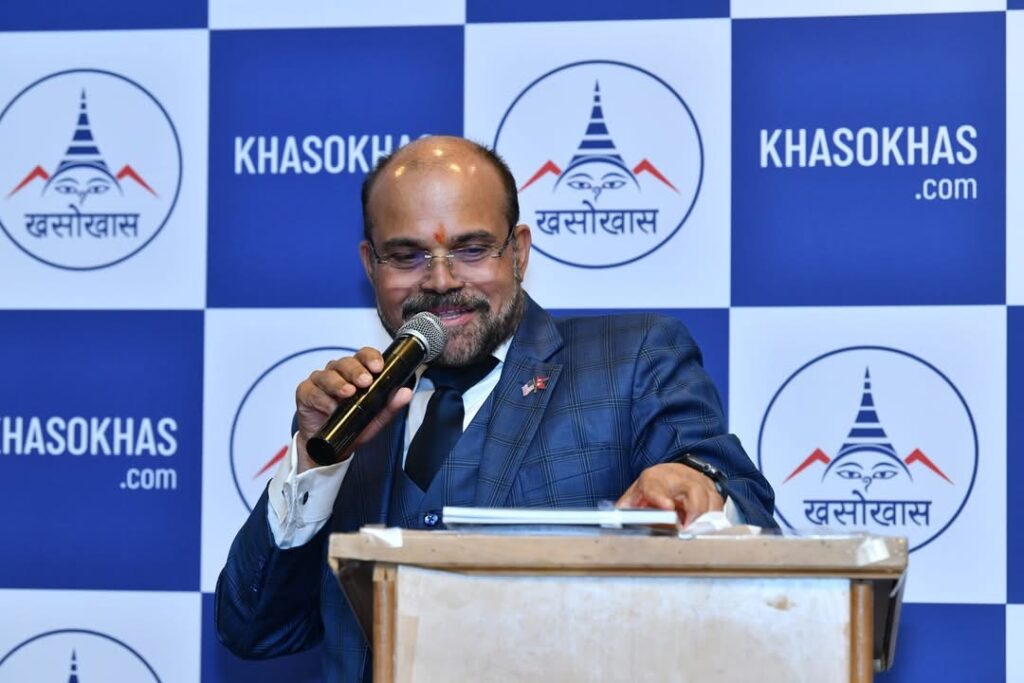
Many times, even in the rain, we used to walk holding umbrellas. When I came here, hai used to say, “Let’s go.” We used to go together, pick up papers, go door to door, and distribute them.
I live in DC, and he used to post around twenty to twenty-five newspapers. So I had to go door to door and leave them, or sometimes at temples. That is how we grew. It was a very tough time.
But even now, in the Trump era, the community and diaspora are still facing difficulties. In this situation, I believe you need to work even harder because people are confused about what is going on.
Khasokhas has always brought factual immigration-related information forward. Because of that, Nepali people rely on Khasokhas whenever they need information about visas or their children’s status. So I would like to request you all to continue investigative work and bring out more truth in the coming two to three years, which are still going to be difficult.
You have already come a long way with honesty and progress. Keep it up. I wish you continued success. Once again, congratulations to all of you. Thank you so much.
Suresh Shahi: Thank you so much, Lok Tiwari. Speaking of recognition, the Mithila art you saw today was created by Shivangi Singh and Mahendra Rauniyar. Thank you so much. Now I would like to invite Dharma Bhattarai all the way from Michigan. He is a Nepali American community leader and entrepreneur based in Michigan.
Dharma Bhattarai: Thank you. The three main principles of community media are inform, empower, and advocate. I have been connected with Kishor Panthi since almost 14 to 15 years ago, from the very beginning. As a founding board member, I feel proud to be part of this journey. Many respected speakers have already spoken.

There is a Nepali saying that if others keep talking, you just go along with it, so I will not speak too much. From Michigan, I have also worked as a kind of legal advocate for the Nepali community, like respected Ramesh Dai, Bashu Sir, and Khagendra Dai.
The truth of media is that truth is always one. What you are doing in media today is almost like a role of an advocate. I say this also from a business perspective. Media also needs to be sustainable like a business to survive.
In the United States, we have thousands of successful Nepali business owners. It is also our responsibility to support media like Khasokhas.
Recently, I opened a branch and started a franchise called The Breakfast Club. We currently have eleven locations in Michigan and have created employment for hundreds of Nepalis. I encourage all Nepali entrepreneurs to support media like this in any way they can.
Sometimes misleading information spreads quickly through social media, creating fear and confusion about deportation or other issues. Khasokhas has been correcting such misinformation.
I also request embassy officials to improve services. Many students face issues with passport renewal and communication. Phones are not answered, and services are delayed. This is a serious concern.
From Michigan and Ohio, I respectfully request improvements in embassy services.
I will not speak much more as many respected political leaders are present here. As a writer, I always believe in truth. Do not let truth bow down. Kishor Panthi, please continue your journey without pause. The community is fully behind you.
Many Nepali families are benefiting from your online portal, especially in difficult times. Legal experts here are also contributing their advice.
Earlier, when we came, it was just about meeting someone and getting small help. Now we have moved forward to structured processes like registration and employment systems. We must continue to grow professionally and support each other.
We all started this journey together. Kishor Panthi and I have come a long way together.
I fully support Kishor’s work. The main duty of journalism is to deliver truth and accurate information to the public. What Khasokhas has been doing for the Nepali diaspora and immigrants is truly important.
Please give a big round of applause to Kishor Panthi and his team. Thank you so much for giving me this opportunity. I wish Khasokhas continued success in its mission of serving the community and continuing this important work. Namaste, Jay Nepal.
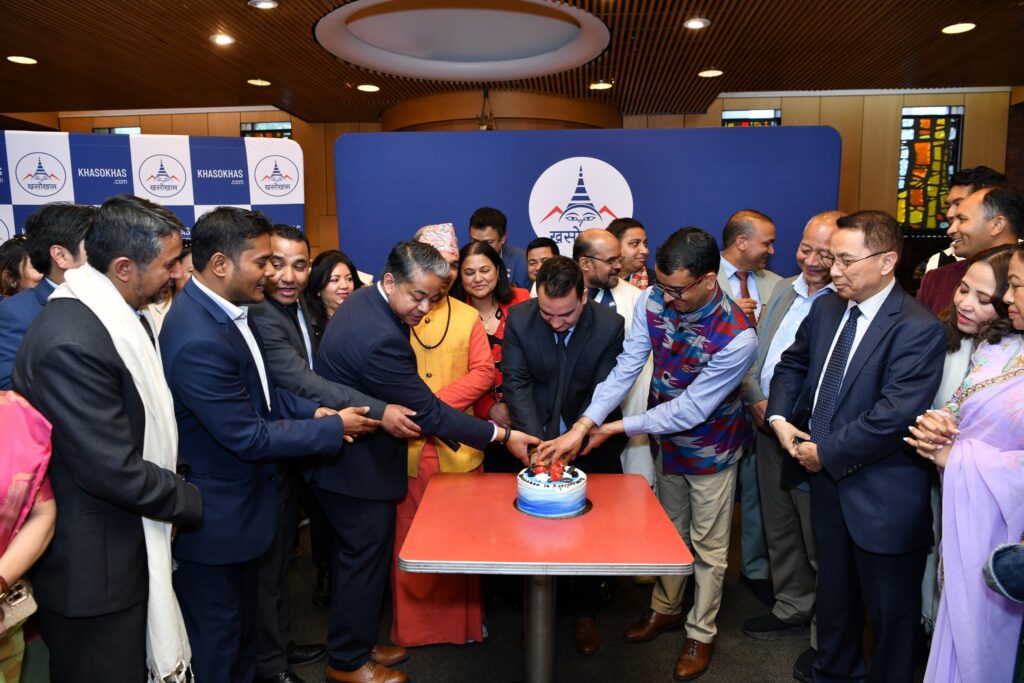
Community members, business owners, legal professionals, healthcare workers, and entrepreneurs were called on stage and recognized with Community Excellence Awards and appreciation. The program concluded with a celebratory cake-cutting to mark the anniversary, followed by closing remarks from Rajan Thapaliya, who thanked everyone for attending and supporting the journey of Khasokhas. He emphasized the importance of collective effort, community solidarity, and continued engagement to strengthen the platform in the years ahead.
Click here to see photos from the award ceremony.
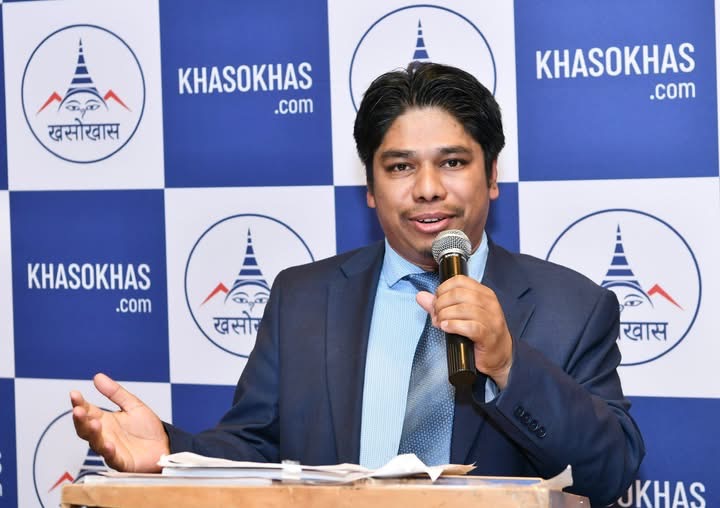
Note: This transcript was transcribed and translated by AI and lightly edited by editors. All photos were taken by Rajan Kafle.

NepYork News Staff
View More PostsNepYork News Staff comprises a dedicated team of reporters and editors collaborating to gather, verify, and report essential local news and information. They focus on delivering concise news items that are relevant to the community. NepYork utilizes authentic news coverage and cultural representation to make visible the diverse and vibrant experiences of Nepali individuals, ensuring their stories are heard and valued.