
The House Appropriations Committee has released its Fiscal Year 2027 appropriations bill and the accompanying report. In the document, the Committee reaffirms support for Tibetan refugees and highlights serious concerns over rights restrictions in Nepal.
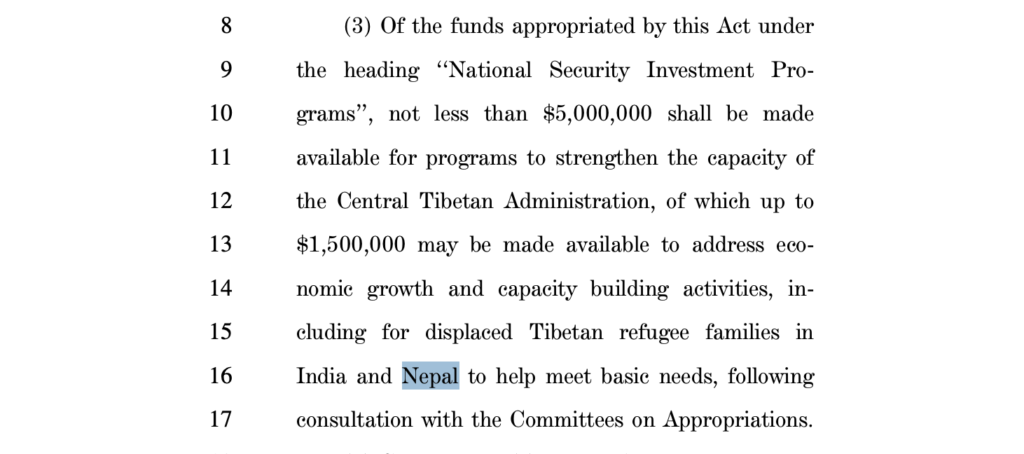
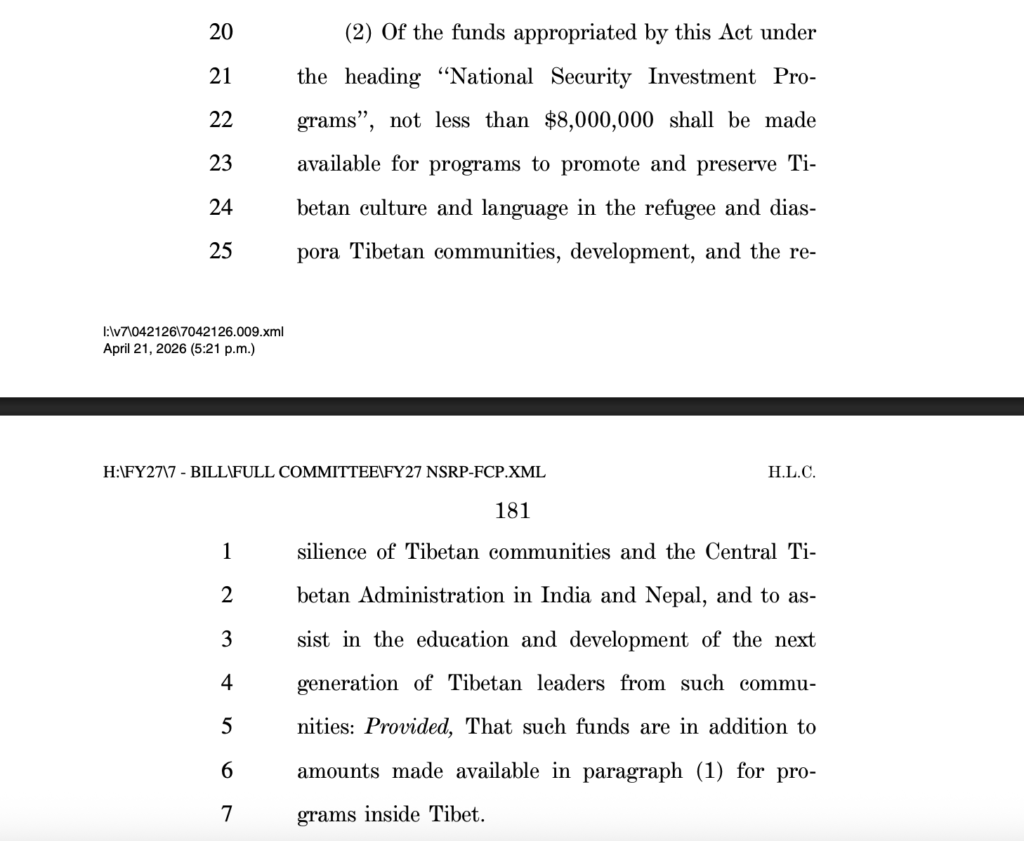
In the report, the committee directed that funding to assist Tibetan refugees in Nepal and India continue at levels commensurate with prior years, ensuring stable humanitarian support for these vulnerable communities. It also called for no less than the previous year’s funding to promote human rights and democracy within Tibetan communities while directing continued resources for the Office of the Special Coordinator for Tibetan Issues.
The report further supports the implementation of the Ngwang Choephel Fellows Program and Tibetan exchange and fellowship initiatives, consistent with the Tibetan Policy and Support Act of 2020.
Committee members voiced growing alarm over the situation facing Tibetans in Nepal, noting that recent agreements between the Nepali government and the People’s Republic of China have restricted basic rights and increased vulnerability for both residents and those transiting through the country.
The committee urged the Secretary of State to press Nepal to honor its agreements with the United Nations High Commissioner for Refugees, particularly the principle of non-refoulement, which prohibits the return of refugees to places where they face persecution.
“The Committee supports continued funding to assist Tibetan refugees in India and Nepal at levels commensurate with prior years. The Committee remains concerned that Tibetans living in Nepal are restricted from enjoying certain basic rights resulting from agreements in recent years between the governments of Nepal and the PRC, which has resulted in increased vulnerability for Tibetans both within and transiting through Nepal,” the report reads.
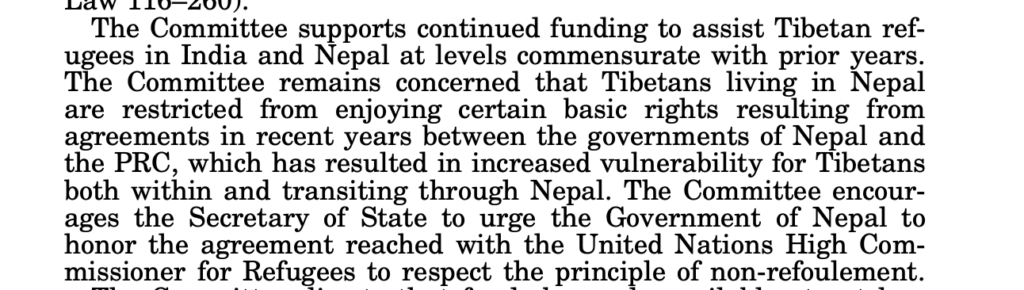
The report further states, “The Committee encourages the Secretary of State to urge the Government of Nepal to honor the agreement reached with the United Nations High Commissioner for Refugees to respect the principle of non-refoulement.”
These measures are part of a broader $47.32 billion appropriations package that advances an “America First” foreign policy. The bill includes up to $400 million for the Countering People’s Republic of China Influence Fund to address global activities of the Chinese Communist Party and at least $1.8 billion to strengthen U.S. national security interests in the Indo-Pacific region.
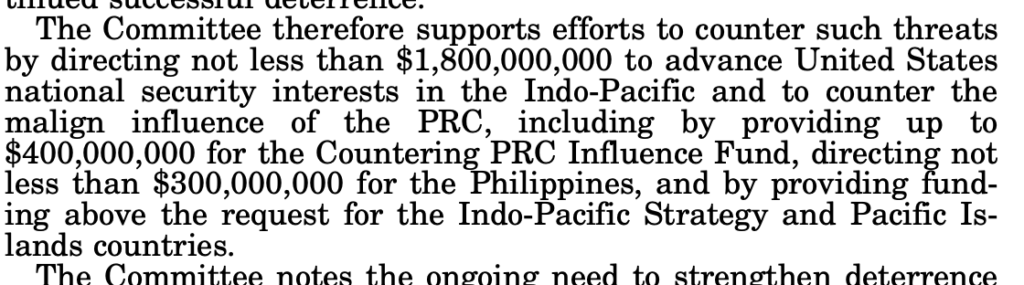
“The Committee therefore supports efforts to counter such threats by directing not less than $1,800,000,000 to advance United States national security interests in the Indo-Pacific and to counter the malign influence of the PRC, including by providing up to $400,000,000 for the Countering PRC Influence Fund, directing not less than $300,000,000 for the Philippines, and by providing funding above the request for the Indo-Pacific Strategy and Pacific Islands countries,” the report reads.
“The Committee notes that financing infrastructure development remains a strategic priority for the United States in the Indo-Pacific, including in PICs. The Committee notes the intense geopolitical competition in the region with the PRC, the existence of large unobligated balances at DFC, and the need for DFC to act with greater dispatch,” the report reads.
Lawmakers also directed the Secretary of State to consider countries’ United Nations voting records and their cooperation in opposing adversaries when determining certain types of assistance.
Presenting the bill to the full committee on April 28, Subcommittee Chairman Mario Diaz-Balart said the legislation strengthens national security while reducing spending, including $2.7 billion in cuts below current enacted levels.
“If you are a friend or an ally of the United States, this bill supports you. If you are an adversary or are cozying up to our adversaries, then you will not like this bill,” Diaz-Balart said in remarks.
He emphasized that the bill maintains or increases funding for key strategic priorities, including $1.8 billion for partners in the Indo-Pacific, with $500 million in military assistance for Taiwan, as well as support for the Philippines and Pacific Island countries.

Kishor Panthi
View More PostsKishor Panthi is the founder and editor-in-chief of Khasokhas and NepYork. He is the author of three books, “Kampan,” "UNTRANSLATABLE" and “Zero Mile.” He writes about social issues, immigration, and politics.

