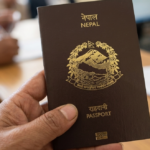
Nepal’s passport has slipped to one of its weakest positions on record, with visa-free access falling to 35 destinations, according to the Henley Passport Index 2026 (May global ranking).
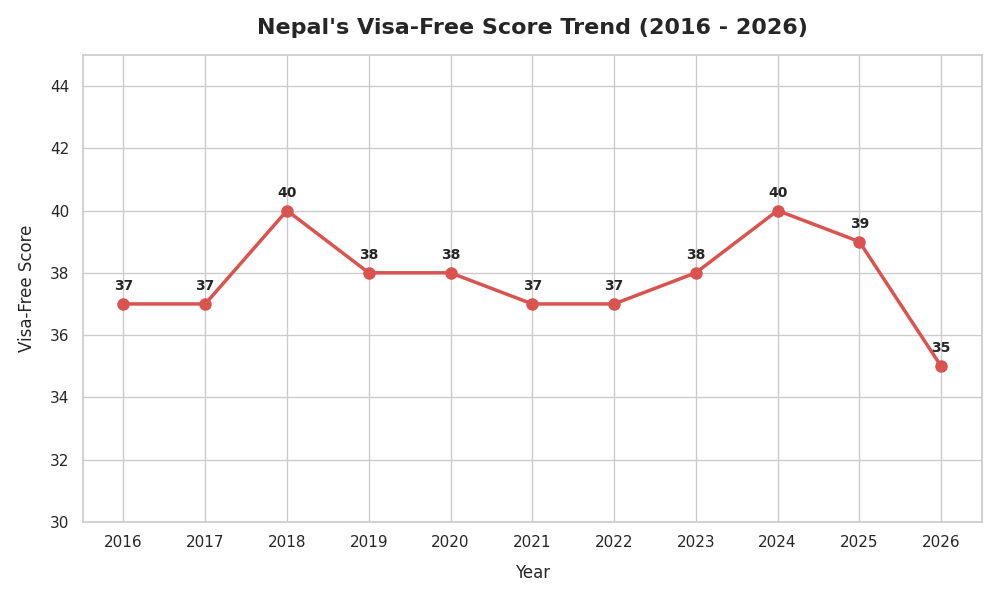
The latest report by Henley & Partners shows Nepal ranked 97th globally, tying with North Korea as the seventh-weakest passport in the world. Despite minor shifts in ranking compared with 2025, Nepal’s actual travel freedom has declined, with its visa-free score dropping from 39 last year to 35 in 2026.
The decline marks the lowest level for Nepal in recent years. Historical data show Nepali passport holders previously had access to between 37 and 40 destinations without prior visas. The score stood at 40 in 2024, 38 in 2023, 37 in 2022 and 2021, 38 in 2020 and 2019, 40 in 2018, and 37 in both 2017 and 2016.
The report defines visa-free access as travel without a prior visa, including destinations offering visa-on-arrival. The current drop means Nepali citizens can now travel to only 35 countries without obtaining a visa in advance.
North Korea, which ranked above Nepal in 2025 with a score of 41, has also declined to 35 this year, placing both countries jointly at 97th. Nepal now occupies the position held by Somalia last year; Somalia’s score fell further from 35 to 32 in 2026. Yemen’s score also declined, dropping from 33 to 31.
The report indicates a broader global trend of declining mobility among lower- and middle-ranking passports. Nigeria fell from a score of 46 in 2025 (84th place) to 44 in 2026 (90th), while the Democratic Republic of Congo and Myanmar dropped from 46 to 43, ranking 91st.
Ethiopia and Lebanon now rank 92nd with scores of 42, while South Sudan and Sudan stand at 93rd with scores of 41. Libya and Sri Lanka rank 94th with scores of 39, and Iran and Palestine rank 95th with scores of 38. Bangladesh, another regional neighbor, saw its score fall from 40 to 36, pushing it to 96th place.
The world’s weakest passports have also deteriorated further. As of May 2026, Yemen (31), Pakistan (30), Iraq (29), Syria (26), and Afghanistan (23) rank as the five weakest, all recording declines from the previous year.
Experts say Nepal’s declining passport strength reflects weak international relations, limited diplomatic engagement, and policy shortcomings related to travel and mobility. The trend is expected to directly affect Nepali citizens, making international travel and visa processing more restrictive and cumbersome.

Kishor Panthi
View More PostsKishor Panthi is the founder and editor-in-chief of Khasokhas and NepYork. He is the author of three books, “Kampan,” "UNTRANSLATABLE" and “Zero Mile.” He writes about social issues, immigration, and politics.