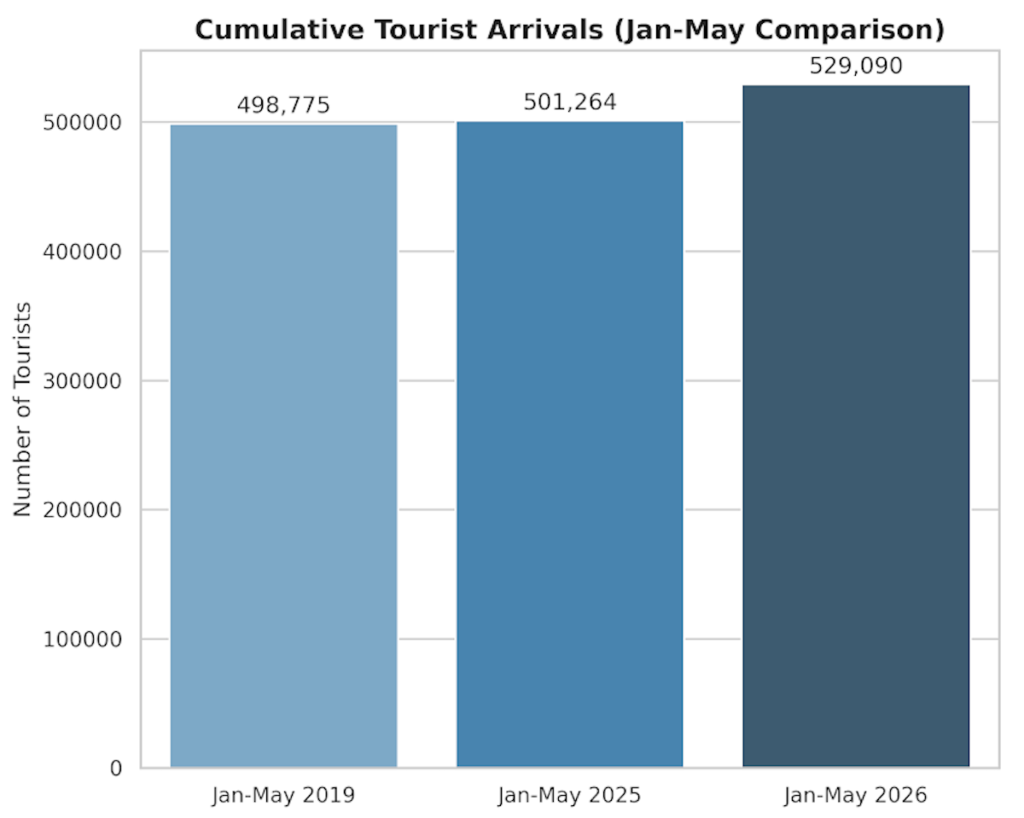
Nepal has welcomed more than half a million foreign tourists in the first five months of 2026, signaling a continued recovery from the COVID-19 pandemic, but industry stakeholders say the surge has yet to translate into broad-based optimism.
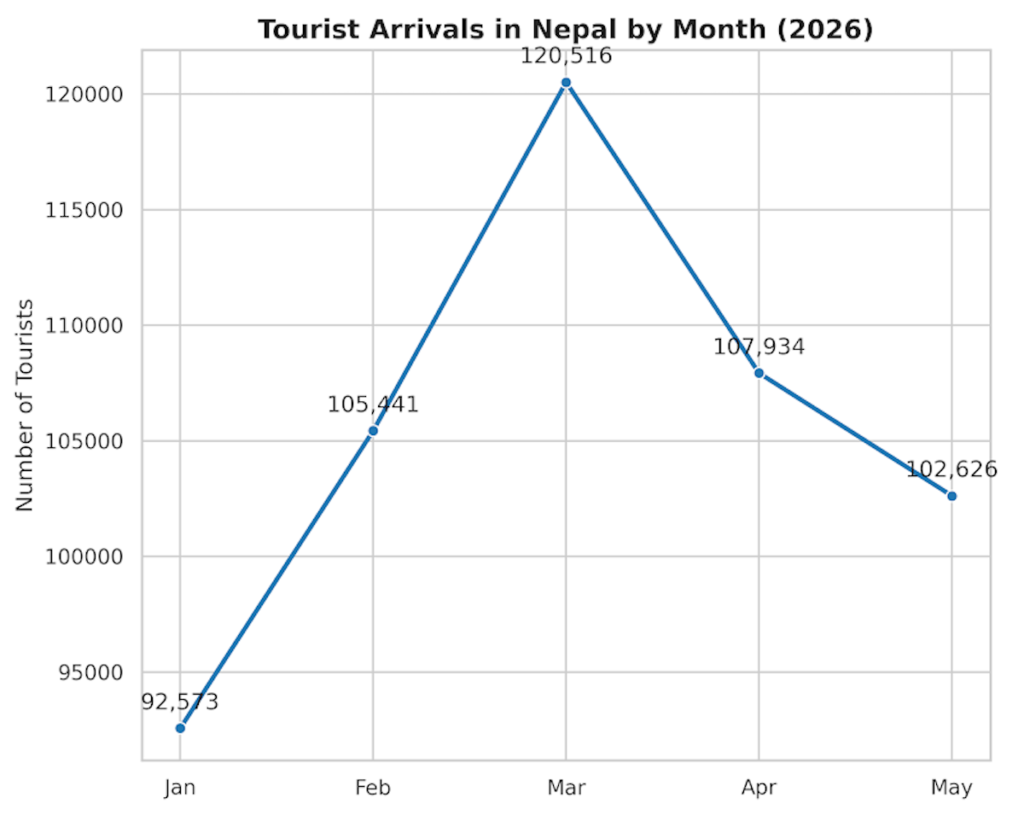
According to the Nepal Tourism Board, a total of 529,090 international visitors arrived in the country between January and May. In May alone, Nepal received 102,626 foreign tourists, a 19% increase from 86,216 in May 2025 and nearly 31% higher than the pre-pandemic level of 78,329 recorded in May 2019.
Tourist arrivals from the United States have emerged as a significant contributor to Nepal’s tourism market. In the first five months of 2026, 44,845 American visitors traveled to Nepal, placing the United States as the third-largest source market after neighboring India and China. American tourists have shown strong interest in trekking, mountaineering and cultural heritage tourism.
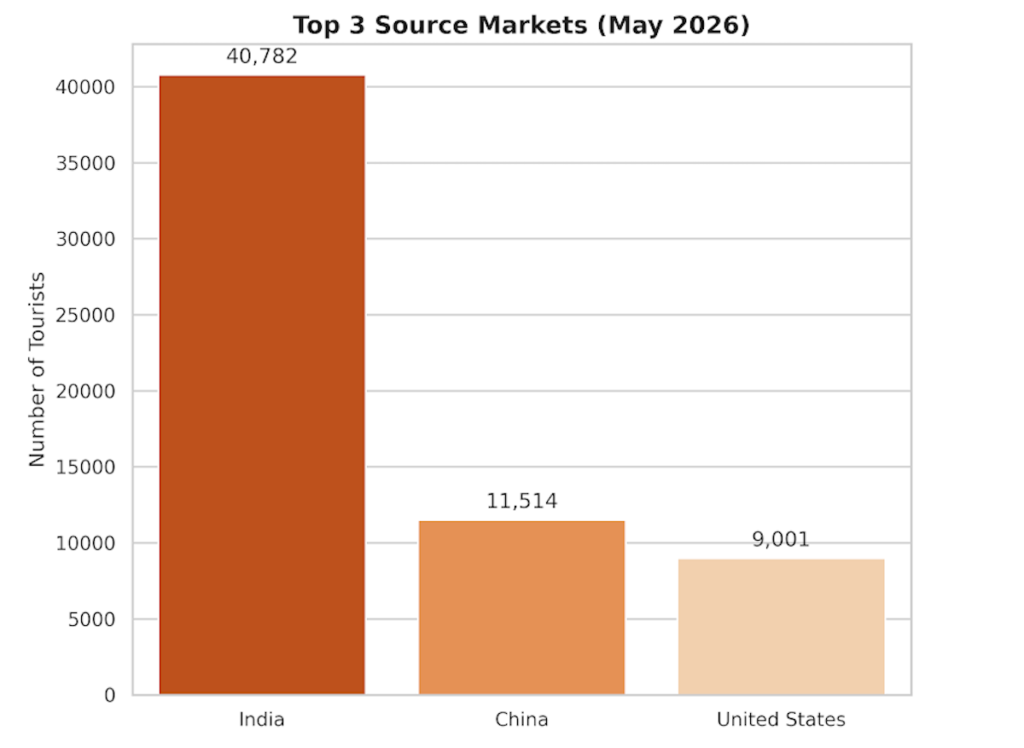
India remained the largest source of visitors in May, with 40,782 arrivals. China ranked second with 11,514 visitors, followed by the United States with 9,001. Other notable source markets included Bangladesh, the United Kingdom, Australia, Malaysia, Japan, Russia and Germany.
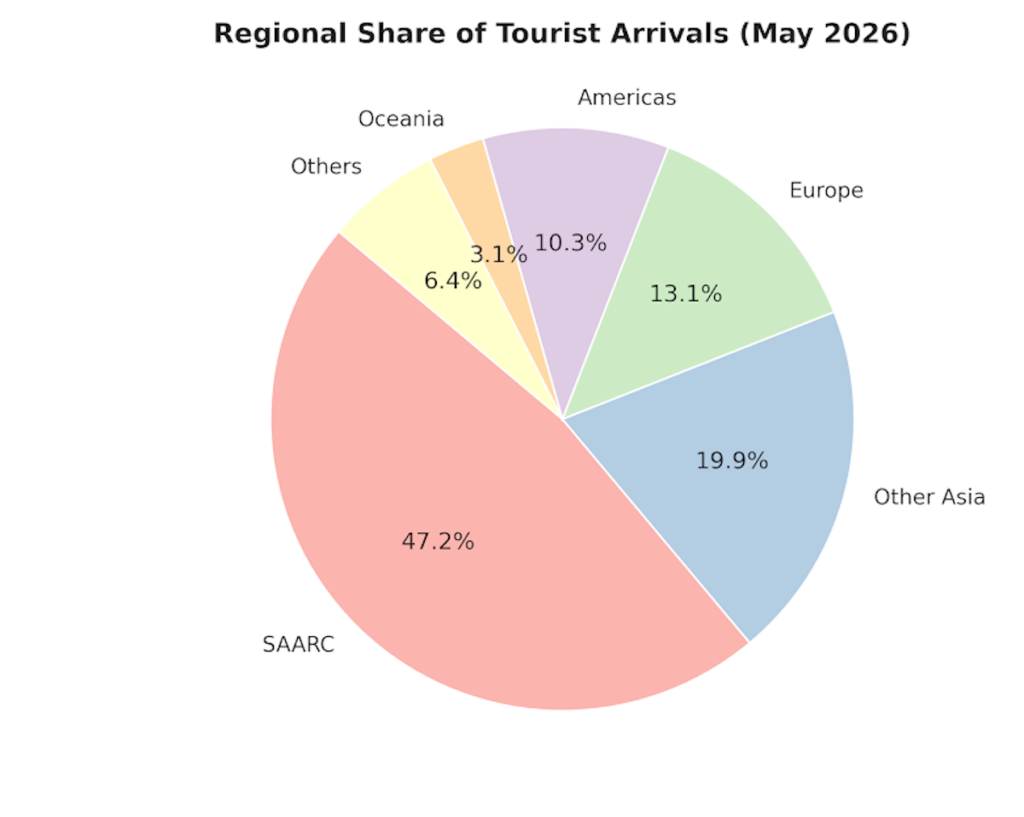
Regionally, visitors from SAARC countries accounted for 47.2% of total arrivals in May. This was followed by other Asian countries at 19.9%, Europe at 13.1%, the Americas at 10.3% and Oceania at 3.1%. Smaller shares came from the Middle East, Africa and other regions.
Tourist arrivals have remained consistently strong throughout the year. Nepal received 92,573 visitors in January, 105,441 in February, 120,516 in March and 107,934 in April, bringing the total for the first four months to 426,464.
The 2026 figures exceed both last year and pre-pandemic levels for the same period. Nepal recorded 501,264 tourist arrivals between January and May in 2025, while 498,775 tourists visited during the same period in 2019.
Despite the steady rise in visitor numbers, tourism entrepreneurs say the recovery is uneven and falls short of expectations. Bhavishwor Sharma, former president of the Thamel Tourism Development Council, said increased arrivals alone do not indicate a healthy tourism sector.
He said that compared to Nepal’s tourism infrastructure and capacity, the current number of tourists is still not sufficient. He added that the traditional distinction between peak and off-seasons has become unclear in recent years.
Sharma noted that while there has been some increase in high-spending tourists staying in five-star hotels and traveling in organized groups, the benefits have not spread evenly across the industry. Trekking activity appears satisfactory, but participation in city tours, hiking, mountaineering and other tourism activities remains relatively low.
He added that many tourism businesses continue to face financial pressure, struggling to meet bank repayments, pay staff salaries and cover operating costs. According to him, the tourism sector has yet to fully return to a stable and satisfactory condition.

Suraj Ghimire
View More PostsSuraj Ghimire is a Nepali journalist based in Kathmandu. He focuses on political, social, migration, and international issues. He has also worked with various national television networks in Nepal.