Following the catastrophic arson and vandalism during the recent protests on September 9, 2025, the Government of Nepal has urgently escalated its call for contributions to the Physical Infrastructure Reconstruction Fund. The initiative was formalized through a cabinet decision on September 21, 2025. Recent arson and vandalism caused an estimated $2 billion USD in damages to public and private infrastructure.
The Nepali Consulate General in New York has echoed this appeal, urging the U.S.-based Nepali diaspora, non-resident Nepalis (NRNs), and American allies to support Nepal’s recovery. “We would like to sincerely request all Nepali brothers and sisters, the non-resident Nepali community, American friends, and organizations to participate in this campaign,” the Nepali Consulate General in New York appealed through social media.

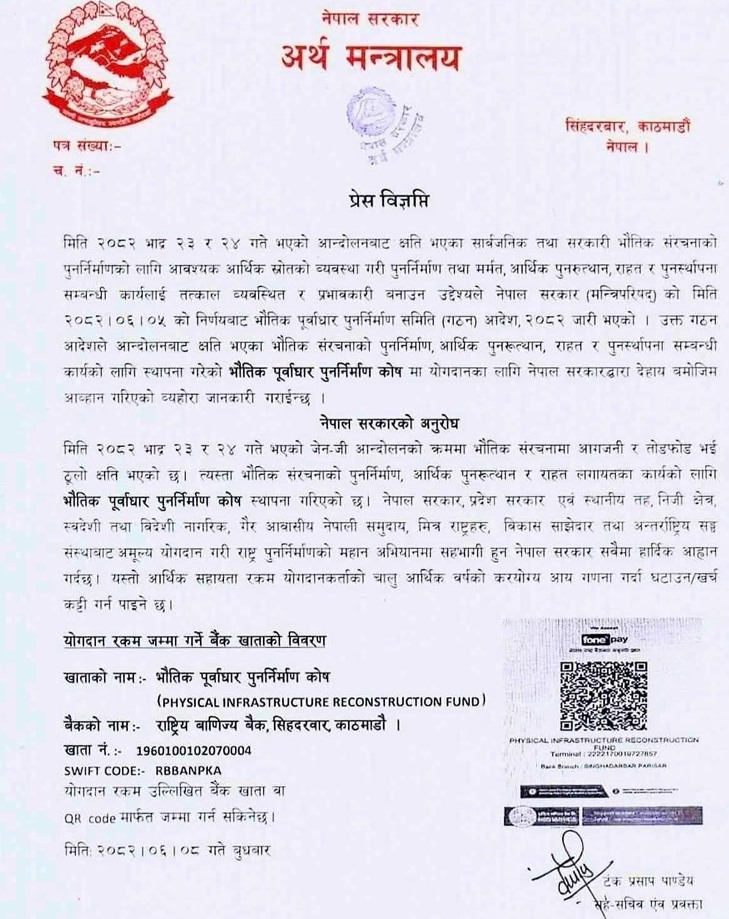
A press release from the Ministry of Finance reinforces the government’s commitment to swift rebuilding, economic revitalization, and relief efforts. The Government of Nepal established the Physical Infrastructure Reconstruction Fund to facilitate the reconstruction, repair, economic recovery, relief, and rehabilitation of public and government infrastructure damaged during the protests.
The government earnestly appeals to federal, provincial, and local governments, Nepali citizens, foreign nationals, the NRN community, international organizations, development partners, and non-governmental organizations to contribute to this fund and join the campaign of national reconstruction. Contributions to the fund are tax-deductible, allowing donors to deduct their donations from taxable income for the relevant fiscal year.
The Gen-Z protests, sparked by a controversial social media ban, rapidly escalated into widespread unrest on September 8. Frustrated by systemic corruption and economic inequality, thousands of young Nepalis, led by students and tech-savvy activists, took to the streets.
Just a day after violent clashes claimed at least 19 lives, protesters defied a curfew to set fire to the parliament building, Singha Durbar, and the residences of political leaders. Demonstrators stormed Singha Durbar, Nepal’s main administrative center for over 115 years, and set it ablaze, torching nearly all the ministries within the complex. Protesters also targeted other government buildings, political homes, the Supreme Court, and media houses.
The violence claimed at least 100 lives, including protesters and police, and injured hundreds. The Nepali Army enforced a nationwide curfew and evacuated leaders by helicopter. The protests forced Oli’s resignation on September 9, paving the way for former Chief Justice Sushila Karki to assume the role of interim prime minister.
The Physical Infrastructure Reconstruction Fund, managed by a high-level committee chaired by Finance Minister Rameshore Prasad Khanal, is central to Nepal’s recovery strategy. With 270 government buildings destroyed and 360 partially damaged, the fund will support immediate repairs, economic stabilization, and victim relief.

Susan Shrestha
View More PostsSusan Shrestha is a Europe-based journalist. He covers a wide range of topics, from local matters to global affairs. Shrestha previously worked as a reporter for Khasokhas in Nepal.