
Nepal’s Supreme Court has issued an interim order halting the deportation of four former Bhutanese refugees who were arrested in Nepal after being deported from the United States. The individuals, identified as Ashok Gurung, Sandip Darji, Roshan Tamang, and Ashish Subedi, were detained by Nepal Police and handed over to immigration authorities. They are currently held at the immigration office in Kankadbhitta, Jhapa.
The court’s decision follows a legal petition and arguments presented by lawyer Himesh Krishna Kharel on behalf of the detainees. After reviewing the case, Justice Hariprasad Phuyal’s single bench issued a habeas corpus order, directing the Immigration Department in Kalikasthan, Kathmandu, and the Kankadbhitta Immigration Office to present the detainees in court on April 24, 2025. The court also sought written responses from the authorities within three days, excluding travel time, to justify why the detainees should not be protected from deportation.
The four individuals were originally Bhutanese refugees registered in Nepal before being resettled in the United States under a third-country resettlement program. Although the Supreme Court’s order mistakenly refers to them as naturalized U.S. citizens, they were, in fact, green card holders. Their green cards were revoked by U.S. immigration courts at various times due to criminal convictions, which led to their deportation orders. The lack of travel documents had previously delayed their removal from the U.S., but pressure from the Trump administration prompted Bhutan to issue the necessary documents, thereby facilitating their deportation.
Upon arrival at Bhutan’s Paro International Airport, the deportees were briefly hosted by Bhutanese authorities before being transported to the border town of Phuentsholing and released. From there, they crossed into India via the Jaigaon border and entered Nepal through the Panitanki-Kankadbhitta border. Nepali authorities arrested them in Jhapa’s Beldangi area, raising concerns about their legal status and potential deportation to Bhutan or another country.
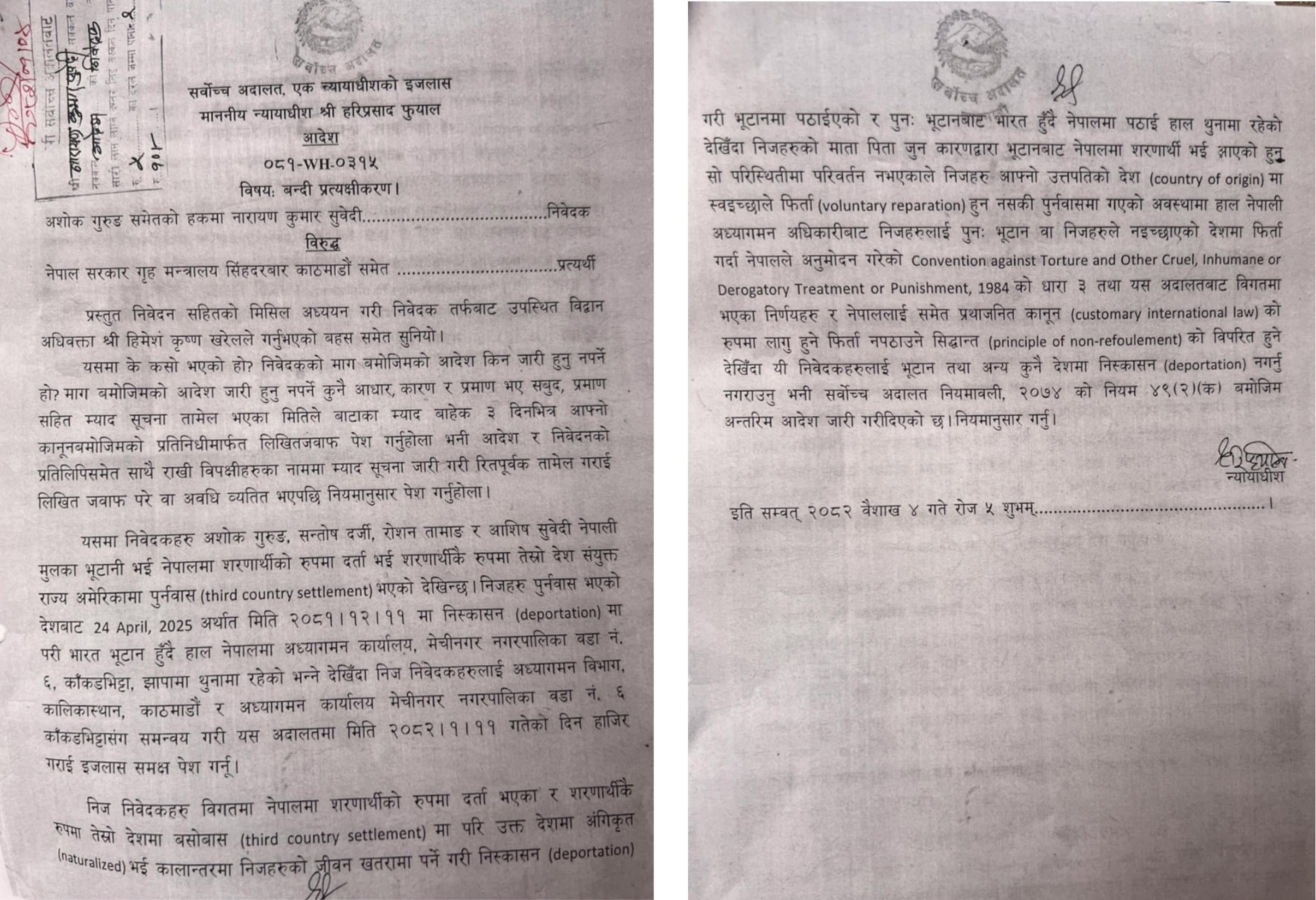
The Supreme Court’s interim order emphasizes that the detainees, whose parents fled Bhutan as refugees due to ethnic persecution in the 1990s, face unchanged circumstances in Bhutan that make voluntary return impossible. The court noted that deporting them to Bhutan or any other country against their will would violate Nepal’s obligations under the 1984 Convention Against Torture and Other Cruel, Inhuman or Degrading Treatment or Punishment (Article 3), to which Nepal is a signatory. Additionally, such actions would contravene the principle of non-refoulement, a customary international law prohibiting the return of individuals to countries where they face persecution or harm, as well as prior Nepali court precedents.
The court’s order, issued under Rule 49(2)(a) of the Supreme Court Regulations 2074, explicitly prohibits the deportation of the detainees to Bhutan or any other country until further hearings.
According to U.S. Immigration and Customs Enforcement (ICE), former Bhutanese refugees were deported for convictions for various crimes in the United States. Roshan Tamang was convicted in Cincinnati, Ohio, for serious sexual abuse, resisting arrest, drug possession, criminal mischief, and criminal trespass. ICE cited his sexual offenses as posing a significant danger to the community, justifying his deportation.
Ashok Gurung arrived in the U.S. as a refugee in 2012 and settled in New Jersey. In 2014, he was convicted of aggravated assault in Georgia, serving a three-year prison sentence. An Atlanta immigration judge ordered his deportation in July 2017, and ICE arrested him in Harrisburg on March 9 for deportation.
Maita Singh Gurung arrived in the U.S. in 2010. He was convicted in 2013 for simple assault and terroristic threats stemming from a domestic dispute involving pushing his wife and threatening her with a kitchen knife. He was also convicted in 2014 for theft. An immigration judge ordered his deportation in 2015, and ICE arrested him in Harrisburg on March 12.
Bahadur Singh Rai arrived in New York in 2011. He was convicted in 2013 in Idaho for domestic assault in the presence of a child, receiving a 90-day jail sentence, five years of probation, and a fine. ICE issued a notice to appear in August 2013, and a judge granted voluntary departure in September, which he did not comply with. ICE arrested him in Pittsburgh on March 7 for deportation.
Other Bhutanese refugees deported from the U.S., such as Budha Singh Gurung, Bidur Khadka, and Rupnarayan Kharel, were convicted of severe crimes, including rape, sexual assault, indecent assault on a minor, and endangering child welfare, leading to their deportation orders.
Since the Trump administration’s return, approximately 20 former Bhutanese refugees have been deported from the U.S., with four arrested in Nepal. Others remain unaccounted for, with some suspected to have entered Nepal undetected. The Jhapa District Police have intensified border security at Kankadbhitta following these arrests, citing the novel nature of the situation. Nepal Police are investigating whether other deportees are in Bhutan or hiding in Nepal.
Bhutan’s refusal to accept these individuals as citizens, despite issuing travel documents for their deportation, has created a statelessness crisis. After being deported to Bhutan, the individuals were promptly transported to the Indian border and released, leaving them to enter Nepal. This has sparked criticism from Nepali officials, with Jhapa’s Chief District Officer Gopal Kumar Adhikari describing the situation as unprecedented and requiring coordination with higher authorities and the Immigration Department.
The Bhutanese refugee crisis began in the early 1990s when Bhutan expelled over 100,000 ethnic Nepali-speaking Lhotshampa citizens, who fled to Nepal and lived in refugee camps in Jhapa and Morang. Through a UN-led resettlement program, nearly 85,000 were resettled in the U.S., with others relocated to Europe and Oceania. Approximately 7,000 Bhutanese refugees remain in Nepal, awaiting resolution.
Community leaders among Bhutanese refugees in the U.S. argue that deporting refugees for criminal convictions, even after serving sentences, is unjust, as they face statelessness with no safe country to return to. Human rights activists warn that Nepal’s delayed diplomatic efforts to resolve the refugee issue could exacerbate the problem, leaving deportees vulnerable.
The Immigration Department has yet to decide on the detainees’ fate, creating uncertainty. The Supreme Court’s interim order provides temporary relief, but the April 24, 2025, hearing will determine their future.

Dipendra Dhungana
View More PostsDipendra Dhungana is a journalist based in Kathmandu with over a decade of experience in photojournalism. His work has been featured in numerous national and international outlets, showcasing the stories and resilience of the Nepali people. He is also a contributing journalist for NepYork.

