Ambassador Lok Bahadur Thapa, Nepal’s permanent representative to the United Nations and outgoing president of the Economic and Social Council (ECOSOC), called for reinforced global solidarity and inclusive multilateralism during a reception marking the conclusion of the 2026 High-level Political Forum on Sustainable Development (HLPF) and Nepal’s one-year presidency of the council.
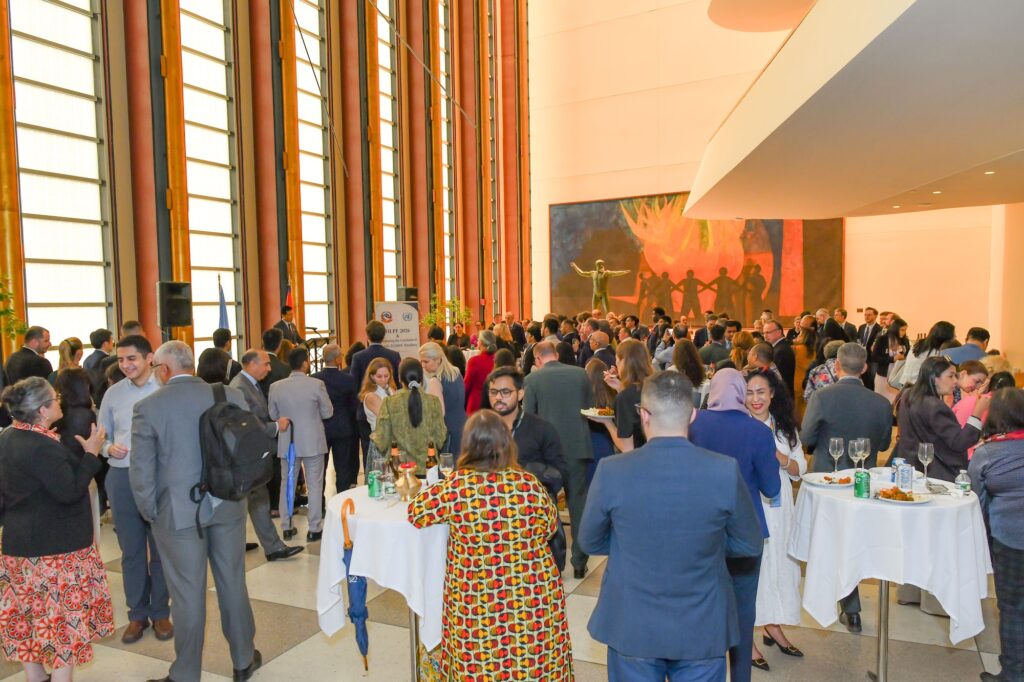
The reception, held July 15 at Sputnik Hall inside U.N. headquarters in New York, brought together ministers, heads of delegations, senior U.N. officials and diplomats to celebrate partnerships and the conclusion of the forum.
Addressing the gathering, Thapa said the weeklong HLPF reaffirmed a shared global commitment to advancing the 2030 Agenda for Sustainable Development despite mounting and interconnected global challenges.
“We have just concluded the High-level Political Forum on Sustainable Development,” he said. “Your active participation and thoughtful contributions have once again demonstrated our shared commitment to advancing the 2030 Agenda.”
The HLPF, the United Nations’ central platform for reviewing progress on the Sustainable Development Goals (SDGs), highlighted both persistent gaps and opportunities for acceleration. Thapa acknowledged that progress has been uneven but stressed that meaningful advancement remains achievable through innovation, cooperation and determined leadership.
“What is needed are innovative policies, inclusive partnerships, stronger international cooperation, and determined leadership to drive sustainable development forward,” he said.
He underscored that inclusive development must be at the core of global efforts, warning that progress cannot be sustained if vulnerable populations are left behind.
“Development cannot succeed when entire communities remain unheard,” Thapa said. “Nor can the SDGs be achieved unless those facing the greatest vulnerabilities become equal partners in shaping the solutions.”
Emphasizing the interconnected nature of today’s global crises — including poverty, climate change and inequality — he called for equally integrated responses.
“Our solutions must be equally interconnected,” he said. “No country can achieve sustainable development alone. No institution can achieve transformation in isolation.”
Thapa also linked sustainable development to global peace and security, noting that no nation can be secure unless development becomes more inclusive, resilient and sustainable for all.
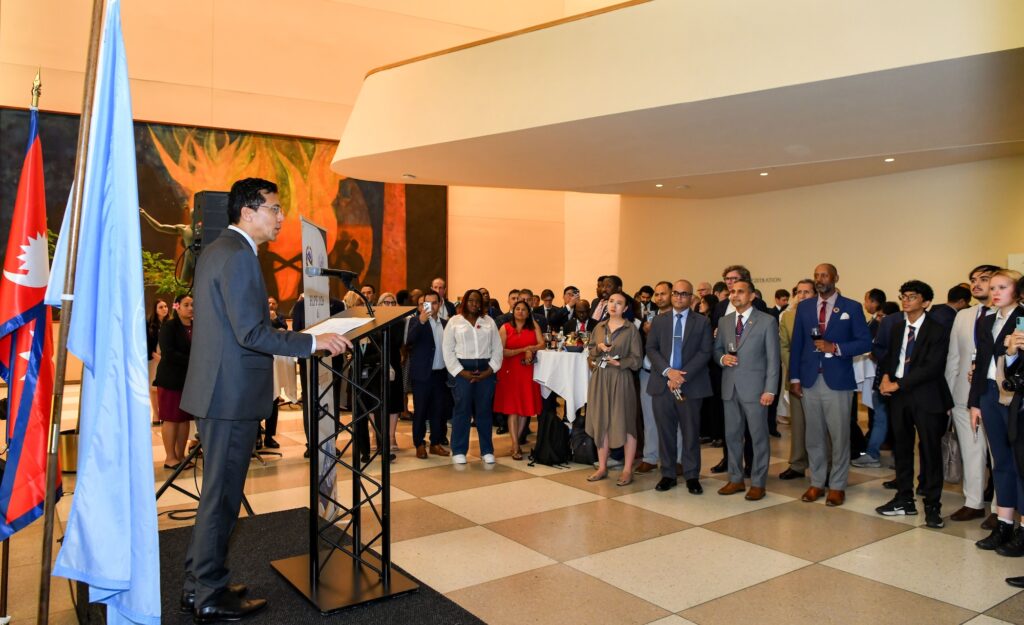
As the forum concluded, he urged member states to translate commitments into concrete actions.
“The true success of this forum will be measured not by the quality of our deliberations alone, but by the actions we take to implement the commitments we have reaffirmed here,” he said.
Reflecting on his presidency, which coincided with the 80th anniversary of ECOSOC, Thapa emphasized that international cooperation is no longer optional in an increasingly volatile and uncertain global landscape.
“When I assumed the presidency of ECOSOC one year ago, I carried with me a simple but firm conviction — that in a rapidly changing world, effective and inclusive multilateralism is not a choice; it is an absolute necessity,” he said.
He described ECOSOC as a critical platform where global commitments are aligned with national realities, facilitating dialogue, consensus-building and collective action.
“This is the place where global commitments meet national realities,” he said. “It is where ideas are translated into partnerships, and where dialogue becomes collective action.”
During his tenure, Thapa said he engaged with a wide range of stakeholders, including member states, U.N. agencies, international financial institutions, civil society, academia, local governments, youth representatives and the private sector.
These engagements, he said, reinforced a central lesson: “Our diversity is our strength, but our unity is our greatest asset.”
He noted that his presidency focused on strengthening trust among member states, advancing implementation of the 2030 Agenda, promoting policy coherence across the U.N. development system, and advancing discussions on financing for development.
Thapa also highlighted efforts to expand engagement with youth, women, civil society, scientists and local authorities, while ensuring that the voices of those furthest behind — including least developed countries, landlocked developing countries and small island developing states — remain central to global deliberations.
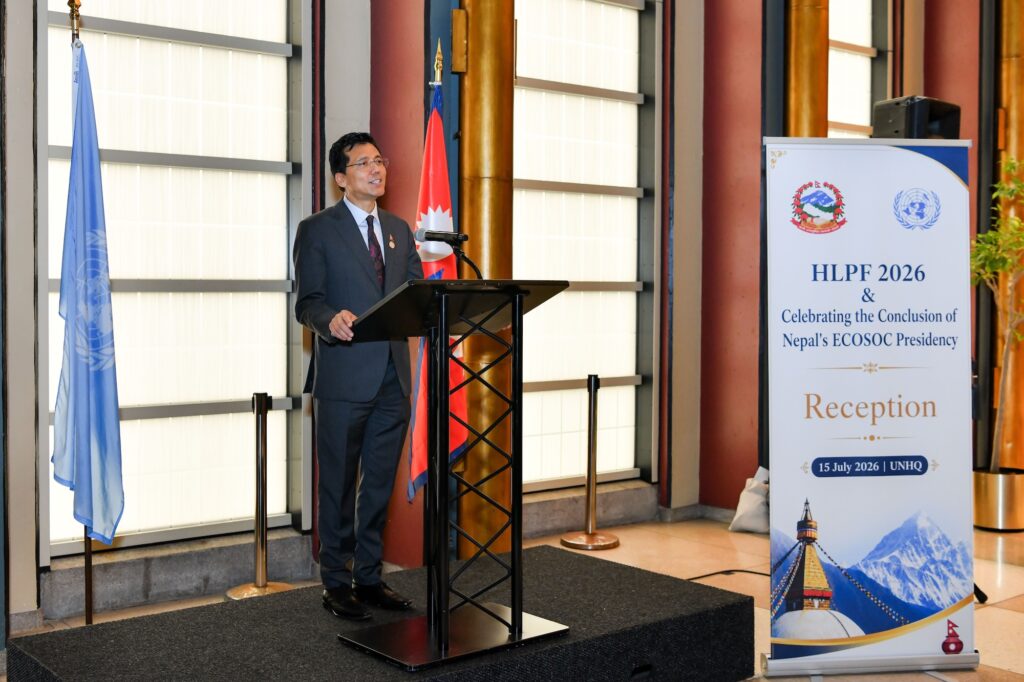
Reaffirming Nepal’s longstanding commitment to the United Nations, Thapa described multilateralism as a cornerstone of the country’s foreign policy. Since joining the U.N. in 1955, Nepal has remained an active partner in promoting international peace, sustainable development and human rights.
He pointed to Nepal’s significant contributions to U.N. peacekeeping, noting that since 1958, more than 183,500 Nepali peacekeepers have served in 44 missions worldwide, with more than 4,200 currently deployed in 12 missions.
“Their service reflects Nepal’s unwavering commitment to international peace and security,” he said.
Thapa also underscored Nepal’s continued engagement in global efforts on climate action, gender equality and the interests of least developed, landlocked and mountainous countries.
Concluding his remarks, he expressed gratitude to ECOSOC vice presidents, member states, the U.N. Secretariat and partners for their collaboration throughout his presidency.
“I believe the success of the HLPF and my ECOSOC presidency does not belong to one individual — it belongs to all of you,” he said.
The event concluded with a reception celebrating partnership, friendship and multilateral cooperation, where guests were invited to enjoy traditional Nepali cuisine.

Rajan Kafle
View More PostsRajan Kafle is a Nepali photojournalist now based in New York. He began his career in video journalism during Nepal's 2006 democratic movement. Kafle has worked for various media outlets in Nepal, including Nepal Television and Kantipur Television. He served as the official photographer for the office of the Prime Minister of Nepal from 2019 to 2021. He has been recognized for his contributions to the field with several awards.