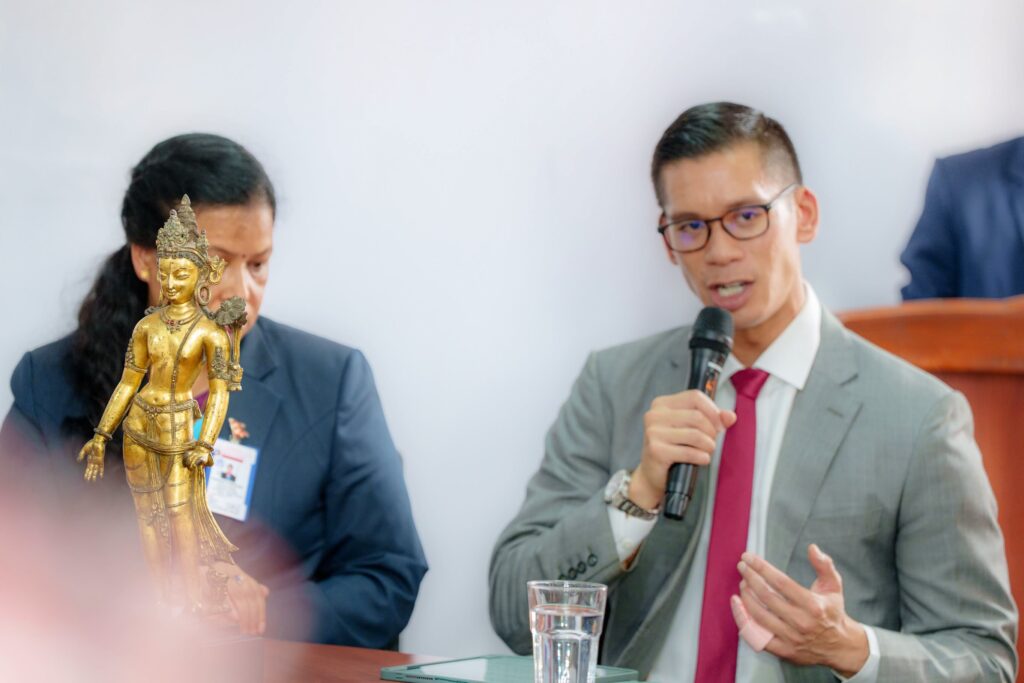
Two sacred Nepali artifacts dating back to the 13th and 16th centuries were formally returned to Nepal on Monday during a repatriation ceremony hosted by the Department of Archaeology, officials said.
The items — a 13th-century gilt bronze Padmapani and a 16th-century polychromed wooden Nrityadevi — were repatriated from the United States as part of ongoing bilateral efforts to combat the illicit trafficking of cultural property.
U.S. Embassy officials said the return reflects years of cooperation between the two countries aimed at restoring stolen or trafficked religious and historical objects to their communities of origin.
“To date, 127 Nepali antiquities have been returned from the United States to their rightful homes in Nepal,” said Mike Harker, public affairs chief at the U.S. Embassy in Kathmandu. “With the return of these two sacred statues, that record of cooperation grows stronger and demonstrates how criminal investigations, diplomatic coordination, and community advocacy can work together to disrupt antiquities trafficking networks.”
Officials also highlighted the recently enacted U.S.-Nepal Cultural Property Agreement, which is expected to strengthen collaboration on investigations, prevent trafficking, and enhance the protection of Nepal’s cultural heritage.
The United States congratulated Nepal on the milestone and reiterated its commitment to supporting efforts to safeguard the country’s historical and religious artifacts for future generations.
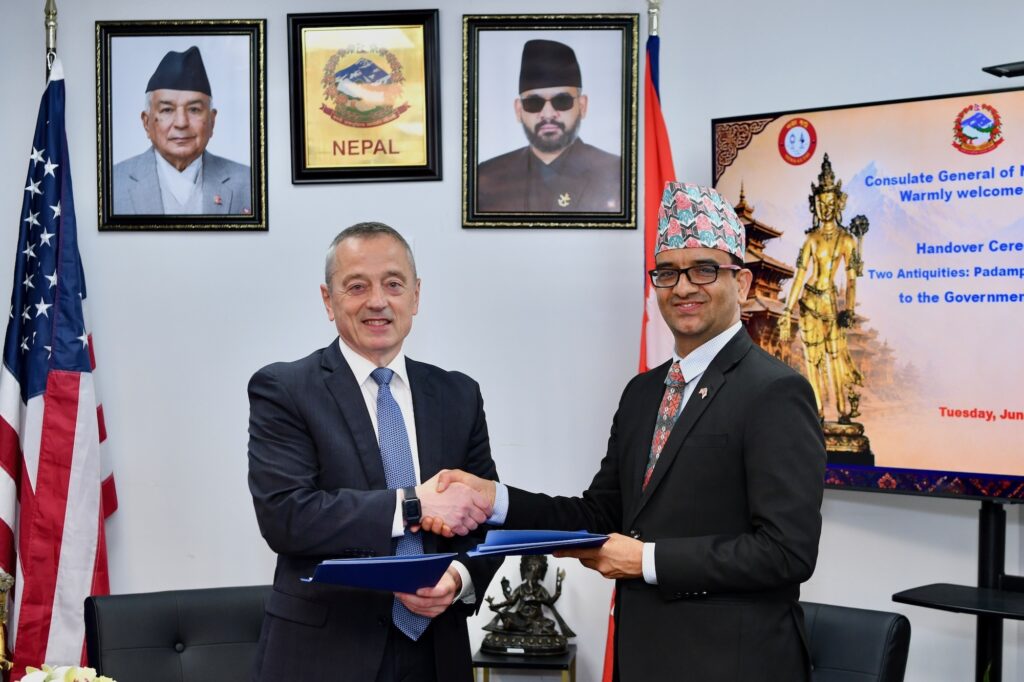
The artifacts had earlier been formally handed over to Nepali officials in New York on June 23, when the Consulate General of Nepal received them during a ceremony. Consul General Dadhiram Bhandari and Col. Matthew Bogdanos, chief of the Antiquities Trafficking Unit at the Manhattan District Attorney’s Office, signed documents transferring ownership to the Government of Nepal.
The pieces were recovered following a criminal investigation by the Manhattan District Attorney’s Office, with support from Homeland Security Investigations and other partners. Authorities said the artifacts had been stolen decades ago and trafficked into the United States through illicit networks before being seized from museums and the art market.
The Padmapani, originally from Tham-Bahil in Kathmandu, was smuggled into the United States in the 1970s and later surfaced in galleries and collections, while the Nrityadevi, from Patan, was taken from its temple and eventually seized from the Metropolitan Museum of Art in New York.
“These artifacts were stolen, not merely lost,” Bogdanos said during the ceremony, emphasizing the responsibility of authorities to recover and return cultural property to its rightful home.
Nepali officials and community members said the return carries deep spiritual and cultural significance. Bhandari described the repatriation as a restoration of Nepal’s heritage and identity, while representatives of the Newar diaspora noted the artifacts’ importance to living religious traditions in the Kathmandu Valley.
Following the June handover, the artifacts were transported to Nepal in coordination with the consulate and community organizations, where they were received by the Department of Archaeology for conservation and eventual restoration to their original sites.

Kishor Panthi
View More PostsKishor Panthi is the founder and editor-in-chief of Khasokhas and NepYork. He is the author of three books, “Kampan,” "UNTRANSLATABLE" and “Zero Mile.” He writes about social issues, immigration, and politics.