New York City will temporarily transform parts of Midtown Manhattan to prioritize buses, shuttles and mass transit during the 2026 FIFA World Cup, as officials prepare for heavy crowds and potential congestion across eight match days.
Mayor Zohran Kwame Mamdani said the city will convert 42nd Street into a bus and shuttle corridor and implement special bus lanes along Fifth and Sixth avenues on match days, part of a multiagency effort to keep traffic moving while accommodating fans traveling to matches in New Jersey.
The plan, coordinated with the Metropolitan Transportation Authority, NJ TRANSIT and the Port Authority of New York and New Jersey, aims to funnel World Cup-related travel into designated corridors while minimizing disruptions for residents.
“Even as the eyes of the world turn to our city, our responsibility remains the same — to make sure New Yorkers can still get where they need to go safely, affordably and without unnecessary disruption,” Mamdani said.
The city will designate each of the eight match days — June 13, 16, 22, 25, 27, 30 and July 5 and 19 — as “Gridlock Alert Days,” discouraging nonessential driving and encouraging the use of public transportation.
On those days, shuttle buses will run express service between Manhattan and the stadium in East Rutherford, New Jersey, with pickup and drop-off points at the Port Authority Bus Terminal, Columbus Circle and near Grand Central Terminal. Dedicated bus access will be enforced on several Midtown streets, including West 40th and 41st streets, with restrictions in place starting six hours before matches and lasting up to three hours after they end.
City officials also plan to limit truck deliveries in Midtown between 30th and 60th streets during those same time windows, while smaller delivery vehicles and emergency services will be exempt.
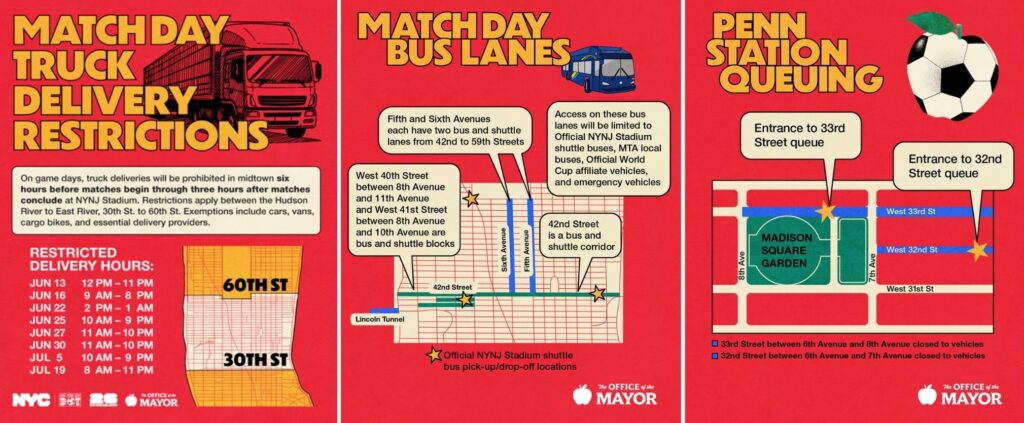
Commuters should expect street closures and transit changes around Penn Station, where NJ TRANSIT will restrict outbound rail access to ticketed match attendees several hours before kickoff. Nearby streets, including portions of West 32nd and 33rd streets, will be closed to accommodate passenger queues.
Transportation officials urged residents and visitors to rely on subways, which are expected to handle the bulk of travel demand. Bus service in Midtown may face disruptions, while regional rail systems such as the Long Island Rail Road and Metro-North will operate on normal schedules with some adjustments.
MTA Chair and CEO Janno Lieber said the subway system has sufficient capacity to move riders during the tournament, calling it the “fast, reliable way to beat gridlock.”
The city will also expand ferry service across high-demand routes and maintain normal Citi Bike operations to provide additional travel options.
Officials said traffic signal timing will be adjusted in real time on match days, and public awareness campaigns will promote transit use and inform businesses and residents about restrictions.
The transportation strategy is part of broader preparations for the World Cup, including permanent street redesigns, expanded bike lanes and pedestrian improvements across parts of Manhattan and Queens.
City leaders said the measures are designed to ensure smooth travel for both residents and the expected influx of visitors while maintaining day-to-day mobility in one of the nation’s busiest urban centers.

Kishor Panthi
View More PostsKishor Panthi is the founder and editor-in-chief of Khasokhas and NepYork. He is the author of three books, “Kampan,” "UNTRANSLATABLE" and “Zero Mile.” He writes about social issues, immigration, and politics.