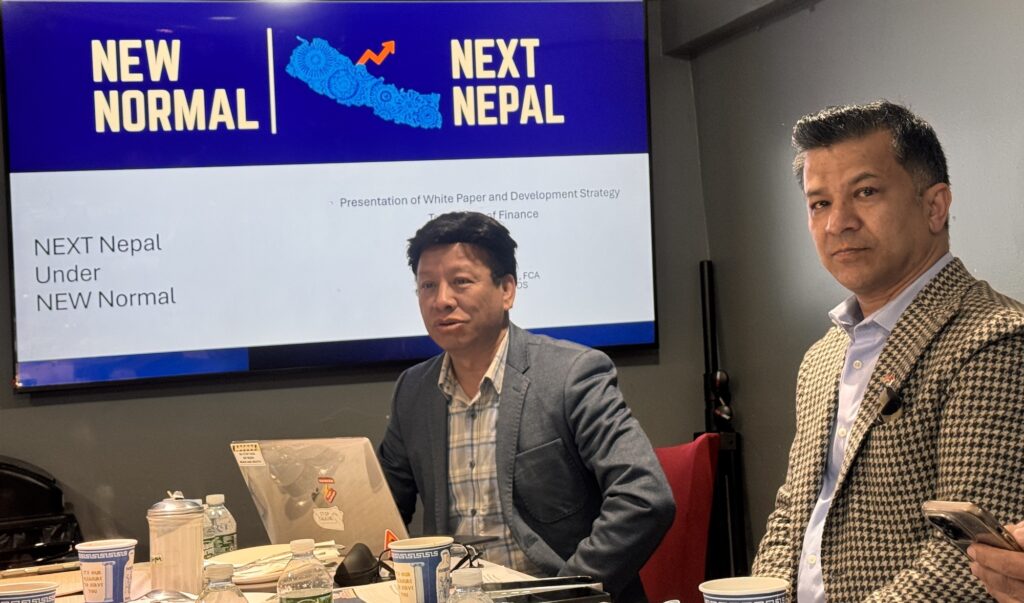
Nepal must move beyond remittance-driven growth and integrate into global value chains to achieve sustainable economic progress, Dr. Biswash Gauchan, executive chair of the Institute for Integrated Development Studies (IIDS), said Friday during an interactive session in New York.
The program, organized by the Greater New York Nepali Chamber of Commerce at Himalayan Restaurant & Bar in Jackson Heights, brought together members of the Nepali diaspora, business leaders and policy stakeholders.
Gauchan, a former senior official at the United Nations Development Programme (UNDP), emphasized that Nepal’s development strategy must expand beyond traditional approaches and fully incorporate the role of the global Nepali diaspora.
“The footprint of IIDS should extend not only within Nepal or the region, but globally,” Gauchan said. “The global dimension is especially important because of the Nepali diaspora.”
He said Nepal’s long-standing national vision of “Prosperous Nepal, Happy Nepalis” remains relevant but cannot be achieved without innovation, evidence-based policymaking and stronger diaspora engagement.
Gauchan criticized what he described as a narrow and outdated perception of the diaspora by political actors in Nepal, noting that contributions are often limited to remittances while overlooking broader roles in investment, knowledge transfer and global networking.
“Beyond remittances, the diaspora can play an instrumental role in trade, tourism, human capital development and research,” he said.
Highlighting structural weaknesses in Nepal’s economy, Gauchan said the country remains trapped in a cycle of exporting labor, importing goods and investing disproportionately in real estate rather than productive sectors.
He warned that Nepal risks remaining in the lower-middle-income category for decades if current trends continue. Nepal’s per capita income stands at around $1,500, far below the approximately $4,500 threshold required to reach upper-middle-income status.
“At the current growth rate of about 4.3%, we won’t get there anytime soon,” he said.
Gauchan also pointed to a declining growth trajectory, with recent economic expansion hovering closer to 3%, and raised concerns over large-scale youth outmigration. Approximately 2,500 Nepalis leave the country daily for foreign employment, he said, describing it as “premature depopulation” despite Nepal’s relatively young population.
He further criticized policy priorities that emphasize welfare spending over wealth creation, noting that billions of rupees are allocated annually to social allowances rather than long-term investments in productivity.
Nepal’s heavy reliance on remittances has helped reduce poverty but has not translated into sustained economic transformation, Gauchan said, adding that the country is caught in a “complacency trap” fueled by remittance inflows and overreliance on sectors such as tourism and hydropower.
Challenging conventional narratives, Gauchan argued that neither tourism nor hydropower alone can drive Nepal’s transition to prosperity. Even under optimistic scenarios, their combined contribution would raise per capita income by only about $450, leaving the country far short of its development targets.
Instead, he called for a strategic shift toward a service-based economy, particularly in information technology and professional services.
“IT exports already generate more than $500 million annually, with about 80% of clients based in the United States,” he said. “This is one of Nepal’s most promising sectors.”
Gauchan said Nepal should focus on modernizing agriculture, utilizing natural resources more effectively and selectively developing industries that serve domestic demand, rather than attempting to compete globally in large-scale manufacturing.
He also stressed the importance of digital transformation, skilled human capital and private-sector reform to support long-term growth.
Addressing Nepal’s geopolitical and economic positioning, Gauchan said the country has failed to benefit from economic spillovers from neighboring India and China due to weak integration into regional value chains and persistent trade imbalances.
“With India, we export only about 10 to 15 percent of what we import. With China, the gap is even wider,” he said.
He urged policymakers to adopt a more pragmatic approach to foreign relations and economic diplomacy, cautioning against unrealistic expectations of preferential treatment from larger neighbors.
Gauchan also raised concerns about policy decisions related to electric vehicles, arguing that subsidies disproportionately benefit wealthier consumers while placing a higher foreign exchange burden on the country.
“For a poor country like Nepal, rushing into EV adoption may be premature,” he said.
Gauchan outlined an ambitious vision of transforming Nepal into a $100 billion economy within the next decade, though he acknowledged that achieving such a target would require significantly higher growth rates and structural reforms.
He underscored the importance of leveraging Nepal’s limited but critical resources, including water, forests, minerals, foreign exchange reserves and its young population.
“The diaspora is a bridge to the global economy,” he said. “Without it, Nepal cannot fully integrate into global value chains.”
Gauchan also expressed optimism about the potential of second-generation Nepalis abroad, suggesting they could play a significant role in shaping Nepal’s economic future through investment, leadership and global influence.
“Even small successes should be celebrated,” he said. “They are stepping stones.”
The discussion was part of IIDS’ broader “Policy Dialogue” initiative aimed at promoting evidence-based policymaking and challenging long-standing assumptions about Nepal’s development path.
Gauchan said Nepal must move away from “copy-paste” policies and adopt context-specific strategies grounded in research and practical realities.
“We must remain realistic,” he said. “We cannot become Singapore or Switzerland overnight. But with the right approach, we can achieve steady and meaningful progress.”

Kishor Panthi
View More PostsKishor Panthi is the founder and editor-in-chief of Khasokhas and NepYork. He is the author of three books, “Kampan,” "UNTRANSLATABLE" and “Zero Mile.” He writes about social issues, immigration, and politics.