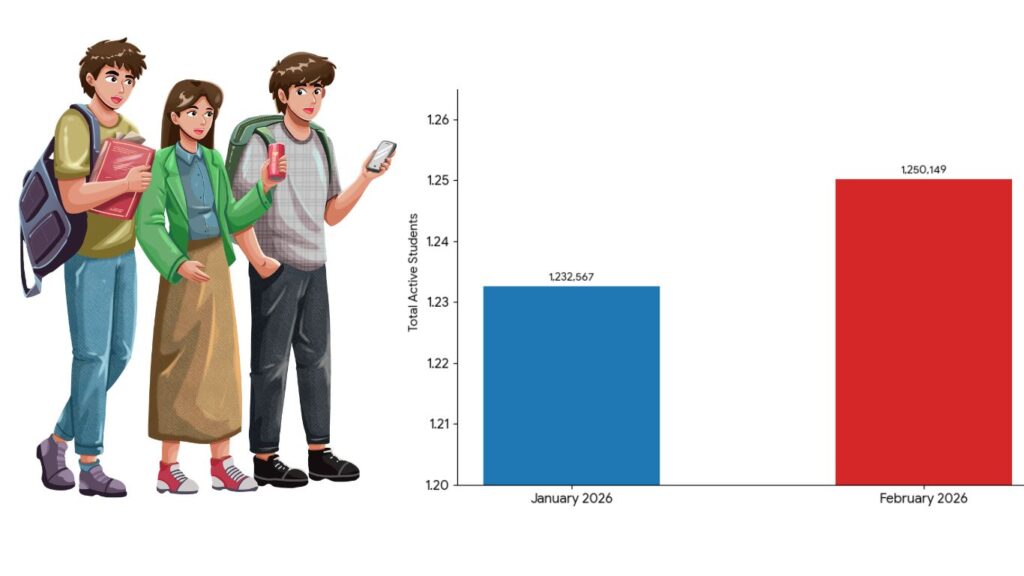
The number of active international students in the United States rose by more than 17,000 in February, reaching a total of 1.25 million, as robust growth from emerging markets offset continuing declines from China, according to federal data released this week.
The 1.4% monthly increase brought the total number of active F-1 and M-1 visa holders to 1,250,149, up from 1,232,567 in January, according to figures published by the Department of Homeland Security’s Student and Exchange Visitor Information System (SEVIS).
India remained the top country of origin, with 352,644 active students, holding nearly steady after a marginal decrease from the 352,653 recorded in January. China, the second-largest sender, saw its student population drop by 2,443 to 235,322.
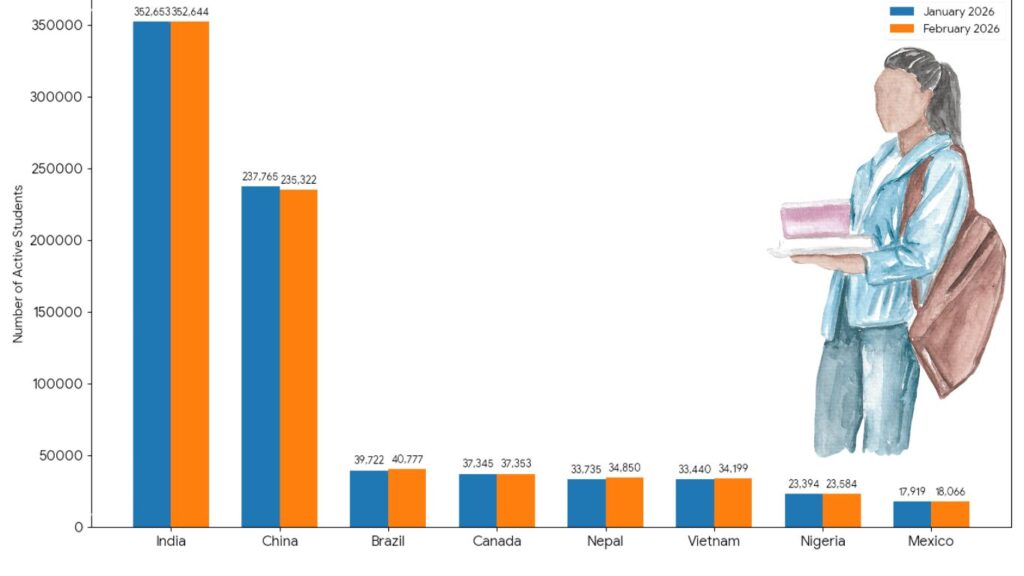
The overall enrollment gains were driven by significant increases from other key countries. Nepal’s student population climbed by 1,115 students to reach 34,850 in February. Brazil also experienced strong growth, adding 1,055 students for a total of 40,777. Vietnam followed a similar upward trend, with its count rising by 759 students to 34,199.
Other notable increases included Nigeria, which grew to 23,584 students, and Mexico, whose numbers rose to 18,066. Canada’s student population remained relatively stable at 37,353.
Asia continues to be the dominant continent of origin, representing the vast majority of the international student body. While East Asian numbers have softened, growth in Southern and Southeast Asia remains a primary driver of U.S. campus enrollment.
The SEVIS Data Mapping Tool provides monthly snapshots of the international student population, tracking geographic distribution and gender ratios across thousands of certified schools nationwide. International students contribute an estimated $43 billion annually to the U.S. economy.

Kishor Panthi
View More PostsKishor Panthi is the founder and editor-in-chief of Khasokhas and NepYork. He is the author of three books, “Kampan,” "UNTRANSLATABLE" and “Zero Mile.” He writes about social issues, immigration, and politics.